การทำนายศักยภาพของสารออกฤทธิ์ทางชีวภาพในเขยตายต่อโปรตีนเป้าหมายที่สัมพันธ์กับการเกิดโรคอัลไซเมอร์บนคอมพิวเตอร์
Article Sidebar
Main Article Content
บทคัดย่อ
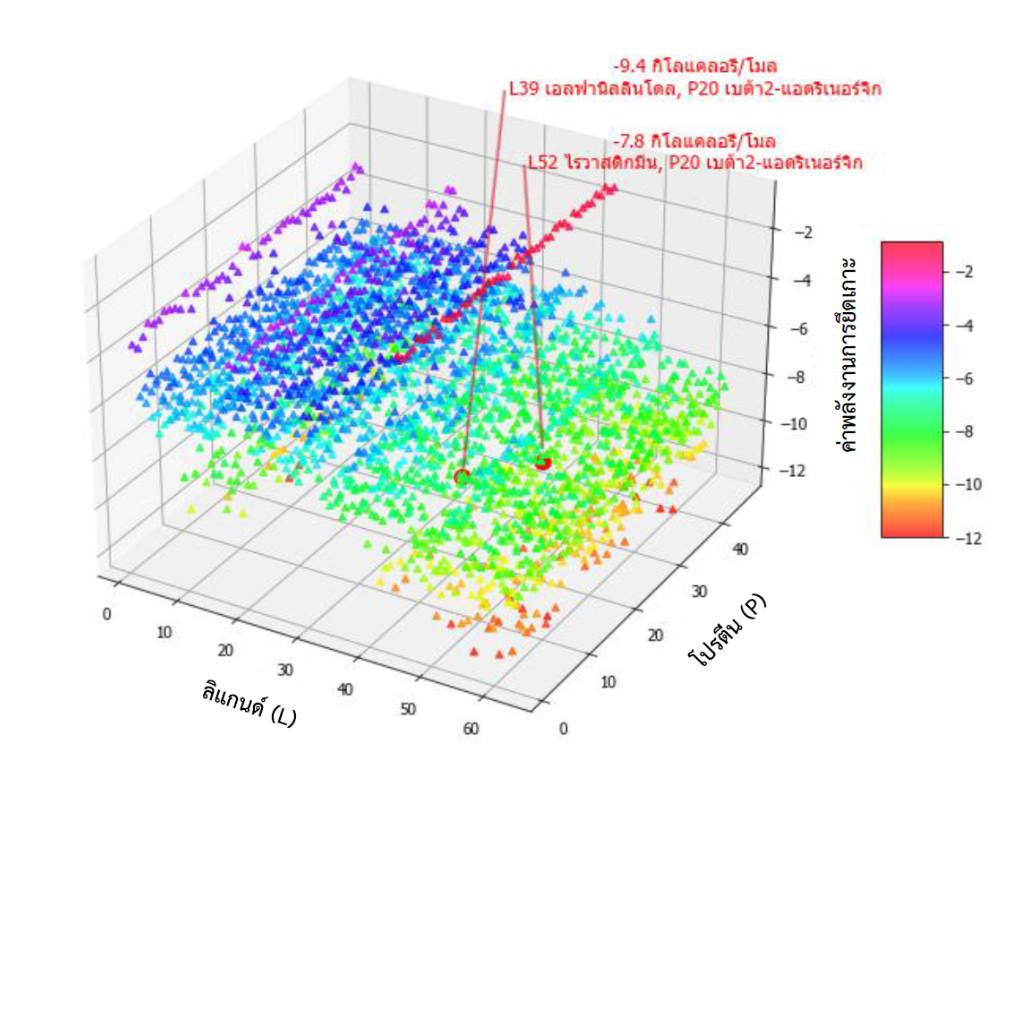
เขยตายเป็นพืชสมุนไพรในตำรับยาไทยหลายตำรับ มีฤทธิ์ต้านการอักเสบ ลดระดับคอเลสเตอรอลในเลือด ต้านอนุมูลอิสระ นอกจากนี้ยังมีคุณสมบัติยับยั้งโคลีนเอสเตอเรส (cholinesterase) ซึ่งเกี่ยวข้องกับการเกิดโรคอัลไซเมอร์ ในปัจจุบันยารักษาโรคอัลไซเมอร์มีผลข้างเคียงค่อนข้างมาก งานวิจัยนี้มีวัตถุประสงค์เพื่อศึกษาการเข้าจับระดับโมเลกุลและอันตรกิริยาของสารออกฤทธิ์ทางชีวภาพในเขยตาย 40 ชนิดกับโปรตีนเป้าหมายที่สัมพันธ์กับการเกิดโรคอัลไซเมอร์ 46 ชนิด โดยมียาควบคุมเชิงบวกที่เกี่ยวข้องกับการรักษาโรคอัลไซเมอร์ 23 ชนิด ศึกษารูปแบบการเข้าจับกันระดับโมเลกุลและวิเคราะห์อันตรกิริยาผ่านโปรแกรมปฏิสัมพันธ์ระหว่างโปรตีนและลิแกนด์ (PLIP) ผลการวิจัยพบว่าค่าพลังงานการยึดเกาะระหว่างแอลฟา-ฟีนิลลินโดล (α-phenylindole) กับโปรตีนเบต้า2-อะดรีเนอร์จิก (β2-adrenergic) เท่ากับ -9.4 กิโลแคลอรีต่อโมล และจากการวิเคราะห์อันตรกิริยาพบว่ามีการเกิดพันธะไฮโดรเจน 1 ตำแหน่ง และเกิดแรงไฮโดรโฟบิก 7 ตำแหน่ง เทียบกับยาควบคุมเชิงบวกไรวาสติกมีน ซึ่งมีค่าพลังงานการยึดเกาะเท่ากับ -7.8 กิโลแคลอรีต่อโมล จึงบ่งชี้ได้ว่าแอลฟา-ฟีนิลลินโดลในเขยตายมีศักยภาพในการเข้าจับกับโปรตีนเบต้า2-อะดรีเนอร์จิกได้ดีกว่ายาไรวาสติกมีน (rivastigmine) นอกจากนั้นยังพบว่าแอลฟา-ฟีนิลลินโดลมีการเกิดแรงไฮโดรโฟบิก (hydrophobic) ที่ซ้อนทับกับยาไรวาสติกมีนอยู่ 4 ตำแหน่ง ได้แก่ VAL1114A PHE1193A PHE1289A และ TYR1308A การศึกษานี้สามารถนำไปสู่ทางเลือกการรักษาหรือบรรเทาอาการโรคอัลไซเมอร์ในอนาคต
Article Details

อนุญาตภายใต้เงื่อนไข Creative Commons Attribution-NonCommercial-NoDerivatives 4.0 International License.
เนื้อหาและข้อมูลในบทความที่ลงตีพิมพ์ในวารสารวิชชา มหาวิทยาลัยราชภัฏนครศรีธรรมราช ถือเป็นข้อคิดเห็นและความรับผิดชอบของผู้เขียนบทความโดยตรง ซึ่งกองบรรณาธิการวารสารไม่จำเป็นต้องเห็นด้วยหรือร่วมรับผิดชอบใด ๆ
บทความ ข้อมูล เนื้อหา รูปภาพ ฯลฯ ที่ได้รับการตีพิมพ์ในวารสารวิชชา มหาวิทยาลัยราชภัฏนครศรีธรรมราช ถือเป็นลิขสิทธ์ของวารสารวิชชา มหาวิทยาลัยราชภัฏนครศรีธรรมราช หากบุคคลหรือหน่วยงานใดต้องการนำข้อมูลทั้งหมดหรือส่วนหนึ่งส่วนใดไปเผยแพร่ต่อหรือเพื่อการกระทำการใด ๆ จะต้องได้รับอนุญาตเป็นลายลักษณ์อักษรจากวารสารวิชชา มหาวิทยาลัยราชภัฏนครศรีธรรมราชก่อนเท่านั้น
The content and information in the article published in Wichcha journal Nakhon Si Thammarat Rajabhat University, It is the opinion and responsibility of the author of the article. The editorial journals do not need to agree. Or share any responsibility.
เอกสารอ้างอิง
ธนพร เตชประภาสรัตน์. (2565). การทำนายศักยภาพของยาเก่าที่นํากลับมาใช้ใหม่ต่อโปรตีนเป้าหมายของโรคอัลไซเมอร์บนคอมพิวเตอร์. โครงการปัญหาพิเศษปริญญาบัณฑิต. มหาวิทยาลัยธรรมศาสตร์.
นภกชมณฑน์ ทหารไทย อภิชญา ขำปลอด และณัฐนิช เชื้อพลพิชัย. (2563). การสกัดและการวิเคราะห์สารออกฤทธิ์ทางชีวภาพจากสมุนไพรเขยตาย (Glycosmis pentaphylla). โครงการสนับสนุนการจัดตั้งห้องเรียนวิทยาศาสตร์ในโรงเรียน (วมว.). มหาวิทยาลัยธรรมศาสตร์-โรงเรียนสวนกุหลาบวิทยาลัย รังสิต.
Agarwal, M., Alam, M.R., Haider, M.K., Malik, M.Z. and Kim, D.K. (2020). Alzheimer's disease: An overview of major hypotheses and therapeutic options in nanotechnology. Nanomaterials (Basel, Switzerland), 11(1), doi: https://doi.org/10.3390/nano11010059.
Chen, H., Lin, J., Zhu, S., Zeng, K., Tu, P. and Jiang, Y. (2022). Anti-inflammatory constituents from the stems and leaves of Glycosmis ovoidea Pierre. Phytochemistry, 203, doi: https://doi.org/10.1016/j.phytochem.2022.113369.
Liu, P.P., Xie, Y., Meng, X.Y. and Kang, J.S. (2019). History and progress of hypotheses and clinical trials for Alzheimer’s disease. Signal Transduction and Targeted Therapy, 4, doi: https://doi.org/10.1038/s41392-019-0063-8.
Mimica, N. and Presecki, P. (2009). Side effects of approved antidementives. Psychiatria Danubina, 21(1), 108-113.
Rahman, R.I., Tania, F., Hossain, A., Sharmin, H. and Anwarul H. (2017). Evaluation of antioxidant, cholinesterase inhibitory properties, and antibacterial potentials of Glycomis pentaphylla leaf extract relevant to the treatment of Alzheimer's disease. Journal of Applied Pharmacy, 9, 17-30, doi: https://doi.org/10.14233/ajchem.2019.21913.
Sintupachee, S. and Ruang-On, S. (2022). A database system for the diversity of medicinal herbs used as traditional medicinal formulas of the Cha-Uat Thai traditional medicine club, Cha-Uat district, Nakhon Si Thammarat province. Wichcha Journal Nakhon Si Thammarat Rajabhat University, 41(1), 49-64.
Soma, M.A., Khan, M.F., Tahia, F., Al-Mansur, M.A., Rahman, M.S. and Rashid, M.A. (2019). Cyclooxygenase-2 inhibitory compounds from the leaves of Glycosmis pentaphylla (Retz.) A. DC.: Chemical and in silico studies. Asian Journal of Chemistry, 31(6), 1260-1264, doi: https://doi.org/10.14233/ajchem.2019.21913.
Sreejith, P.S., Praseeja, R.J. and Asha, V.V. (2012). A review on the pharmacology and phytochemistry of traditional medicinal plant, Glycosmis pentaphylla (Retz.) Correa. Journal of Pharmacy Research, 5, 2723-2728.
Wu, Q., Sun, J.X., Song, X.H., Wang, J., Xiong, C.Q., Teng, F.X. and Gao, C.X. (2017). Blocking beta 2-adrenergic receptor inhibits dendrite ramification in a mouse model of Alzheimer's disease. Neural Regeneration Research, 12(9), 1499-1506, doi: https://doi.org/10.4103/1673-5374.215261.
