
Potential of Black Soldier Fly Larvae as a Fish Meal Replacement in Diet on Growth Performance, Survival Rate and Coloration in Fancy Carp Fish (Cyprinus carpio)
Article Sidebar
Main Article Content
Abstract
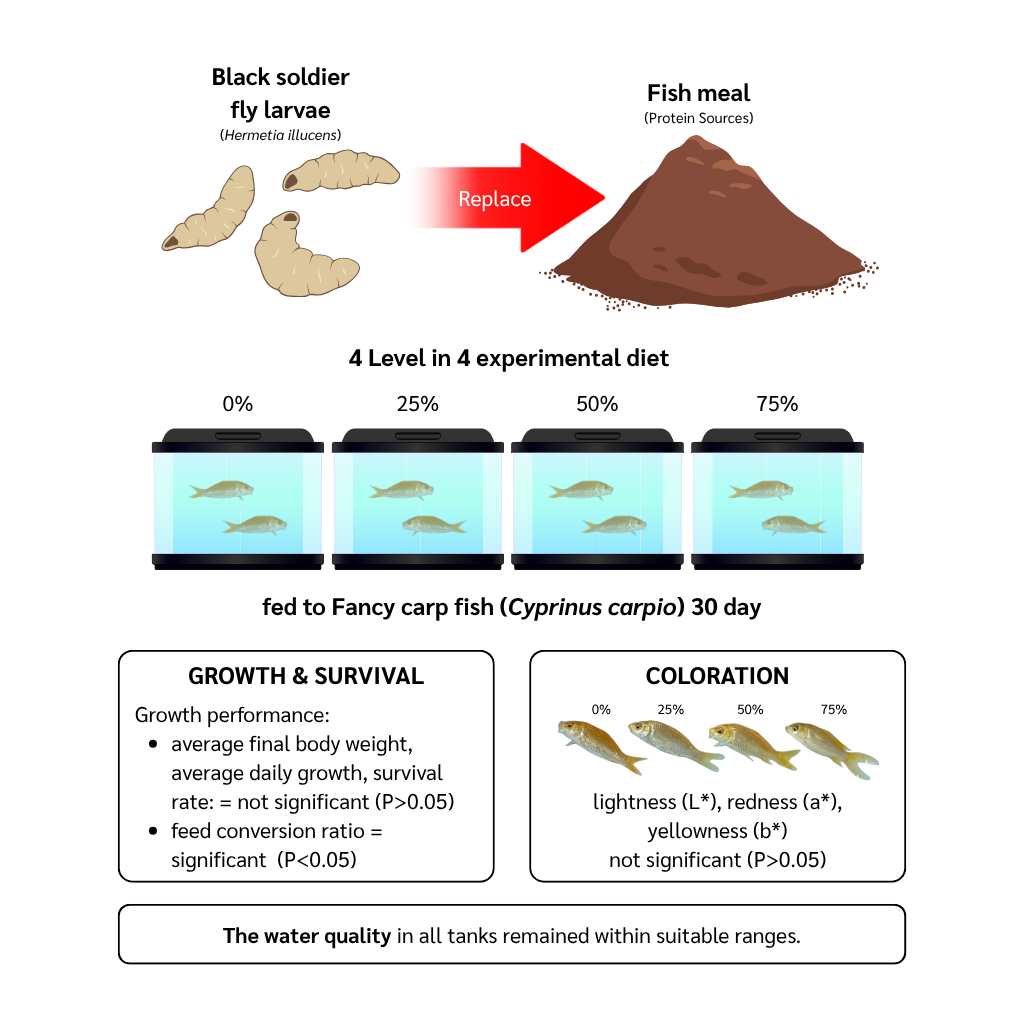
This study aimed to evaluate the effects of replacing fish meal with black soldier fly larvae (Hermetia illucens) on the growth performance, survival rate, and coloration of fancy carp (Cyprinus carpio). Four experimental diets were formulated with black soldier fly larvae replacing fish meal at 0%, 25%, 50%, and 75%. The experiment was conducted in glass aquaria for 30 days. The results revealed no significant differences (p > 0.05) among treatments in final weight, specific growth rate (SGR), or survival rate. However, the feed conversion ratio (FCR) differed significantly (p < 0.05). Skin coloration, including lightness (L*), redness (a*), and yellowness (b*), showed no significant differences (p > 0.05) among treatments. Water quality parameters during the rearing period remained within acceptable ranges. The results indicate that replacing fish meal with black soldier fly larvae does not adversely affect growth performance, survival rate, and coloration in fancy carp, demonstrating its potential as a viable alternative protein source for aquaculture feed formulation.
Article Details

This work is licensed under a Creative Commons Attribution-NonCommercial-NoDerivatives 4.0 International License.
Authors retain the copyright of articles published in Wichcha Journal Nakhon Si Thammarat Rajabhat University. All published articles are distributed under the Creative Commons Attribution–NonCommercial–NoDerivatives License (CC BY-NC-ND 4.0) (https://creativecommons.org/licenses/by-nc-nd/4.0/). Under this license, readers are permitted to read, download, and share the articles for non-commercial purposes, provided that proper attribution to the original source is given and the content is not modified or altered. All contents of the articles, including text, tables, figures, equations, and other illustrations, are the sole responsibility of the authors. The views and opinions expressed in the articles do not necessarily reflect those of the editorial board or the publisher.
References
กองวิจัยและพัฒนาอาหารสัตว์น้ำ. (2563). สูตรอาหารปลาสวยงามกลุ่มกินเนื้อ (ปลากัด/หมอสี/ออสการ์/พาราไดซ์). สืบค้นเมื่อ 1 ธันวาคม 2567, จาก: https://www4.fisheries.go.th/local/file_document/20200514121442_new.pdf.
แจ่มจันทร์ เพชรศิริ และทวีเดช ไชยนาพงษ์. (2567). การประยุกต์ใช้เศษเหลือจากการแปรรูปปลาทะเลในสูตรอาหารต่อการเจริญเติบโตและองค์ประกอบทางเคมีของเนื้อปลากะพงขาว (Lates calcarifer Bloch, 1790) ที่เลี้ยงในน้ำจืด. วารสารวิชชา มหาวิทยาลัยราชภัฏนครศรีธรรมราช, 43(1), 80-92, doi: https://doi.org/10.65217/wichchajnstru.2024.v43i1.257891.
นิคม ละอองศิริวงศ์. (2562). คู่มือการวิเคราะห์น้ำ เพื่อการเพาะเลี้ยงสัตว์น้ำและการตรวจรับรองมาตรฐานฟาร์ม. เชียงใหม่: วนิดาการพิมพ์.
อรพินท์ จินตสถาพร บัณฑิต ยวงสร้อย และประเสริฐ สมิทธิวงศ์. (2548). ระดับเหมาะสมของคาโรทีนอยด์รวมต่อความเข้มสีปลาคาร์ฟ (Cyprinus carpio). ใน การประชุมทางวิชาการของมหาวิทยาลัยเกษตรศาสตร์ ครั้งที่ 43: สาขาประมง สาขาการจัดการทรัพยากรและสิ่งแวดล้อม (หน้า 368-378). กรุงเทพฯ: มหาวิทยาลัยเกษตรศาสตร์.
AOAC. (2000). Official methods of analysis. (17th ed). Maryland: The Association of Official Analytical Chemists.
Caruso, G., Floris, R., Serangeli, C. and Paola, L.D. (2020). Fishery wastes as a yet undiscovered treasure from the sea: Biomolecules sources, extraction methods and valorization. Marine Drugs, 18(12), 622, doi: https://doi.org/10.3390/md18120622.
Chatzifotis, S., Pavlidis, M., Jimeno, C.D., Vardanis, G., Sterioti, A. and Divanach, P. (2005). The effect of different carotenoid sources on skin coloration of cultured red porgy (Pagrus pagrus). Aquaculture Research, 36(15), 1517-1525, doi: https://doi.org/10.1111/j.1365-2109.2005.01374.x.
da Silva, G.D.P. and Hesselberg, T. (2020). A review of the use of black soldier flylarvae, Hermetia illucens (Diptera: Stratiomyidae), to compost organic waste in tropical regions. Neotropical Entomology, 49(2), 151-162, doi: https://doi.org/10.1007/s13744-019-00719-z.
De, D., Sandeep, K.P., Kumar, S., Raja, R.A., Mahalakshmi, P., Sivaramakrishnan, T., Ambasankar, A. and Vijayan, K.K. (2020). Effect of fish waste hydrolysate on growth, survival, health of Penaeus vannamei and plankton diversity in culture systems. Aquaculture, 524, 735240, doi: https://doi.org/10.1016/j.aquaculture.2020.735240.
Diener, S., Zurbrügg, C. and Tockner, K. (2009). Conversion of organic material by black soldier fly larvae: Establishing optimal feeding rates. Waste Management and Research, 27(6), 603-610, doi: https://doi.org/10.1177/0734242X09103838.
Du, Z.-Y., Clouet, P., Zheng, W.-H., Degrace, P., Tian, L.-X. and Liu, Y.-J. (2006). Biochemical hepatic alterations and body lipid composition in the herbivorous grass carp (Ctenopharyngodon idella) fed high-fat diets. The British Journal of Nutrition, 95(5), 905-915, doi: https://doi.org/10.1079/bjn20061733.
Ebeneezar, S., Prabu, D.L., Chandrasekar, S., Tejpal, C.S., Madhu, K., Sayooj, P. and Vijayagopal, P. (2020). Evaluation of dietary oleoresins on the enhancement of skin coloration and growth in the marine ornamental clown fish, Amphiprion ocellaris (Cuvier, 1830). Aquaculture, 529, 735728, doi: https://doi.org/10.1016/j.aquaculture.2020.735728.
FAO. (2020). The state of world fisheries and aquaculture 2020. Rome: Food and Agriculture Organization of the United Nations.
Gatlin, D.M., Barrows, F.T., Brown, P., Dabrowski, K., Gaylord, T.G., Hardy, R.W., Herman, E., Hu, G., Krogdahl, Å., Nelson, R., Overturf, K., Rust, M., Sealey, W., Skonberg, D., Souza, E.J., Stone, D., Wilson, R. and Wurtele, E. (2007). Expanding the utilization of sustainable plant products in aquafeeds: A review. Aquaculture Research, 38(6), 551-579, doi: https://doi.org/10.1111/j.1365-2109.2007.01704.x.
Giri, N.A., Astuti, N.W.W., Sudewi, S., Marzuqi, M. and Asih, Y.N. (2021). Fish hydrolysate supplemented diet improved feed efficiency and growth of coral trout (Plectropomus leopardus). IOP Conference Series: Earth and Environmental Science, 890, 012024, doi: https://doi.org/10.1088/1755-1315/890/1/012024.
Gouveia, L., Rema, P., Pereira, O. and Empis, J. (2003). Colouring ornamental fish (Cyprinus carpio and Carassius auratus) with microalgal biomass: Colouring ornamental fish. Aquaculture Nutrition, 9(2), 123-129, doi: https://doi.org/10.1046/j.1365-2095.2003.00233.x.
Harpaz, S., Hakim, Y., Slosman, T. and Eroldogan, O.T. (2005). Effects of adding salttothe diet of Asian seabass (Lates calcarifer) reared in fresh or salt water recirculating tanks, on growth and brush border enzyme activity. Aquaculture, 248(1-4), 315-324, doi: https://doi.org/10.1016/j.aquaculture.2005.03.007.
Kari, Z.A., T´ellez-Isaías, G., Hamid, N.K.A., Rusli, N.D., Mat, K., Sukri, S.A.M., Kabir, M.A., Ishak, A.R., Dom, N.C., Abdel-Warith, A.-W.A., Younis, E.M., Khoo, M.I., Abdullah, F., Shahjahan, M., Rohani, M.F., Davies, S.J. and Wei, L.S. (2023). Effect of fish meal substitution with black soldier fly (Hermetia illucens) on growth performance, feed stability, blood biochemistry, and liver and gut morphology of Siamese fighting fish (Betta splendens). Aquaculture Nutrition, 2023(1), 6676953, doi: https://doi.org/10.1155/2023/6676953.
Khieokhajonkhet, A., Uanlam, P., Ruttarattanamongkol, K., Aeksiri, N., Tatsapong, P. and Kaneko, G. (2022). Replacement of fish meal by black soldier fly larvae meal in diet for goldfish Carassius auratus: Growth performance, hematology, histology, total carotenoids, and coloration. Aquaculture, 561, 738618 , doi: https://doi.org/10.1016/j.aquaculture.2022.738618.
Kroeckel, S., Harjes, A.-G.E., Roth, I., Katz, H., Wuertz, S., Susenbeth, A. and Schulz, C. (2012). When a turbot catches a fly: Evaluation of a pre-pupae meal of the black soldier fly (Hermetia illucens) as fish meal substitute - Growth performance and chitin degradation in juvenile turbot (Psetta maxima). Aquaculture, 364-365, 345-352, doi: https://doi.org/10.1016/j.aquaculture.2012.08.041.
Kuo, I.-P., Liu, C.-S., Yang, S.-D., Liang, S.-H., Hu, Y.-F. and Nan, F.-H. (2022). Effects of replacing fishmeal with defatted black soldier fly (Hermetia illucens Linnaeus) larvae meal in Japanese eel (Anguilla japonica) diet on growth performance, fillet texture, serum biochemical parameters, and intestinal histomorphology. Aquaculture Nutrition, 2022(1), 866142, doi: https://doi.org/10.1155/2022/1866142.
Li, S., Ji, H., Zhang, B., Zhou, J. and Yu, H. (2017). Defatted black soldier fly (Hermetia illucens) larvae meal in diets for juvenile Jian carp (Cyprinus carpio var. Jian): Growth performance, antioxidant enzyme activities, digestive enzyme activities, intestine and hepatopancreas histological structure. Aquaculture, 477, 62-70, doi: https://doi.org/10.1016/j.aquaculture.2017.04.015.
Madende, M. and Hayes, M. (2020). Fish by-product use as biostimulants: An overview of the current state of the art, including relevant legislation and regulations within the EU and USA. Molecules, 25(5), 1122, doi: https://doi.org/10.3390/molecules25051122.
Makkar, H.P.S., Tran, G., Heuzé, V. and Ankers, P. (2014). State-of-the-art on use of insects as animal feed. Animal Feed Science and Technology, 197, 1-33, doi: https://doi.org/10.1016/j.anifeedsci.2014.07.008.
Newton, G.L., Booram, C.V., Barker, R.W. and Hale, O.M. (1977). Dried Hermetia illucens larvae meal as a supplement for swine. Journal of Animal Science, 44(3), 395-400, doi: https://doi.org/10.2527/jas1977.443395x.
Pandey, P.K. and Mandal, S.C. (2017). Present status, challenges and scope of ornamental fish trade in India. In Conference: Aqua Aquaria India 2017 (pp. 1-10). Mangalore: Marine Products Export Development Authority.
Renna, M., Schiavone, A., Gai, F., Dabbou, S., Lussiana, C., Malfatto, V., Prearo, M., Capucchio, M.T., Biasato, I., Biasibetti, E., De Marco, M., Brugiapaglia, A., Zoccarato, I. and Gasco, L. (2017). Evaluation of the suitability of a partially defatted black soldier fly (Hermetia illucens L.) larvae meal as ingredient for rainbow trout (Oncorhynchus mykiss Walbaum) diets. Journal of Animal Science and Biotechnology, 8, 1-13, doi: https://doi.org/10.1186/s40104-017-0191-3.
Saengsitthisak, B., Chaisri, W., Punyapornwithaya, V., Mektrirat, R., Klayraung, S., Bernard, J.K. and Pikulkaew, S. (2020). Occurrence and antimicrobial susceptibility profiles of multidrug-resistant aeromonads isolated from freshwater ornamental fish in Chiang Mai province. Pathogens, 9(11), 973, doi: https://doi.org/10.3390/pathogens9110973.
Secci, G., Bovera, F., Nizza, S., Baronti, N., Gasco, L., Conte, G., Serra, A., Bonelli, A. and Parisi, G. (2018). Quality of eggs from Lohmann brown classic laying hens fed black soldier fly meal as substitute for soya bean. Animal, 12(10), 2191-2197, doi: https://doi.org/10.1017/S1751731117003603.
Tacon, A.G.J. and Metian, M. (2008). Global overview on the use of fish meal and fish oil in industrially compounded aquafeeds: Trends and future prospects. Aquaculture, 285(1-4), 146-158, doi: https://doi.org/10.1016/j.aquaculture.2008.08.015.
Tippayadara, N., Dawood, M.A.O., Krutmuang, P., Hoseinifar, S.H., Van Doan, H. and Paolucci, M. (2021). Replacement of fish meal by black soldier fly (Hermetia illucens) larvae meal: Effects on growth, haematology, and skin mucus immunity of Nile Tilapia, Oreochromis niloticus. Animals, 11(1), 193, doi: https://doi.org/10.3390/ani11010193.
Tocher, D.R. (2015). Omega-3 long-chain polyunsaturated fatty acids and aquaculture in perspective. Aquaculture, 449, 94-107, doi: https://doi.org/10.1016/j.aquaculture.2015.01.010.
Tschirner, M. and Simon, A. (2015). Influence of different growing substrates and processing on the nutrient composition of black soldier fly larvae destined for animal feed. Journal of Insects as Food and Feed, 1(4), 249-259, doi: https://doi.org/10.3920/JIFF2014.0008.
Zhao, J., Pan, J., Zhang, Z., Chen, Z., Mai, K. and Zhang, Y. (2023). Fishmeal protein replacement by defatted and full-fat black soldier fly larvae meal in juvenile turbot diet: Effects on the growth performance and intestinal microbiota. Aquaculture Nutrition, 2023(1), 128141, doi: https://doi.org/10.1155/2023/8128141.
