
Properties of Reclaimed Asphalt Pavement (RAP) Stabilized with Crushed Rock and Stone Dust
Article Sidebar
Main Article Content
Abstract
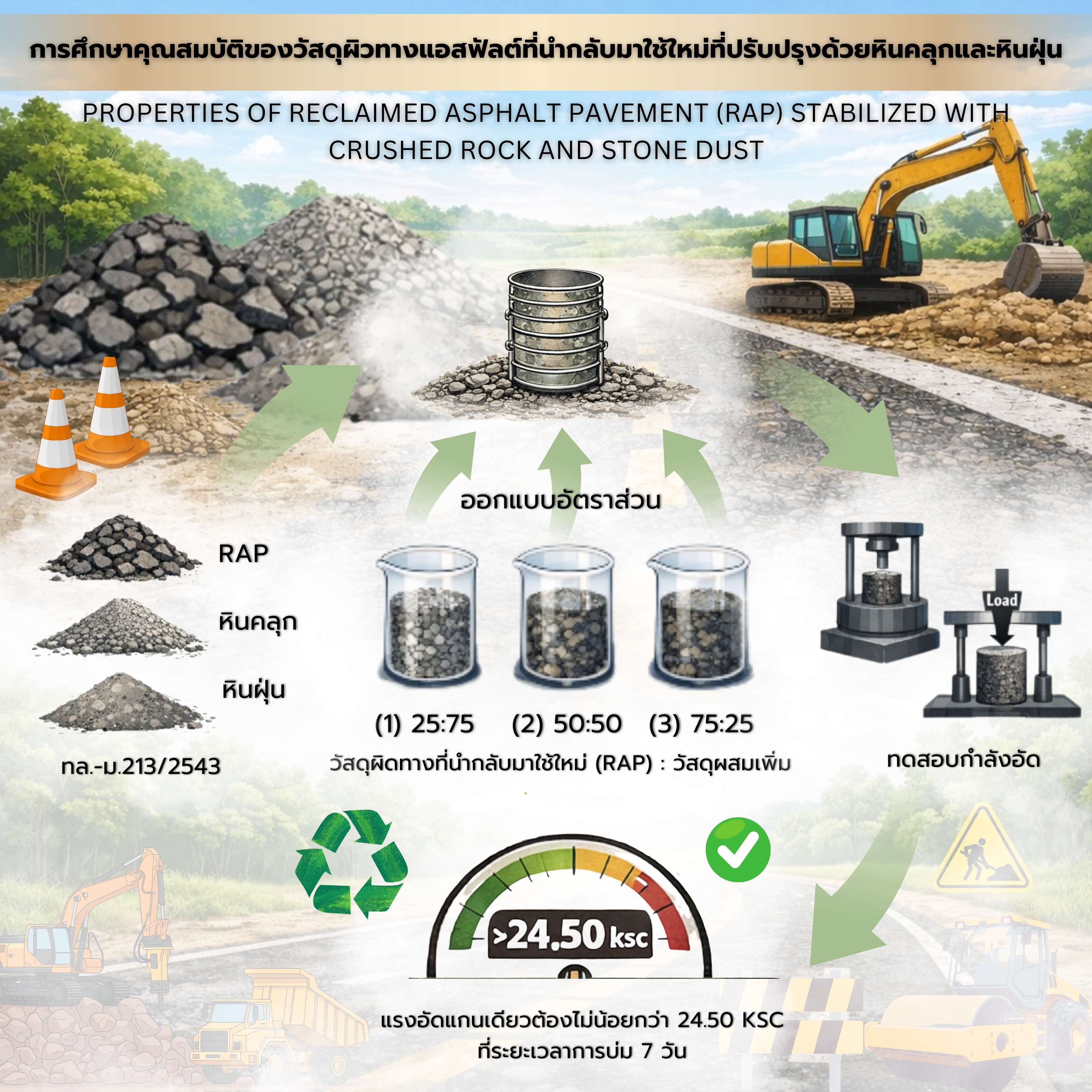
This research investigated the properties of reclaimed asphalt pavement (RAP) stabilized with crushed rock and stone dust for use as an alternative pavement material. Crushed rock and stone dust were employed as stabilizing additives to enhance the compressive strength of RAP. Both additives were first subjected to gradation analysis, and materials meeting the specification were selected for mix design. Pavement in-place recycling mixtures were designed in accordance with the Thai Department of Highways standard DH-S 213/2543 for reclaimed asphalt pavement (RAP). The mixtures were prepared by combining RAP with two types of additives crushed rock and stone dust at three RAP-to-additive ratios of 25:75, 50:50, and 75:25 by weight. Unconfined compressive strength tests were conducted on the prepared mixtures. The results indicated that stabilized RAP has potential for use as an alternative material in road construction and rehabilitation. In particular, the mixture with a RAP-to-additive ratio of 25:75 satisfied the Department of Highways requirement for a cement-treated gravel subbase layer, achieving a minimum unconfined compressive strength of 24.50 kgf/cm2 (ksc) after 7 days of curing.
Article Details

This work is licensed under a Creative Commons Attribution-NonCommercial-NoDerivatives 4.0 International License.
Authors retain the copyright of articles published in Wichcha Journal Nakhon Si Thammarat Rajabhat University. All published articles are distributed under the Creative Commons Attribution–NonCommercial–NoDerivatives License (CC BY-NC-ND 4.0) (https://creativecommons.org/licenses/by-nc-nd/4.0/). Under this license, readers are permitted to read, download, and share the articles for non-commercial purposes, provided that proper attribution to the original source is given and the content is not modified or altered. All contents of the articles, including text, tables, figures, equations, and other illustrations, are the sole responsibility of the authors. The views and opinions expressed in the articles do not necessarily reflect those of the editorial board or the publisher.
References
กนกพล จันทรา ชยกฤต เพชรช่วย วรวิทย์ โพธิ์จันทร์ วีระวัฒน์ วรรณกุล และชินะวัฒน์ มุกตพันธ์. (2566). การปรับปรุงคุณภาพผิวทางแอสฟัลต์คอนกรีตรีไซเคิลผสมหินคลุกด้วยเถ้าลอยจีโอโพลิเมอร์แบบผง. ใน การประชุมวิชาการวิศวกรรมโยธาแห่งชาติ ครั้งที่ 28 (หน้า GTE22-1 - GTE22-6). ภูเก็ต: วิศวกรรมสถานแห่งประเทศไทย ในพระบรมราชูปถัมภ์ ร่วมกับมหาวิทยาลัยสงขลานครินทร์.
กรมทางหลวง. (2544). มาตรฐานพื้นทางหินคลุก (ทล.-ม 213/2543). สืบค้นเมื่อ 22 มกราคม 2567, จาก: https://doh.go.th/doh/images/aboutus/standard/01/dhs213-43.pdf.
จิระยุทธ สืบสุข เบญจพล ขุนวิเศษ อนิรุทธิ์ สุขแสน เชิดศักดิ์ สุขศิริพัฒนพงศ์ และคมกร ไชยเดชาธร. (2559). กำลังอัดแกนเดียวและโครงสร้างจุลภาคของดินลูกรังเกือบตกชั้นคุณภาพปรับปรุงด้วยผิวทางแอสฟัลต์รีไซเคิลและซีเมนต์. วิศวสารลาดกระบัง, 33(2), 111-116.
พิษณุ ช่วยเวช สราวุธ จริตงาม ปฐเมศ ผาณิตพจมาน และโอภาส สมใจนึก. (2568). การใช้ดินซีเมนต์แทนหินคลุกในการก่อสร้างถนน. วารสารวิชชา มหาวิทยาลัยราชภัฏนครศรีธรรมราช, 44(1), 122-134, doi: https://doi.org/10.65217/wichchajnstru.2025.v44i1.264030.
Chakravarthi, S. and Shankar, S. (2018). Effect of age on reclaimed asphalt pavement mixes. Indian Highways, 46(7), 25-36.
Debbarma, S., Ransinchung, G.D.R.N. and Singh, S. (2021). Suitability of various supplementary cementitious admixtures for RAP inclusive RCCP mixes. International Journal of Pavement Engineering, 22(12), 1568-1581, doi: https://doi.org/10.1080/10298436.2019.1703981.
Fedrigo, W., Núñez, W.P., Schreinert, G.G., Kleinert, T.R., Matuella, M.F., López, M.A.C. and Ceratti, J.A.P. (2019). Flexural strength, stiffness, and fatigue of cement-treated mixtures of reclaimed asphalt pavement and lateritic soil. Road Materials and Pavement Design, 22(5), 1004-1022, doi: https://doi.org/10.1080/14680629.2019.1660207.
Hoy, M., Horpibulsuk, S., Rachan, R., Chinkulkijniwat, A. and Aeulrajah, A. (2016). Recycled asphalt pavement-fly ash geopolymers as a sustainable pavement base material: Strength and toxic leaching investigations. Science of the Total Environment, 573, 19-26, doi: https://doi.org/10.1016/j.scitotenv.2016.08.078.
Jahanbakhsh, H., Karimi, M.M., Naseri, H. and Nejad, F.M. (2019). Sustainable asphalt concrete containing high reclaimed pavements and recycling agents: Performance assessment, cost analysis, and environmental impact. Journal of Cleaner Production, 244, 118837, doi: https://doi.org/10.1016/j.jclepro.2019.118837.
Ma, X., Wang, J. and Xu, Y. (2022). Investigation on the effects of RAP proportions on the pavement performance of recycled asphalt mixtures. Frontiers in Materials, 8, 842809, doi: https://doi.org/10.3389/fmats.2021.842809.
Plati, C. and Cliatt, B. (2019). A sustainability perspective for unbound reclaimed asphalt pavement (RAP) as a pavement base material. Sustainability, 11(1), 78, doi: https://doi.org/10.3390/su11010078.
Saed, S.A., Karimi, H.R., Rad, S.M., Aliha, M.R.M., Shi, X. and Haghighatpour, P.J. (2022). Full range I/II fracture behavior of asphalt mixtures containing RAP and rejuvenating agent using two different 3-point bend type configurations. Construction and Building Materials, 314(part B), 125590, doi: https://doi.org/10.1016/j.conbuildmat.2021.125590.
Singh, S., Ransinchung, G.D.R.N. and Kumar, P. (2019). Feasibility study of RAP aggregates in cement concrete pavements. Road Materials and Pavement Design, 20(1), 151-170, doi: https://doi.org/10.1080/14680629.2017.1380071.
Wu, Z., Zhang, C., Xiao, P., Li, B. and Kang, A. (2020). Performance characterization of hot mix asphalt with high RAP content and basalt fiber. Materials, 13(14), 3145, doi: https://doi.org/10.3390/ma13143145.
