Submissions
Submission Preparation Checklist
As part of the submission process, authors are required to check off their submission's compliance with all of the following items, and submissions may be returned to authors that do not adhere to these guidelines.
- Submitted manuscripts must be original articles in the fields of science and technology that have not been previously published or disseminated in any form, and are not under consideration for publication in any other journal.
- Please provide your name and mobile phone number in the “Comments for the Editor” field and click Save. If you have any questions or inquiries, you may also communicate with the editorial office through this channel.
- The journal communicates with authors primarily via the registered email address. Please check your inbox (including spam or junk mail) regularly. If no email is received after submission, please contact us at journal@nstru.ac.th
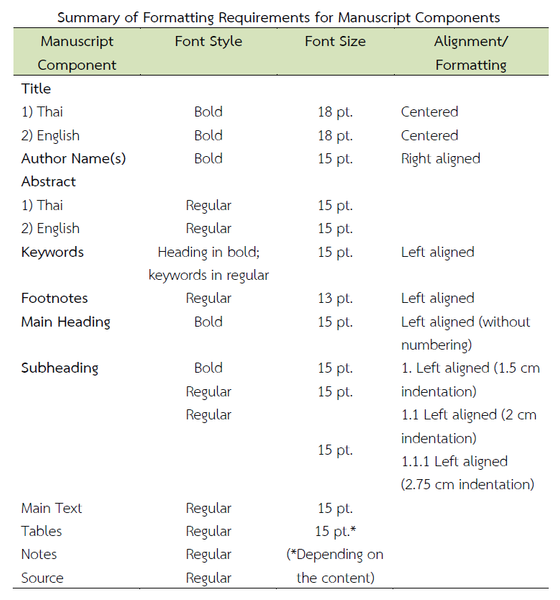
- Manuscripts must be prepared in Microsoft Word format and typed on Executive-size paper (18.41 × 26.67 cm). Page margins should be set as follows: top 2.5 cm, bottom 2.5 cm, left 2.3 cm, and right 2.5 cm. The text should be formatted in a single-column layout with full justification. The font used must be TH Sarabun PSK, font size 15.
Author Guidelines
Download Author Guidelines
Download Wichcha template-research article
Download Wichcha template-academic article
Manuscript Preparation
- Manuscripts may be prepared in Thai or English.
- For manuscripts written in Thai:
The manuscript must include article information in both Thai and English, including the article title, author name(s), author affiliation(s), abstract, and keywords. The use of Thai language must follow the principles of terminology usage and English transliteration in accordance with the guidelines of the Royal Society of Thailand. The use of English words intermixed with Thai text should be avoided unless necessary, such as in cases of technical terms that have no Thai equivalents or when the English term improves clarity. English words appearing within Thai text should be written in lowercase letters, except for proper nouns. - For manuscripts written in English:
The manuscript must contain article information in English only, including the article title, author name(s), author affiliation(s), abstract, and keywords. Thai information is not required. The manuscript should be proofread for linguistic accuracy by a qualified language expert prior to submission. - Manuscripts must be prepared using Microsoft Word. The document size should be set to Executive paper size (18.41 × 26.67 cm) with the following margins: top 2.5 cm, bottom 2.5 cm, left 2.3 cm, and right 2.5 cm. The text should be formatted in a single column with fully justified alignment. Use TH Sarabun PSK font at a font size of 15 pt.
------------------------------------------------------------------------------------------------------------------------------------------------
Components of an Article
1. A research article is a scholarly paper derived from a completed research project conducted by the author(s). It presents a concise and systematic synthesis of the research process and findings. The manuscript should be organized in the following order:
1.1 Title: The title should be brief, concise, and not excessively long. It must be presented in Thai first, followed by the English title on the next line.
1.2 Authors and Co-authors: Provide full names and surnames of all authors in both Thai and English. For English names, capitalize only the first letter of the given name and surname.
If there are multiple authors, use superscript numbering to indicate affiliations. Include institutional affiliations and contact addresses at the bottom of the first page. The corresponding author must be indicated with an asterisk (*) and an email address for correspondence must be provided.
1.3 Abstract: Both Thai and English abstracts are required, each not exceeding 300 words. Abstracts should be concise, precise, and contain only essential information. The Thai abstract should appear first, followed by the English abstract.
1.4 Keywords: Keywords should be selected from terms appearing in the manuscript that represent the research methodology, research issues, findings, applications, or study location. Provide keywords in both Thai and English at the end of each abstract, with no more than five keywords per language.
1.5 Introduction: The introduction should explain the background, significance of the problem, and rationale leading to the study. It must include a literature review with proper citations and clearly state the research objectives.
1.6 Research Methods: Describe the research procedures in detail, including materials, methodology, study subjects, sample size, specific characteristics of the samples, and the instruments or equipment used. The research design, sampling methods, data collection procedures, data analysis, and statistical methods used for hypothesis testing must also be clearly explained.
1.7 Results: Present the research findings clearly and directly in accordance with the research objectives. Results should primarily be explained through descriptive text. When there are numerous numerical data or variables, figures and tables should be used and integrated into the text, with clear and complete explanations.
1.8 Discussion: This section should interpret the findings in relation to the research objectives or hypotheses. It should discuss whether the results are consistent or inconsistent with previous studies and explain possible reasons. The discussion should conclude with recommendations for applying the research findings or propose questions/issues for future research.
The Results and Discussion sections may be combined into a single section where appropriate for clarity and presentation.
1.9 Conclusion: Summarize the research findings clearly and concisely.
1.10 Suggestions (if any)
1.11 Acknowledgements: Specify any funding sources or organizations and individuals who provided support or assistance for the research.
1.12 References: List only the sources cited in the manuscript. References must be complete and formatted correctly according to the journal’s style. Arrange references alphabetically, listing Thai sources first, followed by English sources.
------------------------------------------------------------------------------------------------------------------------------------------------
2. An academic article is a scholarly work compiled by the author through study and synthesis of documents, translated works, and knowledge derived from the author’s own experience or knowledge transferred from others. Its purpose is to disseminate knowledge, bodies of knowledge, and valuable academic perspectives that contribute to various fields of study. The manuscript should be organized in the following order:
2.1 Title: The title should be concise and not excessively long. It must be written in Thai first, followed by the English title on the next line.
2.2 Authors and Co-authors: Provide full names and surnames of all authors in both Thai and English. For English names, capitalize only the first letter of the given name and surname.
If there are multiple authors, use superscript numbering to indicate affiliations. Include institutional affiliations and contact addresses at the bottom of the first page. The corresponding author must be indicated with an asterisk (*) and an email address for correspondence must be provided.
2.3 Summary: This section provides a concise summary of the entire article while retaining all essential content and key points.
2.4 Keywords: Keywords should be selected from terms appearing in the article that represent methods, subjects of study, findings, academic disciplines, applications, or locations. Provide keywords in both Thai and English, with no more than five keywords per language.
2.5 Introduction: The introduction should present the significance and interest of the topic before proceeding to the main content.
2.6 Content: The content should present the development of the topic in an engaging manner and include updated and relevant information appropriate to the current context.
2.7 Conclusion: This section should concisely summarize the essential points drawn specifically from the main content of the article.
2.8 References: List only the sources cited in the academic article. The reference format must follow the style specified in Section 4 (References) of the journal guidelines.
------------------------------------------------------------------------------------------------------------------------------------------------
3. Tables and Figures: Tables and figures should be inserted within the main text and included only when necessary. The content and captions of tables and figures must be presented in either Thai or English only, not both.
3.1 Tables: After placing a table, a caption must be provided above the table in the following format: “Table X (followed by one space and a brief title or description)” The source of the table (if any) must be indicated below the table in the following format: “Source: (followed by one space and the reference in the format: Author, Year)” Example formatting should follow the journal’s prescribed style.
3.2 Figures: Figures should be centered on the page and used to support the content of the manuscript. After inserting a figure, a caption must be provided below the figure in the following format: “Figure X (followed by one space and a brief title or description)” The line immediately below the caption must indicate the source, formatted as: “Source: …” The source citation format must be identical to that used for tables in all respects.
------------------------------------------------------------------------------------------------------------------------------------------------
4. References: The journal uses a referencing style adapted from the American Psychological Association (APA), 6th edition.
4.1 In-text Citation: In-text citations must follow the author–date format. The author’s name and year of publication must be provided, consistent with the reference list at the end of the article.
4.1.1 Author Mentioned Before the Text (Narrative Citation)
Thai: จิรวัฒน์ (2554) ข้อความ..............................
English: Tomson (2014) text....................................
4.1.2 Author Mentioned After the Text (Parenthetical Citation)
Thai: ข้อความ............................... (จิรวัฒน์, 2554)
English: text………………………………… (Tomson, 2014)
Single Author
Thai: Author’s name (B.E. year)
English: Author’s surname (C.E. year)
Two Authors
Thai: First author and second author (B.E. year)
English: First author’s surname and second author’s surname (C.E. year)
Three or More Authors
Thai: First author et al. (B.E. year)
English: First author’s surname et al. (C.E. year)
4.2 Reference Section
- Books (Print Version)
Format: Author’s name. (Year of publication). Book title. (Edition, if not the first). Place of publication: Publisher.
Examples, First Edition
Soramethee Wachiraprakarn. (2008). Revealing the lives of angels: Solving the mysteries of heaven. Nonthaburi: Smart Book.
Almond, G.A. and Powell, B.G. (1976). Comparative political today. Boston: Little Brown and Company.
Examples,Second Edition or Later
Jueajun Jongsathit and Rungrueng Sukhathip. (2007). A synthesis of research on characteristics and ethical cultivation processes in various countries (2nd ed.). Bangkok: Agricultural Cooperative Federation of Thailand.
Carpenter, J.W., Mashima, T.Y. and Rupiper, D.J. (2001). Exotic animal formulary. (2nd ed). Philadelphia: W.B. Saunders Company.
- Electronic Book
Format: Author. (Year online). Book title. Retrieved Day Month Year, from: URL.
Example
The World Society for the Protection of Animals. (2013). The Cayman Turtle Farm: A continued case for change. Retrieved 10 July 2017, from: https://d31j74p4lpxrfpcloudfront.net/sites/default/files/us_files/turtle_a_continued_case_for_change_report.pdf.
- Journal Article
Format: Author. (Year). Title of article. Journal Title, Volume(Issue), page range or article number, doi: http://doi.org/………………….
Example
Somrak Rodcharoen and Karun Thongprachukaew. (2016). Cultivation conditions and chemical composition of microwave-modified blue-green algae (Nostoc commune TISTR 8870). RMUTSV Research Journal, 8(2), 219-229.
Ornjira Jiamsakul and Chutima Septham. (2024). The Kinetic and Thermodynamic Studies of Dyeing Extracted Dye from Cocoa Husk onto Cotton Fabric. Wichcha Journal, Nakhon Si Thammarat Rajabhat University, 43(2), 26-38, doi: https://doi.org/10.65217/wichchajnstru.2024.v43i2.258275.
Gulcin, İ. and Alwasel, S.H. (2023). DPPH radical scavenging assay. Processes, 11(8), 2248, doi: https://doi.org/10.3390/pr11082248.
Porrawatkul, P., Rattanaburi, P., Nuengmatcha, P., Kuyyogsuy, A. and Pimsen, R. (2023). Effect of Na and Al doping on ZnO nanoparticles for potential application in sunscreens. Journal of Photochemistry and Photobiology, B: Biology, 240, 112668, doi: https://doi.org/10.1016/j.jphotobiol.2023.112668.
- Magazine or Newspaper Article
Format: Author. (Day Month Year). Article title. Magazine/Newspaper Title, volume, page.
Example
Malinee Pongkan. (3 July 2017). Registration for low-income citizens. Matichon, 50, p. 12.
- Book Chapter
Format: Chapter author. (Year). Chapter title. In Editor (Ed.), Book title (pp. xx–xx). Place: Publisher.
Example
Maleenon Wuttichak. (2017). Sea grapes (Caulerpa lentillifera). In Bundit Kiddee (Ed.), Modern Agriculture (pp. 100–110). Bangkok: Udomsilp.
Zambonino-Infante, J., Gisbert, E., Sarasquete, C., Navarro, I., Gutiérrez, J. and Cahu, C.I. (2009). Ontogeny and physiology of the digestive system of the marine fish larvae. In Cyrino, J.E.O., Bureau, D. and Kapoor, B.G. (Eds.). Feeding and digestive function of fish, pp. 277–344. Enfield: Science Publishers, Inc.
- Thesis or Dissertation
Format: Author. (Year). Thesis title. Degree level (Field). University, City.
Example
Paitoon Patcharabamrung. (2019). Composting of rain tree leaves and fruit and vegetable waste using a small closed-container system. Master’s thesis (Environmental Engineering). Chulalongkorn University, Bangkok.
Mirera, D.O. (2013). Capture-based mud crab (Scylla serrata) aquaculture and artisanal fishery in East Africa-Practical and ecological perspectives. Ph.D. thesis in Environmental Science (Marine aquaculture). Linnaeus University, Kalmar.
- Website
Format: Author/Organization. (Year). Title of webpage. Retrieved Day Month Year, from: URL.
Example
Attasit Wongmaniroj. (1999). Soil fertility. Retrieved 2 October 1999, from: http://158.108.200.11/scil/009hom~1/009421/chap1.html.
Adkins, J. (2016). Marine scientist devotes career to reversing trend of bycatch. Retrieved 1 July 2018, from: https://phys.org/news/2016-03-marine-scientist-devotes-career-reversing.html.
- Conference Proceeding (Full Paper)
Format: Author. (Year). Title. Conference name. Place of publication.
Example
Surayut Chaengkoed. (2016). Food security of Ban Bang Prik community. National Conference on Food Security. Bangkok.
- Research Report
Format: Author. (Year). Title. Research report. University.
Example
Chantima Changsiriporn, Pornsiri Kaewpradit and Prukraya Pongyila. (2016). Production of activated carbon from para-rubber wood charcoal derived from a biomass power plant for water filtration. Research report. Prince of Songkla University.
- Proceedings Chapter / Seminar Paper
Format: Author. (Year). Title. In Conference name (pp. xx–xx). City: Organizing body.
Example
Kornwan Maksuk. (2012). Beauty discourse among secondary school students in Nakhon Si Thammarat Province. In 3rd National Rajabhat Research Conference (pp. 22–35). Nakhon Si Thammarat: Nakhon Si Thammarat Rajabhat University.
- Conference Abstract
Format: Author. (Year). Title. In Abstracts of Conference (p. xx). City: Organizer.
Example
Kovitvadhi, A., Chandang, P., Luapan, J., Sriyaphai, P., Buahom, R., Cham-iam, T., Leelehapongsathon, K., Tirawattanawanich, C. and Thongprajukaew, K. (2018). Screening three cricket species (Gryllus bimaculatus, Acheta domestica and Modicogryllus confirmata) for broiler diets by in vitro digestibility techniques. In Abstract of the 6th Mediterranean Poultry Summit (pp. 62). Torino: The Mediterranean Poultry Network of the World's Poultry Science Association.
- Royal Gazette
Format: Title of law/announcement. (Year, Day Month). Royal Gazette, Volume(Issue), page range.
Example
Ministry of Public Health Notification (No. 349) B.E. 2556 regarding production methods, equipment, and storage of low-acid and acidified foods in hermetically sealed containers. (2013, 20 February). Royal Gazette, Vol. 130, Special Section 24 Ng, pp. 11–15.
- Intellectual Property
Format: Inventor/Creator. (Year approved). Title of intellectual property. Type and number. City: Issuing agency.
Example
Worapong Boonchuaytan and Chatree Homkiew. (2022). Composition and process for producing packaging from coconut husk fibers. Thai petty patent no. 2203001405. Bangkok: Department of Intellectual Property, Ministry of Commerce.
------------------------------------------------------------------------------------------------------------------------------------------------
Manuscript Submission
Authors who wish to publish in Wichcha J NSTRU must submit their manuscripts in both Microsoft Word and PDF formats to the editorial office via the journal’s online submission system at
https://li01.tci-thaijo.org/index.php/wichcha/submission/wizard
Article Evaluation Criteria for Publication
The editorial board will conduct an initial screening of submitted manuscripts to assess overall formatting accuracy and relevance to the journal’s scope. Manuscripts that do not meet these criteria will be returned to the authors for revision or rejected prior to entering the peer review process.
Manuscripts that pass the preliminary review will be forwarded to expert reviewers for evaluation. Based on the reviewers’ recommendations, the manuscript may be accepted, rejected, or returned for revision. Authors will be notified of the evaluation results through the online submission system.
Once an article has been officially published, the author(s) will receive a notification from the journal via email.
Copyright Notice
Disclaimer
The content, data, and opinions expressed in articles published in Wichcha Journal, Nakhon Si Thammarat Rajabhat University are solely those of the authors. The Editorial Board does not necessarily agree with, nor does it assume responsibility for, any views or opinions expressed therein.
Copyright Notice
All articles, data, content, images, and other materials published in Wichcha Journal, Nakhon Si Thammarat Rajabhat University are copyrighted by Wichcha Journal, Nakhon Si Thammarat Rajabhat University. Any individual or organization wishing to reproduce, distribute, or use all or any part of the published materials for any purpose must obtain prior written permission from Wichcha Journal, Nakhon Si Thammarat Rajabhat University.
