
Effects of Salt-Farm Residue Application Rate on Fruit Quality of ‘Hom Thong’ Banana
Article Sidebar
Main Article Content
Abstract
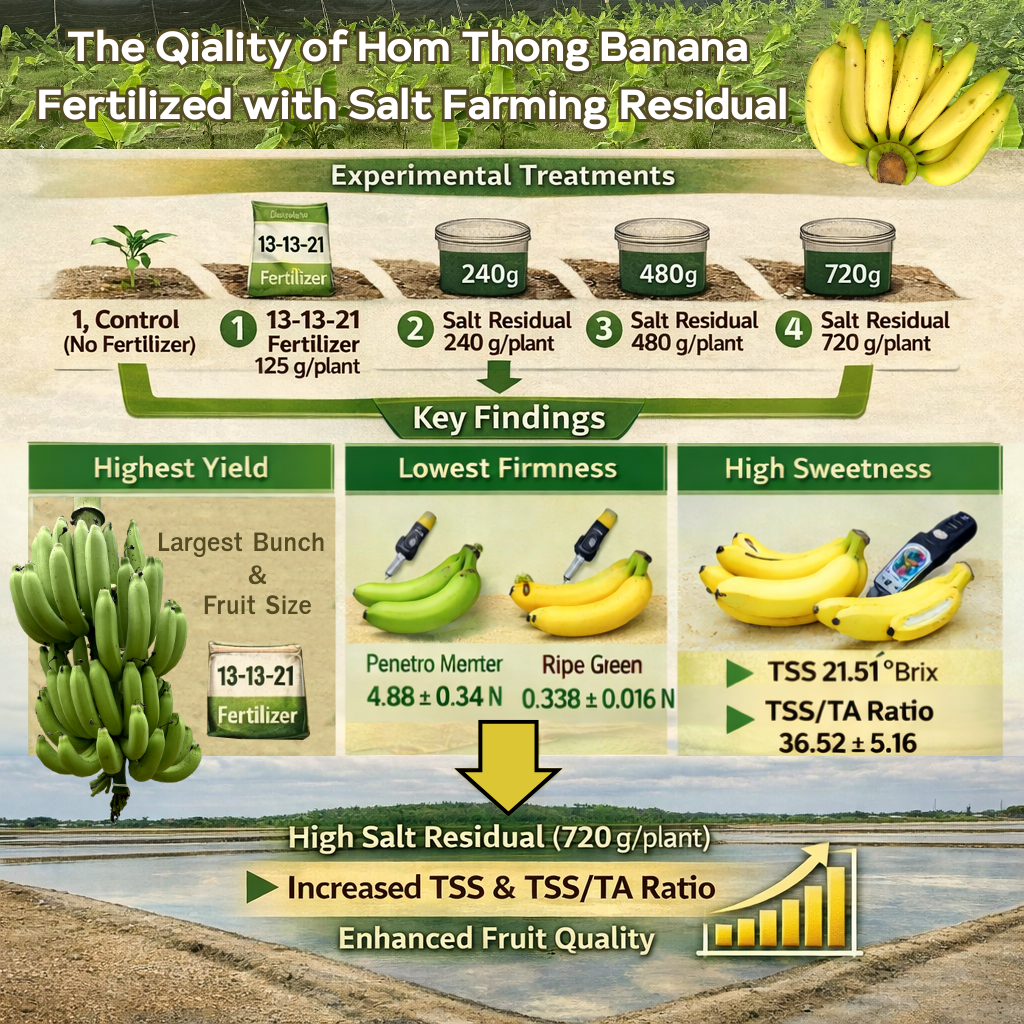
This study investigated the use of salt-farm residue to improve the fruit quality of ‘Hom Thong’ banana. The experiment consisted of five treatments: (1) control (no fertilizer), (2) chemical fertilizer 13-13-21 at 125 g per plant, (3) salt-farm residue at 240 g per plant, (4) salt-farm residue at 480 g per plant, and (5) salt-farm residue at 720 g per plant. The results showed that fertilizer 13-13-21 produced the greatest fruit width, fruit length, bunch weight, and fruit weight. The application of salt-farm residue at 720 g per plant resulted in the lowest firmness values for mature-green and ripe fruits (4.88±0.34 and 0.338±0.016 N, respectively). Salt-farm residue at 480 and 720 g per plant produced the highest total soluble solids (TSS) in ripe fruits (21.37±0.88 and 21.51±0.77 °Brix, respectively). In addition, salt-farm residue at 720 g per plant resulted in a TSS/TA ratio of 36.52±5.16. Overall, the highest application rate of salt-farm residue improved fruit quality, particularly by increasing TSS. Further studies should investigate higher application rates or the combined use of salt-farm residue with chemical fertilizer to reduce production costs and improve product quality.
Article Details

This work is licensed under a Creative Commons Attribution-NonCommercial-NoDerivatives 4.0 International License.
เนื้อหาและข้อมูลในบทความที่ลงตีพิมพ์ในวารสารวิชชา มหาวิทยาลัยราชภัฏนครศรีธรรมราช ถือเป็นข้อคิดเห็นและความรับผิดชอบของผู้เขียนบทความโดยตรง ซึ่งกองบรรณาธิการวารสารไม่จำเป็นต้องเห็นด้วยหรือร่วมรับผิดชอบใด ๆ
บทความ ข้อมูล เนื้อหา รูปภาพ ฯลฯ ที่ได้รับการตีพิมพ์ในวารสารวิชชา มหาวิทยาลัยราชภัฏนครศรีธรรมราช ถือเป็นลิขสิทธ์ของวารสารวิชชา มหาวิทยาลัยราชภัฏนครศรีธรรมราช หากบุคคลหรือหน่วยงานใดต้องการนำข้อมูลทั้งหมดหรือส่วนหนึ่งส่วนใดไปเผยแพร่ต่อหรือเพื่อการกระทำการใด ๆ จะต้องได้รับอนุญาตเป็นลายลักษณ์อักษรจากวารสารวิชชา มหาวิทยาลัยราชภัฏนครศรีธรรมราชก่อนเท่านั้น
The content and information in the article published in Wichcha journal Nakhon Si Thammarat Rajabhat University, It is the opinion and responsibility of the author of the article. The editorial journals do not need to agree. Or share any responsibility.
References
กรมพัฒนาที่ดิน. (2553). คู่มือการปฏิบัติงาน กระบวนการวิเคราะห์ตรวจสอบด้านทางเคมี. กรุงเทพฯ: กรมพัฒนาที่ดิน.
กลุ่มภูมิปัญญาท้องถิ่นและนวัตกรรมด้านการเกษตร. (2564). ภูมิปัญญาท้องถิ่นด้านการเกษตรการผลิตเกลือ. กรุงเทพฯ: กองวิจัยและพัฒนางานส่งเสริมการเกษตร กรมส่งเสริมการเกษตร.
จริงแท้ ศิริพานิช. (2549). สรีรวิทยาและเทคโนโลยีหลังการเก็บเกี่ยวผักและผลไม้. นครปฐม: ศูนย์ส่งเสริมและฝึกอบรมการเกษตรแห่งชาติ.
บุญชาติ คติวัฒน์ ทรงศักดิ์ ธรรมจำรัส และกิตติมา ลีละพงษ์วัฒนา. (2567). ผลของขี้แดดนาเกลือและปุ๋ยเคมีต่อคุณภาพทางเคมีกายภาพของผลฝรั่งพันธุ์กิมจู. วารสารผลิตกรรมการเกษตร, 6(3), 127-137.
ยงยุทธ โอสถสภา. (2552). ธาตุอาหารพืช. กรุงเทพฯ: มหาวิทยาลัยเกษตรศาสตร์.
ยุทธนา นาคคำ. (2564). แนวทางการส่งเสริมการผลิตกล้วยหอมทองแบบแปลงใหญ่ของเกษตรกรจังหวัดชัยภูมิ. วิทยานิพนธ์เกษตรศาสตร์มหาบัณฑิต (เกษตรศาสตร์และสหกรณ์). มหาวิทยาลัยสุโขทัยธรรมาธิราช, นนทบุรี.
รุจิรา แสงแข. (2566). การศึกษาต้นทุนและผลตอบแทนจากการปลูกกล้วยหอมทองปลอดสารพิษ ในเขตพื้นที่อำเภอท่ายางจังหวัดเพชรบุรี. วารสารลวะศรี, 7(1), 122-137.
วสันต์ ชุณห์วิจิตรา. (2557). การปลูกกล้วยหอมทอง. ข่าวสารเกษตรศาสตร์, 60(2), 59-72.
สรณพงษ์ บัวโรย สมบัติ บุตรฉุย สุริยา หรือประเสริฐ เรืองเดช เกิดจงรักษ์ สมทรง แสงตะวัน นัฐยา เพชรพุ่ม ชิษนุวัฒน์ มณีศรีขำ มนู บุญเสริม และบุญปรอด เจริญฤทธิ์. (2545). โครงการศึกษาคุณสมบัติและการใช้ประโยชน์ขี้แดดนาเกลือ ตำบลบางแก้ว อำเภอเมือง จังหวัดสมุทรสงคราม. รายงานวิจัย. สำนักงานกองทุนสนับสนุนการวิจัย.
สำนักงานเกษตรและสหกรณ์จังหวัดเพชรบุรี. (2565). ข้อมูลพื้นฐานจังหวัดเพชรบุรี มกราคม 2565, สืบค้นเมื่อ 11 มกราคม 2568, จาก: https://www.opsmoac.go.th/phetchaburi-dwl-files.
สำนักงานศึกษาธิการ ภาค 4. (2566). แผนพัฒนาการศึกษากลุ่มจังหวัดภาคกลางตอนล่าง 2 พ.ศ. 2566-2570 (ฉบับทบทวน ประจำปี พ.ศ. 2566). สมุทรสงคราม: กลุ่มยุทธศาสตร์การศึกษา สำนักงานศึกษาธิการภาค 4.
สำนักงานเศรษฐกิจการเกษตร. (2564). สารสนเทศเศรษฐกิจการเกษตรรายสินค้า ปี 2563. กรุงเทพฯ: ศูนย์สารสนเทศการเกษตร.
สำนักวิทยาศาสตร์เพื่อการพัฒนาที่ดิน. (2547). คู่มือการวิเคราะห์ตัวอย่างดินน้ำปุ๋ยพืชวัสดุปรับปรุงดินและการวิเคราะห์เพื่อตรวจรับรองมาตรฐานสินค้า. กรุงเทพฯ: กรมพัฒนาที่ดิน.
สุภัทร คำมุงคุณ. (2565). รายการร้อยเรื่องเมืองไทย ขี้แดดนาเกลือกับประโยชน์ทางการเกษตร. สืบค้นเมื่อ 11 มกราคม 2568, จาก: https://library.parliament.go.th/th/radioscript/rr2565-oct3.
AOAC. (1990). Official methods of analysis. (15th ed). Washington DC: Association of Official Analytical Chemist.
Fernando, H.R.P., Srilaong, V., Pongprasert, N., Boonyaritthongchai, P. and Jitareerat, P. (2014). Changes in antioxidant properties and chemical composition during ripening in banana variety 'Hom Thong' (AAA group) and 'Khai' (AA group). International Food Research Journal, 21(2), 749-754.
Hailu, M., Workneh, T.S. and Belew, D. (2013). Review on postharvest technology of banana fruit. African Journal of Biotechnology, 12(7), 635-647.
Hassan, M.H.M., Awang, Y., Jaafar, J.N., Sayuti, Z., Ghani, M.N.O., Sabdin, Z.H.M. and Nazli, M.H. (2022). Effects of salinity sources on growth, physiological process, yield, and fruit quality of grafted rock melon (Cucumis melo L.). Pertanika Journal of Tropical Agricultural Science, 45(4), 919-941, doi: https://doi.org/10.47836/pjtas.45.4.05.
Li, W., Shao, Y.Z., Zhuang, J.P. and Chen, W.X. (2006). Relationships between the sucrose phosphate synthase and ripening senescence of banana fruit. Acta Horticulturae Sinica, 33(5), 1087-1089.
Salvador, A., Sanz, T. and Fiszman, S.M. (2007). Changes in colour and texture and their relationship with eating quality during storage of two different dessert bananas. Postharvest Biology and Technology, 43(3), 319-325, doi: https://doi.org/10.1016/j.postharvbio.2006.10.007.
Siriboon, N. and Banlusilp, P. (2004). A study on the ripening process of ‘Namwa’ banana. AU Journal of Technology, 7(4), 159-164.
Wills, R. and Golding, J. (1981). Postharvest: An introduction to the physiology and handling of fruits and vegetables. Sydney: New South Wales University Press.
Youryon, P. and Supapvanich, S. (2017). Physicochemical quality and antioxidant changes in ‘Leb Mue Nang’ banana fruit during ripening. Agriculture and Natural Resources, 51(1), 47-52, doi: https://doi.org/10.1016/j.anres.2015.12.004.
