
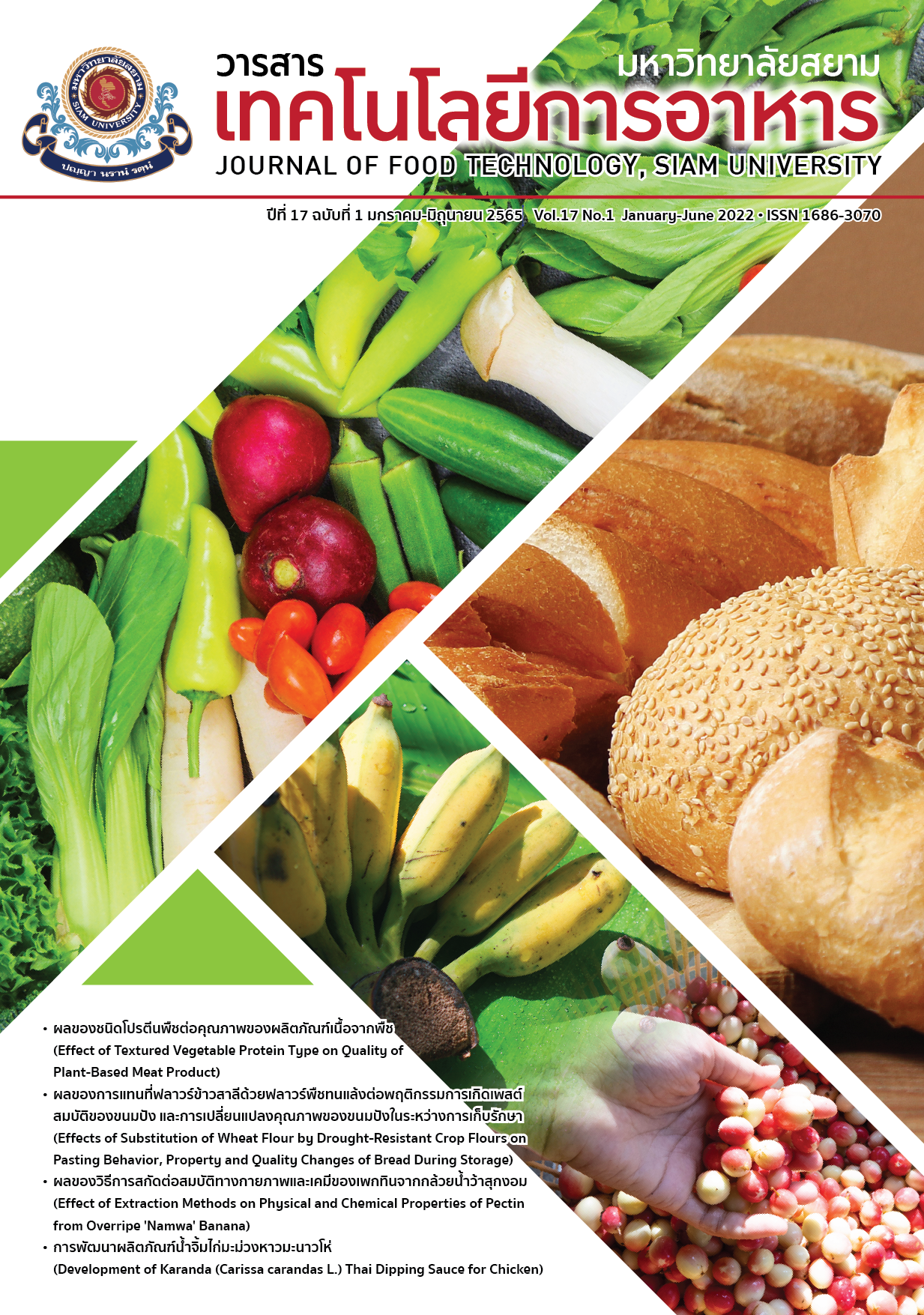
ผลของวิธีการสกัดต่อสมบัติทางกายภาพและเคมีของเพกทินจากกล้วยน้ำว้าสุกงอม
Article Sidebar
Main Article Content
บทคัดย่อ
งานวิจัยนี้ศึกษาผลของวิธีการสกัดเพกทินจากกล้วยน้ำว้าในระยะสุกงอมจากส่วนเปลือก เนื้อ และกล้วยทั้งผล 2 วิธี คือ การสกัดด้วยกรดไฮโดรคลอริกที่ความเข้มข้น 0.05 โมลาร์ อัตราส่วนของตัวอย่างต่อกรดไฮโดรคลอริก 1:12 ที่อุณหภูมิ 95 องศาเซลเซียส 60 นาที และการสกัดด้วยกรดซิตริก 0.05 โมลาร์ อัตราส่วนตัวอย่างต่อกรด
ซิตริก 1:20 ที่อุณหภูมิ 121 องศาเซลเซียส 180 นาที พบว่าเพกทินที่ได้จากการสกัดทั้ง 2 วิธี มีสีน้ำตาล ปริมาณเพกทินและสมบัติทางเคมี ได้แก่ น้ำหนักสมมูล ปริมาณเมทอกซิล ระดับการเกิดเอสเทอร์ และปริมาณกรดกาแลคทูโรนิคของเพกทินที่สกัดด้วยกรดไฮโดรคลอริกก็มีค่าสูงกว่าการสกัดด้วยกรดซิตริกอย่างมีนัยสำคัญ ส่วนเนื้อกล้วยมี เพกทินมากที่สุด เท่ากับ ร้อยละ 15.23 d.b. รองลงมา คือ ส่วนของกล้วยทั้งผล และเปลือกกล้วย เท่ากับ ร้อยละ 9.38 และ 2.49 d.b. ตามลำดับ และเพกทินที่สกัดได้จากทั้งสามส่วน เป็นเพกทินชนิดที่มีเมทอกซิลสูง เนื่องจากปริมาณเมทอกซิลและระดับการเกิดเอสเทอร์ของเพกทินสกัดได้ มีค่าอยู่ในช่วงร้อยละ 11.60 - 15.49 และร้อยละ 82.74 - 93.84 ตามลำดับ ส่วนปริมาณกรดกาแลคทูโรนิคมีค่าอยู่ในช่วงร้อยละ 43.81 – 53.18
Article Details

อนุญาตภายใต้เงื่อนไข Creative Commons Attribution-NonCommercial-NoDerivatives 4.0 International License.
บทความทุกบทความในวารสารเทคโนโลยีการอาหาร ทั้งในรูปแบบสิ่งพิมพ์ และในระบบออนไลน์ ถือเป็นลิขสิทธิ์ของมหาวิทยาลัยสยาม และได้รับการคุ้มครองตามกฎหมาย
เอกสารอ้างอิง
Sudhanyaratana, N., Aoki, S. and Rattana, K. (2016). Tissue culture and the analysis of ploidy stability of Musa (ABB) ‘Namwa Mali-Ong’. SDU Research Journal. 9(3): 1-14. (in Thai)
Department of Agriculture Extension. (2021). Agricultural productivity information system. [Online] Available from https://production.doae.go.th. [Accessed August 1, 2021] (in Thai).
Knee, M. (2002). Fruit quality and its biological basis. CRC Press, Boca Raton, Florida.
Robinson, J.C. and Saúco, V.G. (2010). Bananas and plantains. (2nd ed.). CABI Publishing, Oxford, UK.
Phanyasawan, C., Haruthaithanasun, V., Chompreeda, P., Siriacha, P. and Songkhawasi, T. (2004). Development of concentrated syrup from banana (Musa acuminata ‘Gross Michel’) by using enzyme. Proceedings of 42nd Kasetsart University Annual Conferrence: Fisheries, Agro-Industry, pp 434-441. Bangkok. Thailand. (in Thai).
Brett, C.T. and Waldron, K.W. (1996). Physiology and biochemistry of plant cell walls. Springer Science & Business Media. Cambridge University Press, New York.
Tepya, N. (2003). Pectin. Journal of Science and Technology: Nakhon Si Thammarat Rajabhat University. 3(2): 47-52. (in Thai).
Kasetgala, M. and Kijjarak, R. (2003). Study of suitable methods and conditions for pectin ectraction form local waste. Rearch Report of Nakhon Si Thammarat Rajabhat University. Thailand. 94 p. (in Thai)
Khamsucharit, P., Laohaphatanalert, K., Gavinlertvatana, P., Sriroth, K. and Sangseethong, K. (2018). Characterization of pectin extracted from banana peels of different varieties. Food science and biotechnology. 27(3): 623-629.
May, C.D. (1990). Industrial pectins: Sources, production and applications. Carbohydrate Polymers. 12(1): 79-99.
Cho, S. and Almeida, N. (2012). Dietary fiber and health. CRC Press, Boca Raton, Florida.
Larptansuphaphol, T., Thongkwan, P. and Songpromtip, S. (2013). Extraction of pectin from peels of vegetables and fruits. Agricultural Science Journal. 44(2) (Suppl.): 433-436. (in Thai).
Wititsiri, S. (2017). The comparative extractions of pectin quantities from stringy pulp of nanga jackfruit (Juampa Krop). Journal of Yala Rajabhat University. 9(2): 95-112. (in Thai).
Castillo-Israel, K., Baguio, S., Diasanta, M., Lizardo, R., Dizon, E. and Mejico, M. (2015). Extraction and characterization of pectin from Saba banana [Musa 'saba' (Musa acuminata x Musa balbisiana)] peel wastes: a preliminary study. International Food Research Journal. 22(1): 202-207.
Kontogiorgos, V. (2020). Pectin: technological and physiological properties. Springer International Publishing, Cham.
Mugampoza, D., Gafuma, S., Kyosaba, P. and Namakajjo, R. (2020). Characterization of pectin from pulp and peel of Ugandan cooking bananas at different stages of ripening. Journal of Food Research. 9(5): 67-77.
Oyawaluja, A., Oiseoghaede, J., Odukoya, O. and Aluko, T. (2020). Extraction and estimation of pectins from unripe, ripe and overripe banana (Musa acuminata L.) and plantain (Musa paradisiaca L.) peels and their antioxidant activities. Nigerian Journal of Pharmaceutical Research. 16(1): 87-96.
Varanyanond, W., Naohara, J., Wongkrajang, K. and Manabe, M. (1999). Changes in pectin content and average molecular weight of pectin during maturation of the mango “Kaew”. Food Science and Technology Research. 5(4): 362-364.
Draye, M. and Van Cutsem, P. (2008). Pectin methylesterases induce an abrupt increase of acidic pectin during strawberry fruit ripening. Journal of Plant Physiology. 165(11): 1152-1160.
Chaisri, K., Sa-ae, N. and Sinchai, P.S. (2019). The study on the properties of pectin extracts from Musa peels. In Faculty of Science, Songkhla Rajabhat University. Proceedings of 4th Nation Science and Technology: Southern Network Conference, pp 777-783, Febuary 7-8, 2019. Songkhla, Thailand. (in Thai).
Amnuaysin, N., Suachumsang, N. and Charoenrat, T. (2018). Optimization of pectin extraction from ‘Hom Thong’ banana peel with hydrochloric acid and citric acid. Thai Journal of Science and Technology. 7(5)(Suppl.): 481-490. (in Thai).
Lerkchaiyaphum, K. (2002). Pectin extraction from Citron (Citrus medica Linn.) and its used in food system. Master’s thesis, Khon Kaen University. Thailand. (in Thai).
Williams, P.A. and Phillips, G.O. (2000). Gums and stabilisers for the food industry 10. Royal Society of Chemistry, Cambridge, UK.
Yodumnern, T. (2000). Yam production from “Ta-Koi” pamelo peel. Master’s thesis, Petchabun Rajabhat Institute. Thailand. (in Thai).
FAO JECFA. (2009). Compendium of food additive specifications: Joint FAO/WHO expert committee on food additives - 71st meeting 2009. Rome: Food and Agriculture Organization of the United Nations.
Tangwongchai, R., Lerkchaiyaphum, K., Nantachai, K. and Rojanakorn, T. (2006). Pectin extraction from Citron peel (Citrus medica Linn.) and its used in food system. Songklanakarin Journal of Science and Technology. 28(6): 1351-1363. (in Thai).
Rodsamran, P. and Sothornvit, R. (2019). Microwave heating extraction of pectin from lime peel: characterization and properties compared with the conventional heating method. Food Chemistry. 278: 364-372.
Ma, S., Yu, S-j., Zheng, X-l., Wang, X-x., Bao, Q-d. and Guo, X-m. (2013). Extraction, characterization and spontaneous emulsifying properties of pectin from sugar beet pulp. Carbohydrate Polymers. 98(1): 750-753.
Nguyen, H.D. and Nguyen, H.V. (2014). Effects of maturity stages and solvent types on extraction yield and quality of Chu mango pulp pectin. In Roberts, R.E. Proceedings of III Asia Pacific Symposium on Postharvest Research, Education and Extension: APS2014, pp 399-404. December 8-11, 2014. Hochiminh City, Vietnam.
Emaga, T.H., Robert, C., Ronkart, S.N., Wathelet, B. and Paquot, M. (2008). Dietary fibre components and pectin chemical features of peels during ripening in banana and plantain varieties. Bioresource Technology. 99(10): 4346-4354.
Ciriminna, R., Chavarría Hernández, N., Inés Rodríguez Hernández, A. and Pagliaro, M. (2015). Pectin: A new perspective from the biorefinery standpoint. Biofuels, Bioproducts and Biorefining. 9(4): 368-377.
Masuelli, M. (2020). Pectins: extraction, purification, characterization and applications. IntechOpen, London.
Mollea, C., Chiampo, F. and Conti, R. (2008). Extraction and characterization of pectins from cocoa husks: A preliminary study. Food Chemistry. 107(3): 1353-1356.
Campos-Vega, R., Oomah, B.D. and Vergara-Castaneda, H.A. (2020). Food wastes and by-products: nutraceutical and health potential. John Wiley & Sons Inc., Hoboken, New Jersey.
Nguyen, B.M.N. and Pirak, T. (2019). Physicochemical properties and antioxidant activities of white dragon fruit peel pectin extracted with conventional and ultrasound-assisted extraction. Cogent Food & Agriculture. 5(1): 1-13.
Berk, Z. (2016). Citrus fruit processing. Academic Press, London.
Somogyi, L., Ramaswamy, H.S. and Hui, Y.H. (1996). Processing fruits: science and technology. Taylor & Francis, UK.
Shaha, R.K., Punichelvana, Y. and Afandi, A. (2013). Optimized extraction condition and characterization of pectin from Kaffir lime (Citrus hystrix). Research Journal of Agriculture and Forestry Sciences. 1(2): 1-11.
Sukboonyasatit, D., Pornnikom, N. and Natyay, N. (2018). Chemical and physical properties of pectin from okra. Khon Kaen Agriculture Journal. 46(1): 1418-1423. (in Thai).
Suwannarat, Y., Sawasdikarn, J. and Suwannarat, R. (2019). Extraction and application of pectin from durian rind. Rajabhat Rambhai Barni Research Journal. 13(2): 25-37. (in Thai).
Abdulslam, J. and Banjong, K. (2017). Factors affect pectin extraction process from ripen sugarpalm by water without pH adjusting. Journal of Srinakharinwirot University (Journal of Science and Technology). 9(18): 24-34. (in Thai).
