
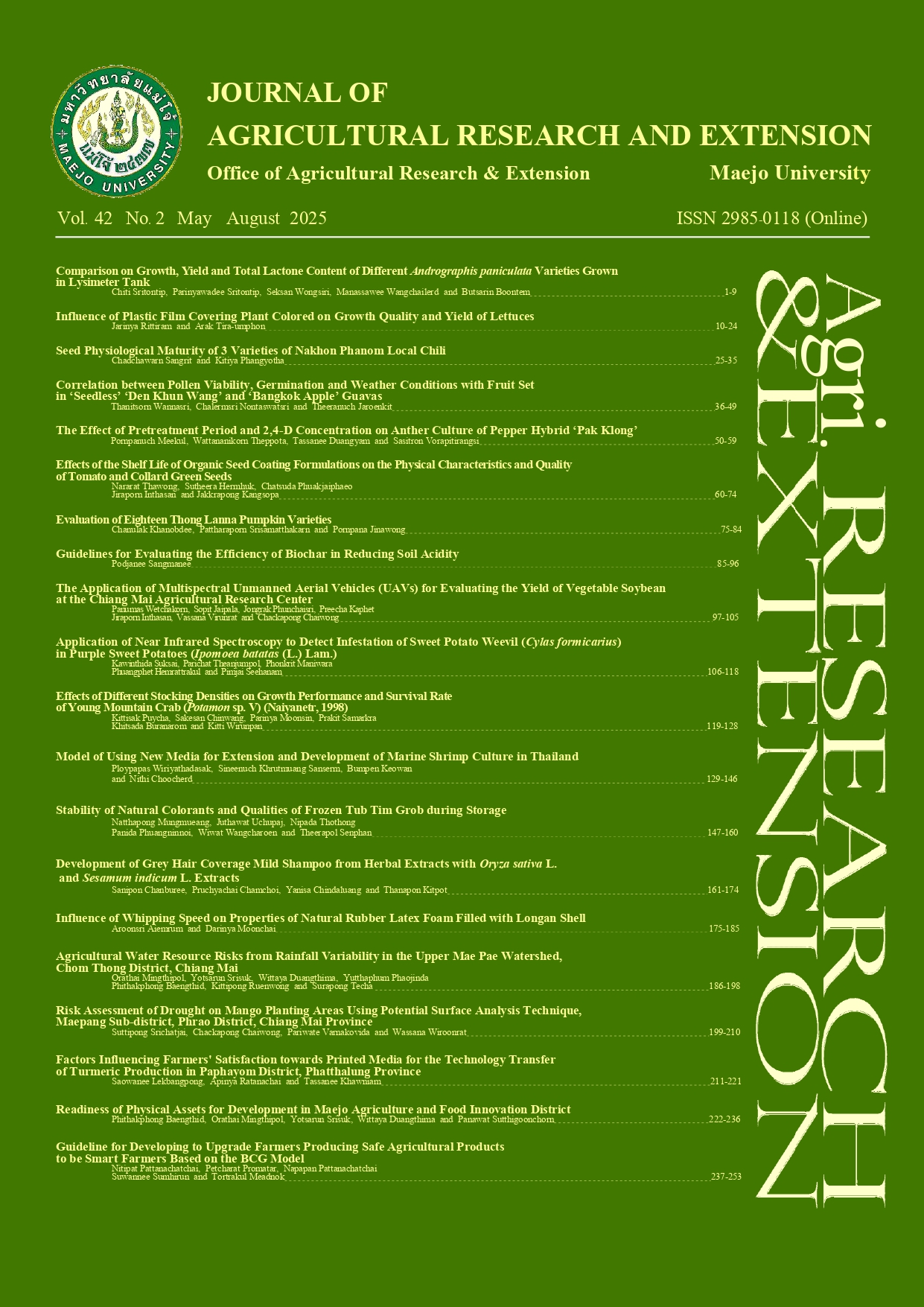
ผลของระยะเวลาการเตรียมอับละอองเกสรร่วมกับความเข้มข้นของ 2,4-D ต่อการเพาะเลี้ยงอับละอองเกสรพริกลูกผสมชั่วที่ 1 พันธุ์ ‘ปากคลอง’
DOI:
https://doi.org/10.14456/jare-mju.2025.25คำสำคัญ:
สายพันธุ์ดับเบิลแฮพลอยด์, การเพาะเลี้ยงอับละอองเกสร, พริก, การเตรียมอับละอองเกสร, 2,4-Dบทคัดย่อ
การสร้างสายพันธุ์ดับเบิลแฮพลอยด์เป็นวิธีการ ที่มีประโยชน์ต่อการปรับปรุงพันธุ์ เนื่องจากเป็นการลดระยะเวลาในการสร้างพืชสายพันธุ์แท้ การเพาะเลี้ยงอับละอองเกสรเป็นวิธีการหนึ่งในการสร้างสายพันธุ์ดับเบิลแฮพลอยด์ งานวิจัยนี้ศึกษาผลของระยะเวลาการเตรียมอับละอองเกสรร่วมกับความเข้มข้นของ 2,4-D ต่อการเพาะเลี้ยงอับละอองเกสรพริกหยวกลูกผสมชั่วที่ 1 พันธุ์ปากคลอง ดำเนินการ ณ ศูนย์วิจัยและพัฒนาการเกษตรที่สูงเชียงราย ระหว่างปี พ.ศ. 2563–2564 นำอับละอองเกสรของพริกที่มีไมโครสปอร์อยู่ในระยะ late uninucleate เพาะเลี้ยงบนอาหารสูตร C ที่เติม 2,4-D ความเข้มข้น 0.1 และ 0.3 มิลลิกรัมต่อลิตร ร่วมกับไคเนตินความเข้มข้น 0.1 มิลลิกรัมต่อลิตร แล้วบ่มในที่มืดที่อุณหภูมิ 35 องศาเซลเซียส เป็นเวลา 4, 6 และ 8 วัน และนำไปเพาะเลี้ยงในที่มืดที่อุณหภูมิ 25 องศาเซลเซียส 10 วัน จึงย้ายอับละอองเกสรลงบนอาหารสูตร R ที่เติมไคเนติน 0.1 มิลลิกรัมต่อลิตร เพาะเลี้ยงในที่มีแสง 16 ชั่วโมง และที่มืด 8 ชั่วโมงต่อวัน เมื่อเพาะเลี้ยงประมาณ 40 วัน สังเกตพบเอ็มบริโอเกิดขึ้นจึงย้ายลงบนอาหารสูตร R ซึ่งไม่เติมสารควบคุมการเจริญเติบโต พบว่าสูตรอาหารและระยะเวลาการเตรียมอับละอองเกสรที่เหมาะสมต่อการชักนำให้ ไมโครสปอร์มีการพัฒนาเป็นเอ็มบริโอคืออาหารสูตร C ที่มี 2,4-D 0.1 มิลลิกรัมต่อลิตร ร่วมกับไคเนติน 0.1 มิลลิกรัมต่อลิตร เพาะเลี้ยงในที่มืดที่อุณหภูมิ 35 องศาเซลเซียส 6 วัน โดยสามารถชักนำให้พัฒนาเป็นต้นได้ประมาณ 5.8 ต้นต่อ 100 อับละอองเกสร เมื่อตรวจสอบต้นที่ได้จากการเพาะเลี้ยงอับละอองเกสรด้วยการนับจำนวนคลอโรพลาสต์ ในเซลล์คุมและดีเอ็นเอเครื่องหมายชนิดไมโครแซทเทลไลท์ ได้ต้นแฮพลอยด์จำนวน 18 ต้น และได้ต้นดับเบิลแฮพลอยด์ที่เกิดจากการเพิ่มจำนวนโครโมโซมขึ้นเองในสภาพเพาะเลี้ยง (spontaneous double haploid) จำนวน 22 ต้น จากการเพาะเลี้ยง 1,270 อับละอองเกสร
เอกสารอ้างอิง
Arjunappa, H.M. K.P. Sateesh and L.D. Prema. 2015. Studies on ploidy analysis and chromosome doubling in androgenic plants of chilli pepper (Capsicum annuum L.). International Journal of Agriculture Innovations and Research 4(4): 2319–1473.
de Vaulx, R.D., D. Chambonnet and E. Pochard. 1981. Culture in vitro d'anthères de piment (Capsicum annuum L.): amé1ioration des taux d'obtention de plantes chez différents génotypes par des trgtitement à + 35°C. Agronomie 1: 859–864.
Fulton, T.M., J. Chunwongse and S.D. Tanksley. 1995. Microprep protocol for extraction of DNA from tomato and other herbaceous plants. Plant Molecular Biology Reporter 13(3): 207–209.
Meekul, P. 2010. Production of Double Haploid Lines from Anthers of F1 Hybrid Pepper. Master Thesis. Kasetsart University. 57 p. [in Thai]
Meekul, P. and J. Chunwongse. 2010. Production and verification of double haploid lines derived from F1 hybrid pepper cvs. ‘83-168’ and ‘PEPAC25’ by anther culture. Agricultural Science Journal 41(2): 203–212. [in Thai]
Seguí-Simarro, J.M. and F. Nuez. 2008. Pathways to doubled haploidy: chromosome doubling during androgenesis. Cytogenetic and Genome Research 120: 358–369.
Wu, F., N.T. Eannetta, M. Mazourek, M.M. Jahn and S.D. Tanksley. 2009. A COSII genetic map of the pepper genome provides a detailed picture of synteny with tomato and new insights into recent chromosome evolution in the genus Capsicum. Theoretical Applied Genetics 118: 1279–1293.
ดาวน์โหลด
เผยแพร่แล้ว
รูปแบบการอ้างอิง
ฉบับ
ประเภทบทความ
สัญญาอนุญาต
ลิขสิทธิ์ (c) 2025 วารสารวิจัยและส่งเสริมวิชาการเกษตร

อนุญาตภายใต้เงื่อนไข Creative Commons Attribution-NonCommercial-NoDerivatives 4.0 International License.
บทความนี้ได้รับการเผยแพร่ภายใต้สัญญาอนุญาต Creative Commons Attribution-NonCommercial-NoDerivatives 4.0 International (CC BY-NC-ND 4.0) ซึ่งอนุญาตให้ผู้อื่นสามารถแชร์บทความได้โดยให้เครดิตผู้เขียนและห้ามนำไปใช้เพื่อการค้าหรือดัดแปลง หากต้องการใช้งานซ้ำในลักษณะอื่น ๆ หรือการเผยแพร่ซ้ำ จำเป็นต้องได้รับอนุญาตจากวารสาร