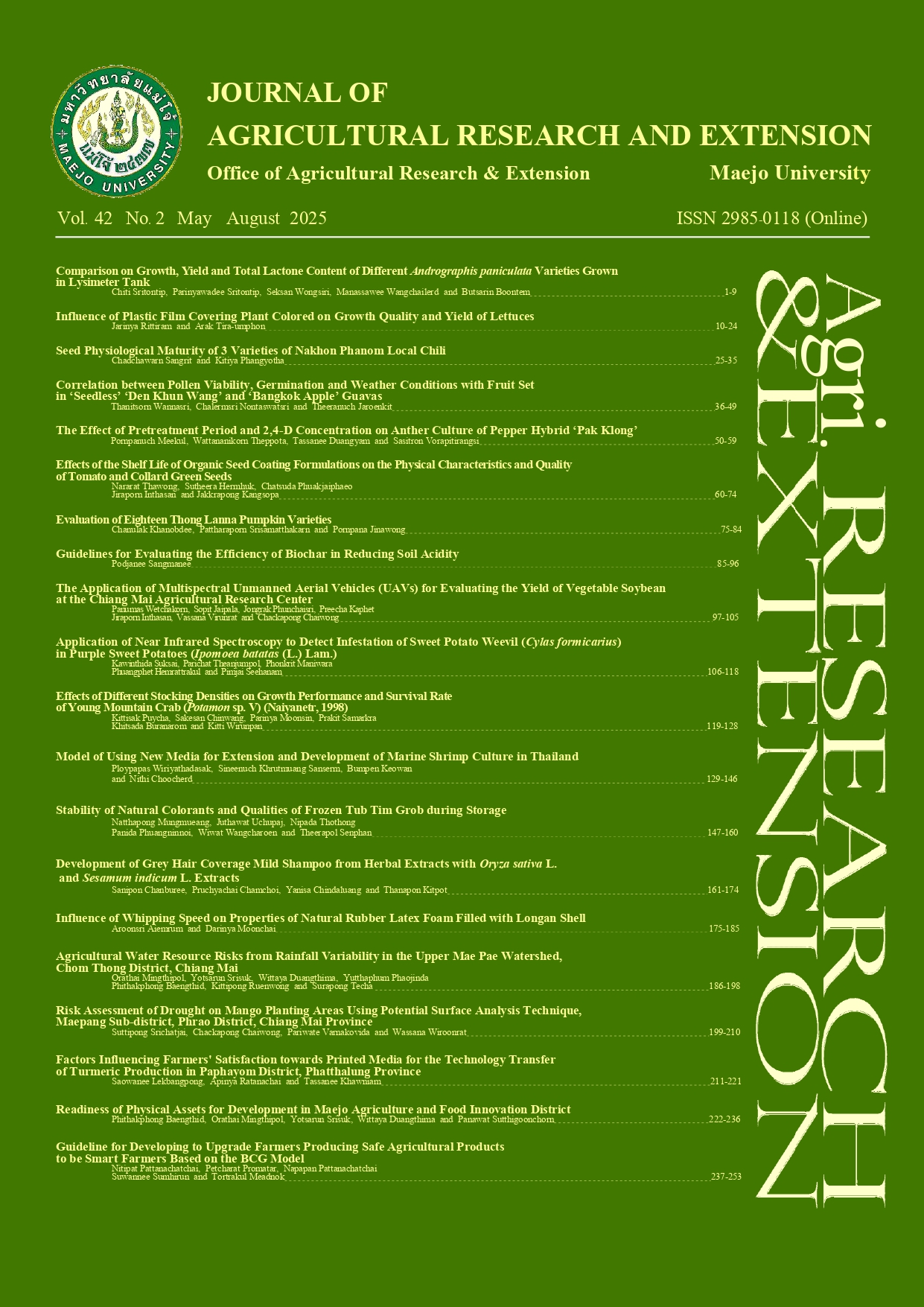
ความเสี่ยงด้านทรัพยากรน้ำภาคการเกษตรจากความแปรปรวนของฝน ลุ่มน้ำแม่แปะตอนบน อำเภอจอมทอง จังหวัดเชียงใหม่
DOI:
https://doi.org/10.14456/jare-mju.2025.36คำสำคัญ:
ทรัพยากรน้ำ, การเกษตร, ความแปรปรวนของฝน , ลุ่มน้ำแม่แปะตอนบนบทคัดย่อ
งานวิจัยนี้มีวัตถุประสงค์เพื่อศึกษาความเสี่ยงด้านทรัพยากรน้ำภาคการเกษตร ภายใต้การเปลี่ยนแปลงสภาพภูมิอากาศที่สามารถระบุปัจจัยบ่งชี้นำไปสู่การวางแผนบริหารจัดการน้ำลุ่มน้ำแม่แปะตอนบนอย่างยั่งยืน โดยใช้กระบวนการวิจัยที่เน้นการเรียนรู้และวิเคราะห์ปัญหาร่วมกับผู้มีส่วนได้ส่วนเสีย ด้วยข้อมูลเชิงวิชาการ และสถานการณ์เชิงประจักษ์ในพื้นที่เพื่อวิเคราะห์การเปลี่ยนแปลงพฤติกรรมการตกของฝนจากความแปรปรวนของสภาพอากาศในรอบ 70 ปีที่ผ่านมา รวมทั้งการวิเคราะห์ลักษณะทางอุทกลุ่มน้ำและสมดุลน้ำภาคการเกษตรกรรม ผลการศึกษาพบว่า ลุ่มน้ำแม่แปะตอนบน มีความเสี่ยงด้านทรัพยากรน้ำภาคการเกษตร จากแนวโน้มปริมาณน้ำฝนเฉลี่ยในช่วง 15 ปีหลัง ตั้งแต่ปี พ.ศ. 2550–2565 ลดลงเหลือเพียง 862.43 มิลลิเมตรต่อปี ซึ่งอยู่ในเกณฑ์ฝนแล้ง (ต่ำกว่า 900 มิลลิเมตรต่อปี) และได้รับอิทธิพลจากปรากการณ์เอลนีโญที่เกิดขึ้นถึง 16 ครั้ง แต่ละครั้งต้องเผชิญกับภาวะแห้งแล้งที่ยาวนานกว่า 20 สัปดาห์ ทำให้ช่วงเวลาการไหลของน้ำท่าไม่สม่ำเสมอตลอดทั้งปี ปรากฏเพียงช่วงฤดูฝนและเมื่อเข้าสู่ฤดูแล้ง มีปริมาณน้ำท่าเพียง 0.37 ล้านลูกบาศก์เมตร ซึ่งเป็นน้ำต้นทุนเพื่อการเพาะปลูกพืชฤดูแล้ง ขณะที่ช่วงเวลาดังกล่าวเกษตรกรมีความต้องการใช้น้ำ 1.21 ล้านลูกบาศก์เมตร ทำให้ปริมาณน้ำเพื่อการเพาะปลูกพืช ฤดูแล้งไม่อยู่ในภาวะสมดุล และขาดแคลนน้ำเฉลี่ย 0.84 ล้านลูกบาศก์เมตรในเดือนพฤศจิกายนถึงเดือนเมษายนของทุกปี สำหรับระบบเก็บน้ำของอ่างเก็บน้ำขุนแปะและอ่างเก็บน้ำต้นผึ้งมีขนาดเล็ก ปริมาณน้ำกักเก็บน้อย ไม่สามารถจัดสรรได้ในฤดูแล้ง บ่อเก็บน้ำ คสล. มีปัญหาทั้งด้านจำนวนและตำแหน่งที่ตั้งที่ไม่สามารถกระจายน้ำได้อย่างทั่วถึง ส่วนรูปแบบการใช้น้ำเพื่อการเกษตรกรรมของเกษตรกรในเขตต้นน้ำมีการสูบน้ำจากลำห้วยขุนแปะไปใช้เพาะปลูกพืชฤดูแล้งจึงเกิดปัญหาความไม่เข้าใจกันของเกษตรกรที่อยู่ต้นน้ำและปลายน้ำ ปัญหาด้านทรัพยากรน้ำดังกล่าวเป็นปัจจัยเงื่อนไขสำคัญที่นำไปสู่การพัฒนาแผนการบริหารจัดการน้ำภาคเกษตรกรรม เพื่อให้เกิดความยั่งยืนด้านทรัพยากรน้ำในลุ่มน้ำแม่แปะตอนบน
เอกสารอ้างอิง
Chanhom, B. 2021. Approaches for the development of public participation in water management for sustainability. Journal of Roi Kaensarn Academi 6(6): 340–356. [in Thai]
Delpla, I., A.V. Jung, E. Baures, M. Clement and O. Thomas. 2009. Impacts of climate change on surface water quality in relation to drinking water production. International Journal of Environment 8(1): 1225–1233.
Piamjaisawang, R., S. Damrongsiri and P. Chanphiwat. 2021. Cover story: drought crisis...national crisis and integration of water management for sustainable development. Journal of Environmental Management 25(2): 157–169. [in Thai]
Royal Irrigation Department. 2009. Study of Runoff Coefficient and Relationship between Average Annual Runoff and 25 Major River Basins of Thailand. Bangkok: Bureau of Hydrology and Water Management. 168 p.
Royal Irrigation Department. 2013. Manual of CER-RID Program 2013. Bangkok: Bureau of Hydrology and Water Management. 95 p.
Sangkarak, S., P. Rattanaphan, A. Phetcharak and S. Kittipongwises. 2020. Impacts of climate change on water resources and management. Journal of Environment Management 24(1): 145–153. [in Thai]
Wirotjanakut, P. 1996. Determination of the average runoff from river basin network characteristics. Journal of KKU Engineering 23(1): 133–147. [in Thai]
ดาวน์โหลด
เผยแพร่แล้ว
รูปแบบการอ้างอิง
ฉบับ
ประเภทบทความ
สัญญาอนุญาต
ลิขสิทธิ์ (c) 2025 วารสารวิจัยและส่งเสริมวิชาการเกษตร

อนุญาตภายใต้เงื่อนไข Creative Commons Attribution-NonCommercial-NoDerivatives 4.0 International License.
บทความนี้ได้รับการเผยแพร่ภายใต้สัญญาอนุญาต Creative Commons Attribution-NonCommercial-NoDerivatives 4.0 International (CC BY-NC-ND 4.0) ซึ่งอนุญาตให้ผู้อื่นสามารถแชร์บทความได้โดยให้เครดิตผู้เขียนและห้ามนำไปใช้เพื่อการค้าหรือดัดแปลง หากต้องการใช้งานซ้ำในลักษณะอื่น ๆ หรือการเผยแพร่ซ้ำ จำเป็นต้องได้รับอนุญาตจากวารสาร