การวิเคราะห์เปรียบเทียบปริมาณมลพิษทางอากาศจากการปลูกข้าวโพดเลี้ยงสัตว์แบบดั้งเดิมและแบบเกษตรอินทรีย์ในพื้นที่ภาคเหนือของประเทศไทย
DOI:
https://doi.org/10.14456/jare-mju.2026.15คำสำคัญ:
มลพิษทางอากาศ , ข้าวโพดเลี้ยงสัตว์ , เกษตรดั้งเดิม , เกษตรอินทรีย์บทคัดย่อ
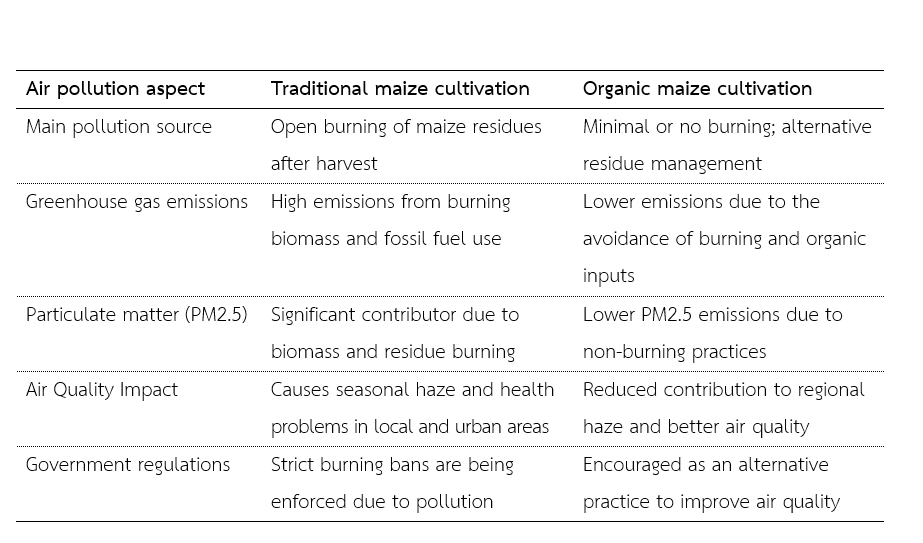
บทความนี้มีวัตถุประสงค์เพื่อประเมินมลพิษทางอากาศที่เกี่ยวข้องกับการปลูกข้าวโพดแบบดั้งเดิมเปรียบเทียบกับการปลูกข้าวโพดแบบอินทรีย์ในภาคเหนือของประเทศไทย ผลการศึกษาชี้ให้เห็นว่าการปลูกข้าวโพดแบบดั้งเดิมเป็นสาเหตุสำคัญของมลพิษทางอากาศหลากหลายชนิด รวมถึงฝุ่นละอองขนาดเล็ก (PM2.5 และ PM10) และหมอกควัน ซึ่งส่วนใหญ่เกิดจากการเผาตอซังและเศษซากพืชหลังการเก็บเกี่ยว นอกจากนี้ การเกษตรแบบดั้งเดิม ยังก่อให้เกิดการปล่อยก๊าซเรือนกระจก เช่น คาร์บอนไดออกไซด์ (CO2) และไนโตรเจนออกไซด์ (NO) อันเนื่องมาจากการใช้ปุ๋ยเคมี ยาฆ่าแมลง และการใช้เครื่องจักรกลการเกษตร ซึ่งส่งผลเสียต่อสุขภาพของประชาชนและสิ่งแวดล้อม ในทางกลับกัน การปลูกข้าวโพดเลี้ยงสัตว์แบบอินทรีย์จะหลีกเลี่ยงการใช้สารเคมีสังเคราะห์และเน้นการจัดการเศษซากพืชทางชีวภาพ แสดงให้เห็นถึงการลดลงของมลพิษทางอากาศอย่างเห็นได้ชัด แม้ว่าการทำเกษตรแบบอินทรีย์จะยังคงปล่อยก๊าซเรือนกระจกและมลพิษจากเครื่องจักรอยู่บ้าง แต่ปริมาณโดยรวมต่ำกว่าเมื่อเปรียบเทียบกับการทำเกษตรแบบดั้งเดิมอย่างมาก บทความนี้สนับสนุนกลยุทธ์ที่ส่งเสริมการทำเกษตรอินทรีย์และการนำเทคโนโลยีทางเลือกมาใช้แทนการเผา เพื่อก้าวไปสู่แนวทางการปลูกข้าวโพดที่ยั่งยืนมากขึ้น
เอกสารอ้างอิง
Changsak, S., P. Thonglueang, S. Rungmekharat, R. Suwannamrak, and T. Phothisung. 2013. Effects of Different Fertilizer Applications on the Yield of Field Corn and Sweet Corn. pp. 448–455.
In Proceedings of 51st Kasetsart University Annual Conference: Plants. Bangkok: The Thailand Research Fund. [in Thai]
Chiang Mai University. 2015. Chapter 3 production and marketing of animal feed corn in the northern part of Thailand. Retrieved from https://archive.lib.cmu.ac.th/full/T/2558/agbus60858rsy_ch3.pdf [in Thai]
Chuenwong-Arun, K. 2020. Soil Pollution. Retrieved from https://ngthai.com/science/27458/soil-pollution [in Thai]
Department of Agricultural Extension. 2019. Organic farming promotes climate change mitigation and reduces air pollution. Retrieved from https://www.dcce.go.th/4007/ [in Thai]
Department of Agricultural Extension. 2019. Planting of corn for animal feed in the dry season after rice farming. Retrieved from https://esc.doae.go.th/ebooks/download-pdf/maize.pdf [in Thai]
Greenpeace. 2020. Maize, land-use change, and transboundary air pollution. Retrieved from https://www.greenpeace.org/thailand/publication/16490/food-agriculture-haze-and-maize-report/ [in Thai]
Highland Research and Development Institute (Public Organization). 2024. About the highland conditions. Retrieved from https://www.hrdi.or.th/About/Highland [in Thai]
Inprasit, S. 2024. Impact of the use of chemicals in agriculture. Retrieved from https://www.onep.go.th [in Thai]
Kantanamalakul, C. 2017. Animal feed corn logistics management of the animal feed industry in the central region of Thailand: part 1, animal feed corn industry and logistics management. Retrieved from https://shorturl.at/8AZ1s [in Thai]
Kasikorn Research Center Co., Ltd. 2024. Econ digest: in 2024, Thailand is expected to import 5.2% more animal feed corn, with nearly all of it coming from countries in the CLM region. Retrieved from https://www.kasikornresearch.com/th/analysis/k-social-media/Pages/Corn-CIS3477-FB-28-03-2024.aspx [in Thai]
Ministry of Agriculture and Cooperatives. 2025. Central database of farmers who have received organic agricultural certification. Retrieved from https://organicmoac.ldd.go.th/agriculture/#/reports [in Thai]
Moungsree, S., S. Polprasert, T. Neamhom and W. Patthanaissaranukool. 2021. Carbon emission from maize cultivation in the dry season of Thailand. Thai Science and Technology Journal 29(6): 951–965. [in Thai]
Nakhon Sawan Field Crops Research Center. 2018. Fertilizer use based on soil analysis in animal feed corn production. Retrieved from https://www.doa.go.th/fc/nakhonsawan/?p=912 [in Thai]
Office of Agricultural Economics. 2024. Agricultural statistics of Thailand 2023 Retrieved from https://www.agrithai.org/wpcontent/uploads/2024/03/statistic2566.pdf [in Thai]
Panmayura, S., P. Kaewwongwattana and C. Utapao. 2021. A Study of Particulated Matters 2.5 Microns from the Burning of Corn Stubble. pp. ENV. 03-1-6. In Proceedings of the 26th National Convention on Civil Engineering, 23-25 June 2021. Bangkok: Department of Civil Engineering, KMITL. [in Thai]
Sukuman, T., S.H. Gheewala, I. Saizen and T. Prapaspongsa. 2025. Life cycle assessment of agricultural systems toward sustainable practices in Thailand. Sustainable Production and Consumption 58: 203–220. https://doi.org/10.1016/j.spc.2025.06.015
Supasri, T., N. Itsubo, S.H. Gheewala and S. Sampattagul. 2020. Life cycle assessment of maize cultivation and biomass utilization in northern Thailand. Scientific Reports 10: 3516. https://doi.org/10.1038/s41598-020-60532-2
Suwannasen, Y., P. Thiampeng and T. Ngamngon. 2012. Sustainable Plant Cultivation System Development Project in Rainfed Areas. 24 p. In Research Report. Bangkok: Department of Agriculture. [in Thai]
Tantivejyapitak, W. 2019. Corn and sugarcane are the leading causes of toxic smog. Retrieved from https://www. the101.world/toxic-smog-from-corn-and-sugarcane-farming/ [in Thai]
ดาวน์โหลด
เผยแพร่แล้ว
รูปแบบการอ้างอิง
ฉบับ
ประเภทบทความ
สัญญาอนุญาต
ลิขสิทธิ์ (c) 2026 วารสารวิจัยและส่งเสริมวิชาการเกษตร

อนุญาตภายใต้เงื่อนไข Creative Commons Attribution-NonCommercial-NoDerivatives 4.0 International License.
บทความนี้ได้รับการเผยแพร่ภายใต้สัญญาอนุญาต Creative Commons Attribution-NonCommercial-NoDerivatives 4.0 International (CC BY-NC-ND 4.0) ซึ่งอนุญาตให้ผู้อื่นสามารถแชร์บทความได้โดยให้เครดิตผู้เขียนและห้ามนำไปใช้เพื่อการค้าหรือดัดแปลง หากต้องการใช้งานซ้ำในลักษณะอื่น ๆ หรือการเผยแพร่ซ้ำ จำเป็นต้องได้รับอนุญาตจากวารสาร