
The Comparative Study of Parboiled Rice Production between Traditional Method and Microwave Method
Article Sidebar
Main Article Content
Abstract
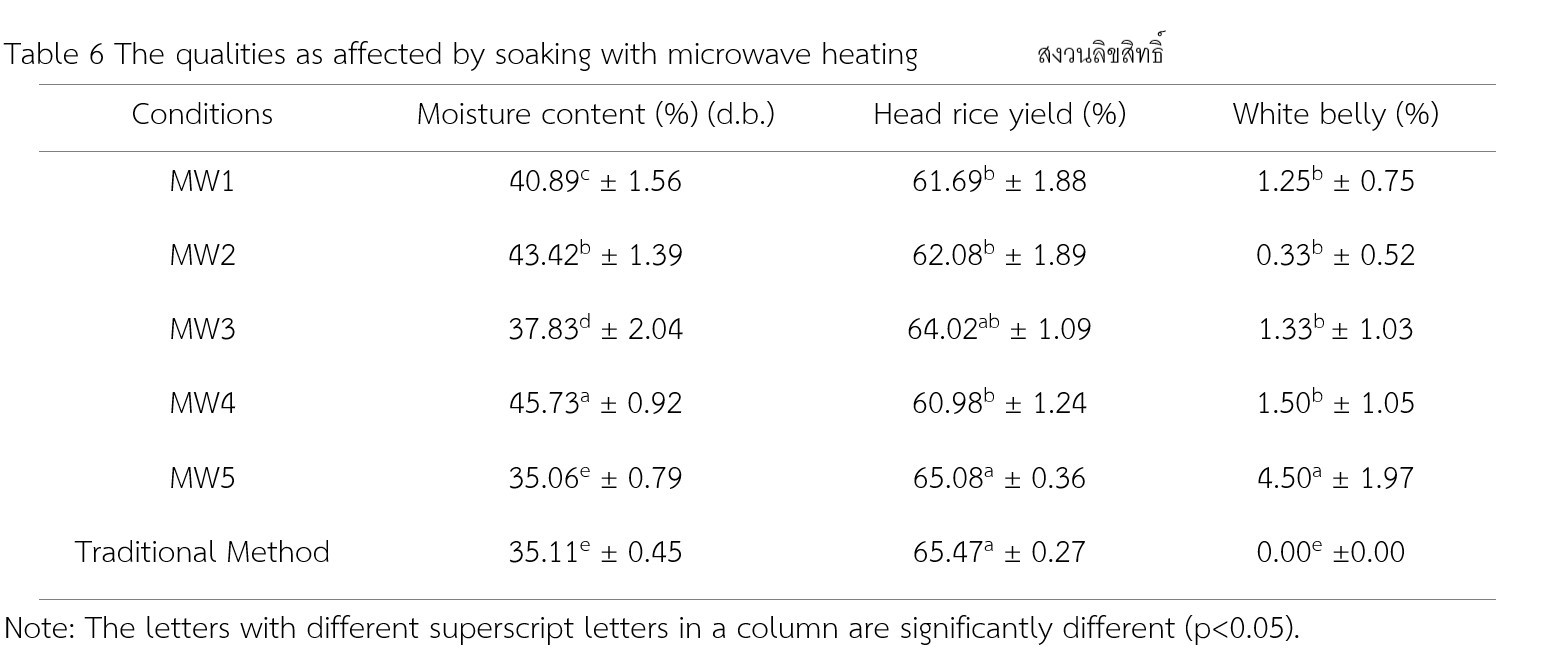
A parboiling process for high-quality rice is important to consume and export. This research was to study and compare the parboiling processes of Thai jasmine rice 105 between a traditional and a microwave technique. The paddy in the conventional method was soaked in the water temperature of 70 and 80 °C with the holding time of 60, 120 and 180 min and steamed at the temperature of 100 °C for 5, 10 and 15 min. The results showed that the steeping with 80 °C for 180 min caused the head rice yield of 65.47 % without chalky grain and the L* and b* values of 64.48 and 19.83, respectively. For soaking by the microwave, the microwave power was varied in the ranges from 400, 440 and 480 W for the duration of 80, 105 and 130 min and after that steamed the paddy as the traditional method. The microwave power of 440 W, the holding period of 160 min for the soaking process and the steaming time of 5 min were suitable conditions. The parboiled rice had the whole grain of 64.02 % with the L* and b* of 60.63 and 16.12, respectively, and the 1.33 % of chalky kernels. Moreover, the characteristics of the whole kernel, chalky grain, values of color space and whiteness from the two techniques were compared and showed no statistically significant (p<0.05). However, the microwave process could reduce the parboiling time and energy consumption.
Article Details
use or modification of the articles is prohibited without permission.
statements expressed in the articles are solely the opinions of the authors.
authors are fully responsible for the content and accuracy of their articles.
other reuse or republication requires permission from the journal."
References
น้ำฝน ลำดับวงศ์, วีรเชษฐ์ จิตตาณิชย์, พิณทิพย์ รัมภกาภรณ์. 2560. “ข้าวนึ่งไทย: จากการค้าสู่การสำรวจความรู้ในกระบวนการผลิต”. สำนักงานกองทุนสนับสนุนการวิจัย (สกว.), กรุงเทพฯ.
น้ำฝน ศีตะจิตต์ และ อรอนงค์ นัยวิกุล. 2546. กระบวนการผลิตข้าวเปลือกนึ่งระดับห้องปฏิบัติการ. รายงานการประชุมวิชาการมหาวิทยาลัยเกษตรศาสตร์ ครั้งที่ 41 ประจำปี 2546, 36-44. มหาวิทยาลัยเกษตรศาสตร์ วิทยาเขตบางเขน, กรุงเทพฯ.
พิสุทธิ์ ไทแก้ว. 2560. การยืดอายุการเก็บรักษาผลิตภัณฑ์อาหารจากการแปรรูปด้วยความร้อน (Thermal Processing). แหล่งข้อมูล: http://km.psru.ac.th/?p=
326&lang=th#more-326. เข้าถึงเมื่อ 7 มกราคม 2561.
ไพศาล วุฒิจำนงค์ และ รุ่งนภา พงศ์สวัสดิ์มานิต. 2555. หลักการแปรรูปผลิตภัณฑ์ด้วยเทคนิคใหม่. 208-229. ใน รุ่งนภา พงศ์สวัสดิ์มานิต บรรณาธิการ, การพัฒนาผลิตภัณฑ์ในอุตสาหกรรมเกษตร. พิมพ์ครั้งที่ 4. สำนักพิมพ์มหาวิทยาลัยเกษตรศาสตร์, กรุงเทพฯ.
สมคิด โฆษิตพันธวงศ์. 2549. อิธิพลของเวลาและอุณหภูมิของการแช่ที่มีผลต่อการผลิตข้าวนึ่งโดยใช้เทคนิคฟลูไอเซชันที่ใช้ไอน้ำร้านยวดยิ่ง. วิทยานิพนธ์วิศวกรรมศาสตรมหาบัณฑิต, มหาวิทยาลัยเทคโนโลยีพระจอมเกล้าธนบุรี.
สมพร อิศวิลานนท์. 2561. ข้าวไทยในตลาดการค้าข้าวโลกและความท้าทาย. รายงานการประชุมสมาชิกเครือข่ายอนุชนชาวนาไทย ครั้งที่ 3. มูลนิธิข้าวไทย ในพระบรมราชูปถัมภ์ และ สํานักงานคณะกรรมการการอาชีวศึกษา, ปทุมธานี
สมาคมผู้ส่งออกข้าวไทย. 2562. รายงานสถานการณ์ส่งออกข้าว แนวโน้มและทิศทางการส่งออกข้าวไทย ปี 2562. แหล่งข้อมูล: http://www.thairiceexporters.or.th/
Press%20release/2019/TREA%20Press%20Release%20Thai%20Rice%20Situation%20&%20Trend%20Year%202019-30012019.pdf. เข้าถึงเมื่อ 10 พฤษภาคม 2562.
สำนักส่งเสริมการค้าสินค้าเกษตรและอุตสาหกรรม. 2562. Factsheet ข้าว ม.ค. 62. แหล่งข้อมูล: https://ditp.go.th
/ditp_web61/article_sub_view.php?filename=contents_attach/539561/539561.pdf&title=539561&cate=456&d=0. เข้าถึงเมื่อ 10 พฤษภาคม 2562.
อรอนงค์ นัยวิกุล. 2556. ข้าว : วิทยาศาสตร์และเทคโนโลยี. พิมพ์ครั้งที่ 3. สำนักพิมพ์มหาวิทยาลัยเกษตรศาสตร์, กรุงเทพมหานคร.
AOAC. 2000. Official Method of Analysis of AOAC International. 17th ed. The Association of Official Analytical Chemists, Virginia.
E. Taghinezhad, M.H. Khoshtaghaza, S. Minaei, A. Latifi. 2015. Effect of soaking temperature and steaming time on the quality of parboiled Iranian paddy rice. International Journal of Food Engineering, 11 (4): 547-556
Juliano, B.O. 1985. Polysaccharide, Protein, And Lipids of Rice, p. 59-160, In B. O. Juliano, ed. Ricce : Chemistry and Technology. Amer. Ass. Cereal Chem., Inc. St. Paul, Minnesota, USA.
Kshirod R Bhattacharya. 2011. Rice Quality: A Guide to Rice Properties and Analysis. First Publishing. Woodhead Publishing Limited. Cambridge, UK.
Parnsakhorn, Sunan and Noomhorm, Athapol. 2008. Changes in Physicochemical Properties of Parboiled Brown Rice during Heat Treatment. Agricultural Engineering International, 10.
Swasdisevi, T. Sriariyakula, W. Tia, W. Soponronnarit, S. 2010. Effect of pre-steaming on production of partially-parboiled rice using hot-air fluidization technique. Journal of Food Engineering, 96 (3): 455-462
