
Design and Development Low Sodium Fish Sauce Distillation Machine for Traditional Fish Sauce Product.
Article Sidebar
Main Article Content
Abstract
The objective of this research is to design and construct a fish sauce distillation apparatus as an alternative
for low-sodium fish sauce production using a physical method, employing inexpensive tools and a straightforward
working principle. We intend to use the apparatus to distill traditional fish sauce from the seafood processing group
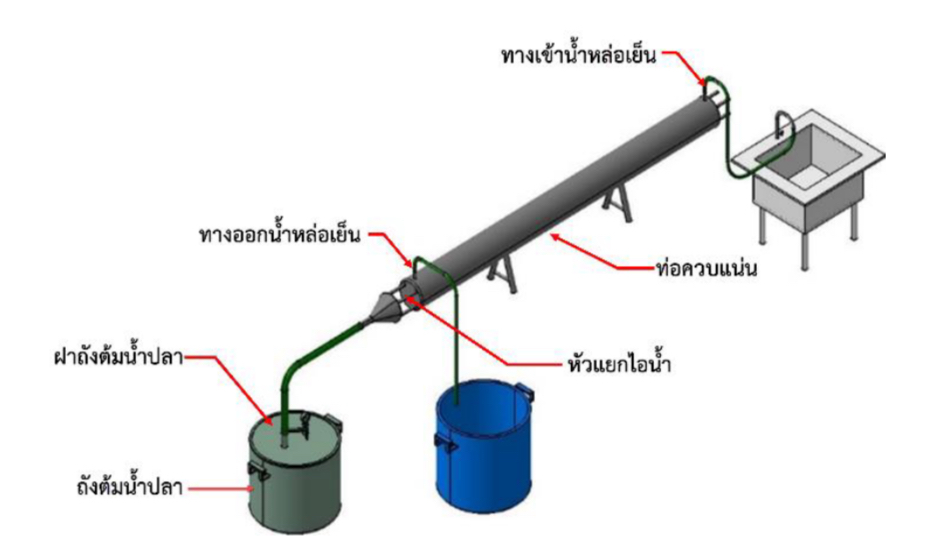
at Ban Talat Lang, Bang Phra, Sriracha, and Chonburi. The fish sauce distillation apparatus consists of three main
components. Firstly, there is a fish sauce boiling tank with a diameter of 280 mm and a height of 240 mm. Secondly there is a conical steam separator with a diameter of 33.4 mm at the base of the cone, as well as a stainless-steel
lid. Lastly, there are four pipes for steam separation, each with a diameter of 10.3 mm and a length of 50 mm. The
apparatus also includes two double-ended capped pipes with a diameter of 114.3 mm and a length of 1300 mm,
and inside these pipes are four steam-carrying pipes with a diameter of 10.3 mm and a length of 1400 mm, passing
through both ends of the capped pipes. We tested the distillation efficiency by distilling 2,500 ml of fish sauce at
a controlled heating temperature of 150°C. The average time required for the distillation process using the designed
and constructed fish sauce distillation apparatus was 286.67 min. The distilled fish sauce has a darker reddishbrown color compared to the non-distilled fish sauce. The color characteristics are as follows: The color brightness
(L*) has a value of 0.49±0.06, the redness-yellowness (a*) has a value of 2.89±0.20, and the yellowness-blueness
(b*) has a value of -0.67±0.13. This is in contrast to the non-distilled fish sauce, which has the following color
characteristics: The color brightness (L*) has a value of 26.45±0.11, the redness-yellowness (a*) has a value of
39.54±0.04, and the yellowness-blueness (b*) has a value of -45.27±0.14. The distilled fish sauce had a maximum
average salt content of 17.57±0.25% w w-1, which is lower than the salt content of the non-distilled fish sauce,
which is 8.17% w w-1. The distilled water obtained had a clear appearance similar to regular water, with an average
salt content of 0.26±0.00% w w-1. Furthermore, the residue left after distilling the saltwater solution had a clumpy
brown appearance and a maximum average salt content of 62.56±3.49% w w-1
Article Details

This work is licensed under a Creative Commons Attribution-NonCommercial-NoDerivatives 4.0 International License.
Articles in this journal are copyrighted by the x may be read and used for academic purposes, such as teaching, research, or citation, with proper credit given to the author and the journal.use or modification of the articles is prohibited without permission.
statements expressed in the articles are solely the opinions of the authors.
authors are fully responsible for the content and accuracy of their articles.
other reuse or republication requires permission from the journal."
References
กระทรวงสาธารณสุข. 2543. ประกาศกระทรวงสาธารณสุข ฉบับที่ 203 (พ.ศ. 2543) เรื่องน้ำปลา. แหล่งข้อมูล: http://fic.nfi.or.th/law/upload/file1/TH_97.pdf เข้าถึงเมื่อ 23 มีนาคม 2562.
ธิดารัตน์ บุญศรี. 2559. การแยกเกลือออกจากน้ำด้วยกระบวนการดูดซับไฟฟ้าร่วมกับกระบวนการลดความกระด้าง. แหล่งข้อมูล: https://www.nstda.or.th/nac/2016/wp-content/uploads/2016/02/Thidarath.pdf เข้าถึงเมื่อ 23 มีนาคม 2562.
ภัทร ศักดิ์เพชร. 2549. การแยกเกลือในน้ำปลาด้วยกระบวนการนาโนฟิลเตรชัน. วิทยานิพนธ์วิทยาศาสตร์มหาบัณฑิต (เทคโนโลยีอาหาร). สงขลา: บัณฑิตวิทยาลัย, มหาวิทยาลัยสงขลานครินทร์.
มาตรฐานผลิตภัณฑ์ชุมชน (มผช.). 2547. น้ำปลาพื้นเมือง (มผช. ๖๗๓/๒๕๔๗). สำนักงานมาตรฐานผลิตภัณฑ์อุตสาหกรรม, กระทรวงอุตสาหกรรม. กรุงเทพฯ. 5 หน้า.
เมธาพร ขจรจรัสกุล, ขนิษฐา หาญวจนวงศ์, วิศัลย์ศยา ศรีทองหลาง, กอบเกียรติ สอนใจ, กมลทิพย์ เสรีนนท์ชัย. 2563. การวิเคราะห์ปริมาณเกลือโซเดียมคลอไรด์ในผลิตภัณฑ์น้ำปลาไทย. วารสารวิทยาศาสตร์และเทคโนโลยี 28(2), 208-218.
สักกมน เทพหัสดิน ณ อยุธยา. 2554. การพัฒนาและศึกษากระบวนการผลิตน้ำปลาโซเดียมต่ำโดยวิธีการแยกสารผ่านเยื่อด้วยไฟฟ้า (รายงานวิจัย). กรุงเทพมหานคร: มหาวิทยาลัยเทคโนโลยีพระจอมเกล้าธนบุรี
กระทรวงสาธารณสุข กรมควบคุมโรค สำนักโรคไม่ติดต่อ. 2556. รายงานผลการทบทวน รูปแบบการดำเนินงานป้องกันการเกิดโรคไม่ติดต่อในวิถีชีวิตด้วยการลดการบริโภคเกลือ. แหล่ง ข้อมูล: http://thaincd.com/2016/media-detail.php?id=8624&tid=30,1-001-003&gid=1-026 เข้าถึงเมื่อ 23 มีนาคม 2562.
สุธัญญา พรหมสมบูรณ์, ภัทราพร สัญชาตเจตน์, มาโนช รัตนคุณ, เพียงขวัญ เครือภู่, วรีภรณ์ รัตนิสสัย, พัชนี บุญธกานนท์, อมรรัตน์ โมราราช, จินตนา เพชรมณีโชติ, ภานุมาศ บุญผดุง, ปราณี นิมิบุตร, สุธีรา อานามวงษ์, ปภากร ศรีสอน, อนงค์นาฏ โสภณางกูร, สุกัลยา ชาญสมร, อรรถนิติ วงศ์จักร, พงษ์พัฒน์ สิงห์ศรี, ศรีชล ภิรมย์ลาภ. 2563. เทคโนโลยีการผลิตน้ำปลาเกลือต่ำชนิดผงเพื่อสุขภาพสู่การจำหน่ายในระบบตลาดออนไลน์ (รายงานวิจัย). ชลบุรี: มหาวิทยาลัยเทคโนโลยีราชมงคลตะวันออก
อรวรรณ คงพันธุ์. 2553. การผลิตน้ำปลาด้วยวิธีการหมักแบบธรรมชาติ. นนทบุรี: บริษัท คุณาไทย จำกัด.
Ettouney, H. (2009). Conventional Thermal Processes. In: Micale, G., Rizzuti, L., Cipollina, A. (eds) Seawater Desalination. Green Energy and Technology. Springer, Berlin, Heidelberg.
Nathamol Chindapan, Sakamon Devahastin, Naphaporn Chiewchan, Shyam S Sablani. 2011. Desalination of fish sauce by electrodialysis: effect on selected aroma compounds and amino acid compositions. Journal of food science, 76(7), S451–S457.
