
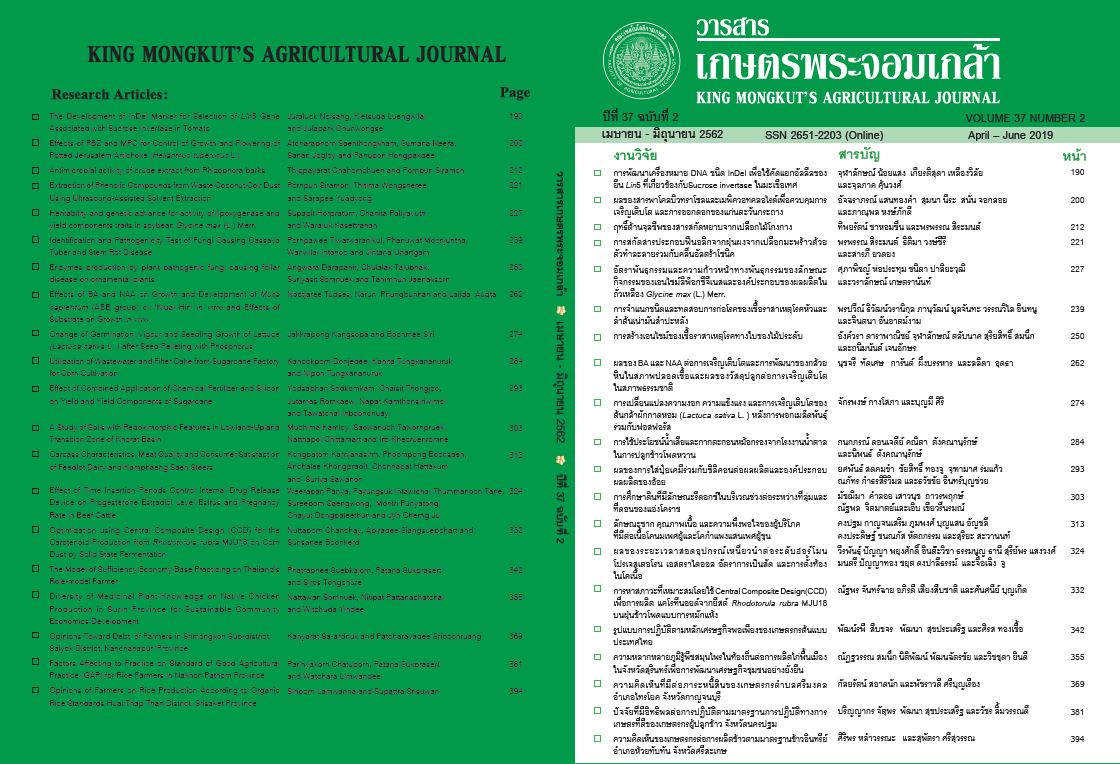
ผลของสารพาโคลบิวทราโซลและเมพิควอทคลอไรด์ เพื่อควบคุมการเจริญเติบโต และการออกดอกของแก่นตะวันกระถาง
Article Sidebar
Main Article Content
บทคัดย่อ
แก่นตะวัน มีศักยภาพที่พัฒนาเป็นไม้ดอกกระถางได้ เมื่อได้รับการควบคุมความสูงต้นและทรงพุ่ม โดยวิธี
การที่ได้รับความนิยมมากที่สุดในการควบคุมขนาดไม้กระถาง คือ การใช้กลุ่มสารชะลอการเจริญเติบโต การศึกษา
ชนิดสาร ความเข้มข้น และวิธีการให้สาร เพื่อผลิตไม้กระถาง ดำเนินการ 2 การทดลอง คือ การทดลองที่ 1 ให้สารพา
โคลบิวทราโซล (paclobutrazol: PBZ) ปัจจัย A คือ วิธีการให้สาร 3 วิธี ราดลงวัสดุปลูก (media drenching) พ่นทาง
ใบ (foliar spraying) และแช่หัวพันธุ์ก่อนปลูก (tuber soaking) ปัจจัย B คือ ความเข้มข้น 4 ระดับ 0, 50, 100 และ
200 มิลลิกรัมต่อลิตร สำหรับการทดลองที่ 2 การใช้สารเมพิควอทคลอไรด์ (mepiquatchloride: MPC) ปัจจัย A คือ
วิธีการให้สาร (เช่นเดียวกับการทดลองที่ 1) และปัจจัย B คือความเข้มข้นสาร 4 ระดับ 0, 250, 500 และ 1,000 มิลลิกรัม
ต่อลิตร ทั้งสองการทดลองวางแผนการทดลองแบบปัจจัยร่วมในสุ่มสมบูรณ์ (factorial in CRD; 3 x 4) เริ่มให้สารใน
สัปดาห์ที่ 4 หลังย้ายปลูก จำนวน 5 ครั้ง ครั้งละ 50 มิลลิลิตร โดยไม่มีการเด็ดยอด ผลการทดลอง พบว่าการให้สาร
PBZ ทั้งวิธีราดและพ่น ที่ 100 และ 200 มิลลิกรัมต่อลิตร สามารถลดความสูงต้น เพิ่มพื้นที่ใบรวม และเพิ่มค่า
compactness index ได้ แต่วิธีการแช่หัวพันธุ์ในสาร PBZ กลับไม่ทำให้พืชออกดอก สำหรับการให้สาร MPC ที่ระดับ
250 มิลลิกรัมต่อลิตร ทำให้พืชมีความสูงลดลงเมื่อเปรียบเทียบกับต้นปกติ ส่วนวิธีการให้สาร ทั้งราดและแช่ ลดความ
สูงต้นได้ดีกว่าการพ่น นอกจากนี้อิทธิพลร่วมระหว่าง วิธีการแช่และความเข้มข้น 1,000 มิลลิกรัมต่อลิตร ให้ผลได้ดี
ที่สุดในการลดความสูงต้น จากผลการทดลองนี้การใช้สารชะลอการเจริญเติบโต ทำได้เพียงลดความสูงต้น แต่ไม่ส่ง
เสริมการออกดอกของแก่นตะวัน เทคนิคดังกล่าวจึงยังไม่สามารถใช้เพื่อการผลิตแก่นตะวันเป็นไม้กระถางได้
Article Details
วารสารเกษตรพระจอมเกล้า
เอกสารอ้างอิง
เพื่อการผลิตเป็นไม้กระถาง. แก่นเกษตร. 45 (พิเศษ 1): 361-367.
จารุณี จูงกลาง กนกกาญจน์ ปองแก้ว กอบเกียรติ แสงนิล และจำนง อุทัยบุตร. 2550. การเปลี่ยนแปลงทางด้านสรีรวิทยาและชีวเคมีบาง
ประการของปทุมมาที่ได้รับสารพาโคบิวทราโซลภายใต้สภาวะขาดน้ำ. ว. วิทย์. กษ. 38: 5(พิเศษ): 33-36.
จิตจำนง ทุมแสน จรรยา พรหมเฉลิม นันทิยา แซ่เตียว กาญจนา สุราภา และวันทนา นาคีสินธ. 2553. ผลของพาโคลบิวทราโซลต่อการ
เจริญเติบโต การออกดอกและการให้ผลผลิตของเยรูซาเล็มอาร์ติโชก พันธ์ุแก่นตะวัน #1. รายงานการวิจัย. มหาวิทยาลัยราชภัฏ
หมู่บ้านจอมบึง. ราชบุรี. 57 หน้า.
จิตราพรรณ พิลึก. 2536. การเพาะเมล็ดและเพาะเลี้ยงเนื้อเยื่อกล้วยไม้. มหาวิทยาลัยเกษตรศาสตร์, กรุงเทพฯ. 82 หน้า.
จิรดา รามนู. 2540. ผลของสารแพคโคลบิวทราโซลต่อการเจริญเติบโตของบานชื่นหนูพันธุ์ดอกสีขาว. ปัญหาพิเศษปริญญาตรี มหาวิทยาลัย
เกษตรศาสตร์. กรุงเทพฯ. 14 หน้า.
ใจศิลป์ ก้อนใจ. 2542. การศึกษาอิทธิพลของสารพาโคลบิวทราโซลที่มีผลต่อการเจริญเติบโตและการออกดอกของชวนชม. รายงานการ
วิจัย สถานีวิจัยและฝึกอบรมการเกษตรแม่เหียะ คณะเกษตรศาสตร์ มหาวิทยาลัยเชียงใหม่. เชียงใหม่.
ชุมพล ปิยานนท์พงศ์. 2529. การทดลองใชส้ าร paclobutrazol เป็นสารชะลอการเจริญเติบโตในดาวเรือง. ปัญหาพิเศษปริญญาตรี.
มหาวิทยาลัยเกษตรศาสตร์. กรุงเทพฯ.
นิติพัฒน์ พัฒนฉัตรชัย. 2557. พาโคลบิวทราโซล: ผลต่อการเติบโตของทรงพ่มุ และ ปริมาณคลอโรฟิ ลล์ของชวนชมพนั ธ์ุฮอลแลนด์.
แก่นเกษตร 42(1): 39-46.
พีรเดช ทองอำไพ. 2537. ฮอร์โมนพืชและการสังเคราะห์แนวทางการใช้ประโยชน์ในประเทศไทย. วันชัยการพิมพ์. กรุงเทพฯ, 196 หน้า.
เพียงพิมพ์ พิสมัย. 2540. ผลของไซโคเซลและพาโคลบิวทราโซลต่อการเจริญเติบโตและการออกดอกของมะลิลาซ้อน. วิทยานิพนธ์วิทยา
ศาสตรมหาบัณฑิต (สาขาวิชาชีววิทยา). มหาวิทยาลัยเชียงใหม่. เชียงใหม่. 129 หน้า.
ภาณุพล หง์ภักดี 2557. ผลของสารพาโคลบวิ ทราโซลตอ่ การใชน้ำและการเติบโตของดาวเรืองกระถาง. วารสารเกษตร 30(3): 281-289.
ภาณุพล หงษ์ภักดี และปวีณา สนทา. 2557. การเปลี่ยนแปลงลักษณะทางสัณฐานวิทยาและการตอบสนองทางสรีรวิทยาของดาวเรือง
กระถางต่อการใช้สารพาโคลบิวทราโซล. แก่นเกษตร 42(3): 541-546.
วรารัตน์ ลีวรางกุล. 2545. ผลของสารพาโคลบิวทราโซลต่อการเจริญเติบโตของทานตะวันพันธ์ุ Pacino ที่ปลูกในกระถางขนาด 5 นิ้ว.
ปัญหาพิเศษปริญญาตรี ภาควิชาพืชสวน มหาวิทยาลัยเกษตรศาสตร์. กรุงเทพฯ. 29 หน้า.
สนั่น จอกลอย วีรยา ลาดบัวทอง และรักชนก มีแก้ว. 2549. แก่นตะวัน (Helianthus tuberosus L.) พืชชนิดใหม่ใช้เป็นพลังงานทดแทน.
แก่นเกษตร. 34(2): 104-111.
อัญรินทร์ หอมกลิ่น.2556. ผลของสารพาโคล บิวทราโซล ต่อการเจริญเติบโตของแก่นตะวัน โครงการนักศึกษาปริญญาตรี สาขาพืชสวน.
ภาควิชาพืชศาสตร์และทรัพยากรการเกษตร. มหาวิทยาลัยขอนแก่น. 16 หน้า
Banon, S., J.Miralles, A.Navarro and M. J. Sánchez-Blanco. 2009. Influence of paclobutrazol and substrate on daily
apotranspiration of potted geranium. Sci. Hort., 122(4): 572-578.
Baldini, M., Danuso, F., Turi, M., and Vannozzi, G. P. 2004. Evaluation of new clones of Jerusalem artichoke
(Helianthus tuberosus L.) for inulin and sugar yield from stalks and tubers. Ind. Crops & Prod., 19(1), 25-40.
Cumming, H.D., F.H. Yelverton and J.D. Hinton. 2002. Use of gibberellic acid to reverse the effects of gibberellic acid
inhibiting plant growth regulators. Available source: http://www.turffiles.ncsu.edu/Files/Turfgrass/presentations/
cummings/2002/Use_of_Gibberellic_Acid_to_Reverse_the_Effects_of_Gibberellic_Acid_Inhibiting_Plant_Growth_
Regulators.pdf, August 23, 2017.
Dalziel, J., and D. K. Lawrence. 1984. Biochemical and biological effects of kaurene oxidase inhibitors, such as
paclobutrazol.Monograph-British Plant Growth Regulation Group.
Denoroy, P. 1996. The crop physiology of Helianthus tuberosus L: A model orientated view. Biomass Bioenergy. 11: 11-32.
Hawkins, S. M., J. M.Ruter and C. D. Robacker. 2015. Spray and drench treatments of paclobutrazol influence growth
of Dissotis and Tibouchina. Hort. Sci., 50(10): 1514-1517.
Jungklang, J., K. Saengnil and J. Uthaibutra. 2017. Effect of water-deficit stress and paclobutrazol on growth, relative water
content, eletrolyte leakage, proline content and some antioxidant changes in Curcuma alismatifolia Gagnep. cv. Chiang
Mai Pink. Saudi J. Bio. Sci. 24: 1505-1512.
Kashid, D. A. 2008. Effect of growth retardants on growth, physiology and yield in sunflower (KBSH-1). Doctoral
dissertation, UAS, Dharwad.
Koutroubas, S. D., G. Vassiliou, S. Fotiadis, and C. Alexoudis. 2004. Response of sunflower to plant growth regulators.
In New Directions for a Diverse Planet: In Proceedings 4th International Crop Science Congress. Available source:
http://www.cropscience.org.au/icsc2004/poster/2/7/4/851_koutroubas.htm
Lalit, S. M. 2002. Plant Growth and Development: Hormones and Environment. Academic Press. 772 pp.
Matsoukis, A. S., I., Tsiros and A. Kamoutsis. 2004. Leaf area response of Lantana camara L. subsp. camara to plant growth
regulators under different photosynthetic flux conditions. Hort. Sci. 39(5): 1042-1044.
Monti, A., Amaducci, M. T., and Venturi, G. 2005. Growth response, leaf gas exchange and fructans accumulation
of Jerusalem artichoke (Helianthus tuberosus L.) as affected by different water regimes. Eur. J. Agro. 23(2): 136-145.
Sterrett, J. P. 1985. Paclobutrazol: a promising growth inhibitor for injection into woody plants. J. Amer. Soc. Hort. Sci. 110(1): 4-8.
Talia, M.C. 1985. Further research about the effects of gibberellic acid upon freesia flowering. Acta Hort. 167: 187-192.
