The Development of Problem-Solving Ability by Utilizing STEAM Activities with Natural Resource of Young Children
Keywords:
Problem-solving Ability, STEAM Activities with Natural Resources, Young Children’sAbstract
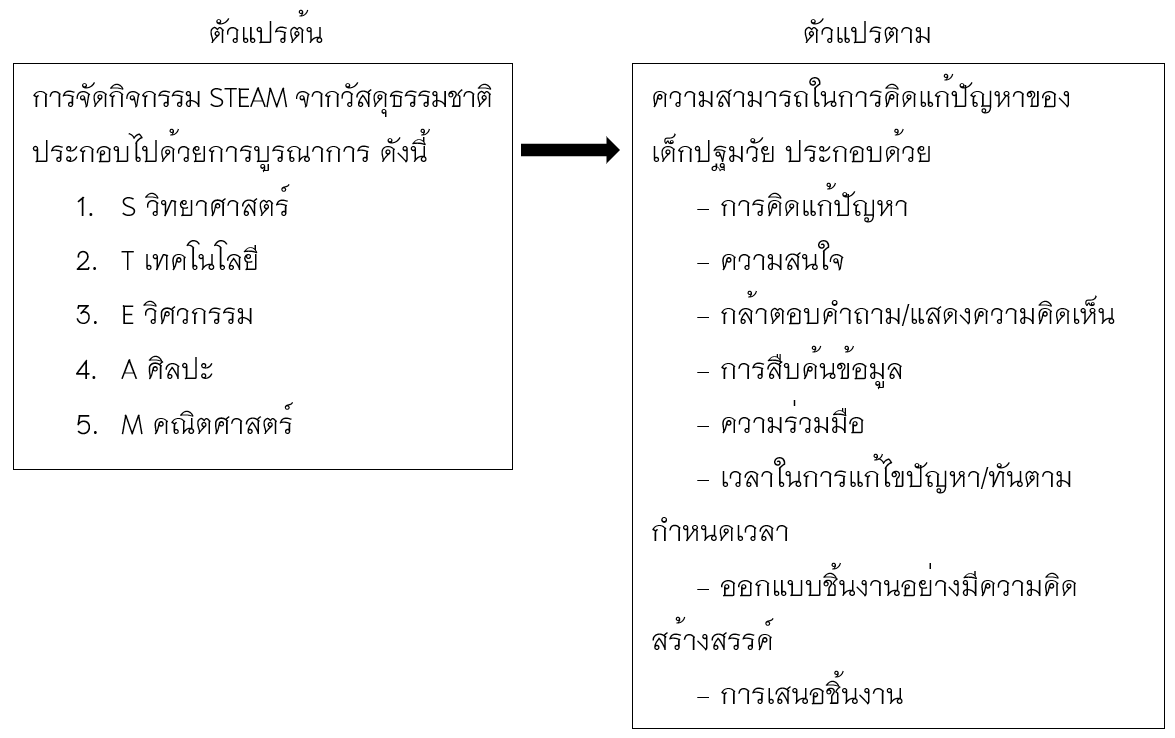
The purpose of this independent study was to compare the young children’s problem-solving abilities before and after participating in STEAM activities with natural resources.
Research target in this study comprised of a class of 35 male and female young children ranging in age between 5-6 years studying in the 3rd year of kindergarten, 2nd semester, 2018 at the Watnongkankrao School, Rayong Primary Educational Service Area Office 2. The instruments used in this study consisted of 1) STEAM activities plan with natural resources that developed the preschoolers’ problem-solving skills for 8 weeks; 2) the 16 situations of the problem-solving thinking interview forms; and 3) the problem-solving thinking observation forms after preschoolers participating in STEAM activities with natural resources. Moreover, the quantitative data were analyzed by applying the mean, standard deviation (SD), and qualitative data analysis was conducted by using content analysis.
It can be found in the results of this study that the preschooler who took in the STEAM natural resources activities had higher problem-solving skills than before the experiment. The results regarding behavior observation showed that preschooler has a higher ability to think and solve problems.
Downloads
References
กระทรวงศึกษาธิการ กรมวิชาการ. (2560). หลักสูตรการศึกษาปฐมวัย พุทธศักราช 2560. กรุงเทพฯ: คุรุสภา ลาดพร้าว.
ปิยพร ค้าสุวรรณ์ และชลาธิป สมาหิโต. (2558). ผลการจัดกิจกรรมสะเต็มศึกษาสำหรับเด็กปฐมวัยที่มีต่อความสามารถในการคิดแก้ปัญหา. วารสารศึกษาศาสตร์ปริทัศน์, 30(3), 93–102.
สุวิทย์ มูลคำ. (2552). การสอนคิดแก้ปัญหา. กรุงเทพฯ: ที พี พริ้น.
หทัยภัทร ไกรวรรณ (2559). การจัดประสบการณ์การเรียนรู้แบบสตีมศึกษาที่มีผลต่อความสามารถในการแก้ปัญหาอย่างสร้างสรรค์ของเด็กปฐมวัย. วารสารศึกษาศาสตร์ปริทัศน์, 32(1), 123-131.
หนึ่งฤทัย เพ็ญสมบูรณ์. (2552). ทักษะการแก้ปัญหาของเด็กปฐมวัยที่ได้รับการจัดกิจกรรมประกอบอาหารประเภทขนมไทย (วิทยานิพนธ์ปริญญามหาบัณฑิต). กรุงเทพฯ: มหาวิทยาลัยศรีนครินทรวิโรฒ.
อรพรรณ บุตรกตัญญู. (2557). เอกสารประกอบการอบรมเชิงปฏิบัติการ STEAM EDUCATION IN EARLY CHILDHOOD EDUCATION. กรุงเทพฯ: บรรยาย ณ คณะศึกษาศาสตร์ มหาวิทยาลัยเกษตรศาสตร์.
Bruner, J. S. (1966). Toward a Theory of Instruction. United States of America: Public Health Service.
Dewey, J. (1976). The Middle Works 1899-1924 (2 vols). London and Amsterdam: Feiffer & Simons, Inc.
Hilburn A. (2011). What is STEAM?. Retrieved June 20, 2018, from http://www.hilburnacademy.net/wha-issteam
Vygotsky, L. S. (1995). Mind is society: The Development of Higher Psychological Processes. Massachusetts: Harvard University Press.
Yakman, G. (2013). STEAM Education Program Description. Retrieved June 20, 2018, from www.steamedu.com
Downloads
Published
Versions
- 2022-07-27 (2)
- 2022-05-24 (1)
How to Cite
Issue
Section
License
Copyright (c) 2022 Chandrakasem Rajabhat University

This work is licensed under a Creative Commons Attribution-NonCommercial-NoDerivatives 4.0 International License.
บทความที่ได้รับการตีพิมพ์เป็นลิขสิทธิ์ของมหาวิทยาลัยราชภัฏจันทรเกษม
ข้อความที่ปรากฏในบทความแต่ละเรื่องในวารสารวิชาการเล่มนี้เป็นความคิดเห็นส่วนตัวของผู้เขียนแต่ละท่านไม่เกี่ยวข้องกับมหาวิทยาลัยราชภัฎจันทรเกษม และคณาจารย์ท่านอื่นๆในมหาวิทยาลัยฯ แต่อย่างใด ความรับผิดชอบองค์ประกอบทั้งหมดของบทความแต่ละเรื่องเป็นของผู้เขียนแต่ละท่าน หากมีความผิดพลาดใดๆ ผู้เขียนแต่ละท่านจะรับผิดชอบบทความของตนเองแต่ผู้เดียว