
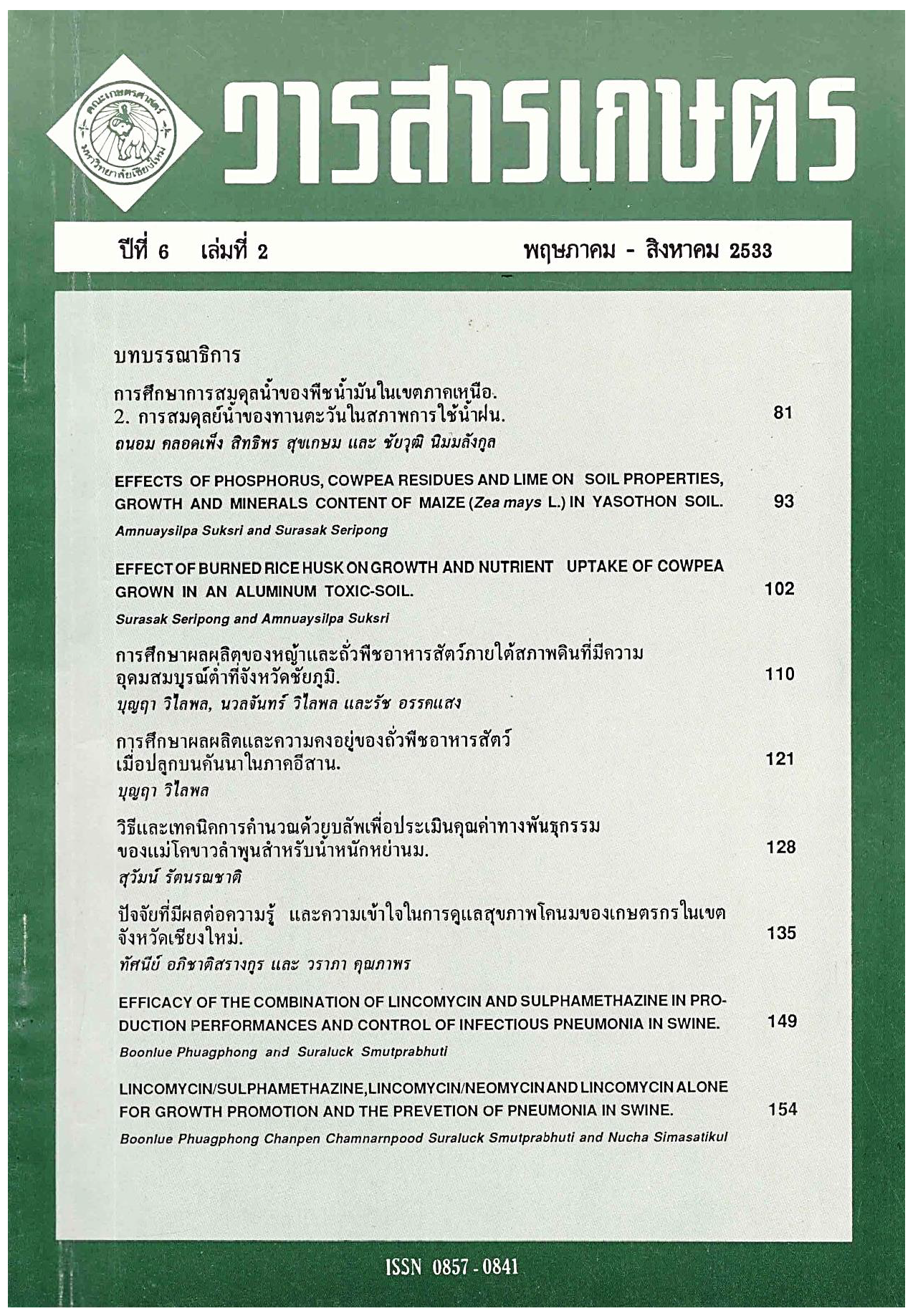
การศึกษาการสมดุลย์น้ำของพืชน้ำมันในเขตภาคเหนือ 2. การสมดุลย์น้ำของทานตะวันในสภาพการใช้น้ำฝน
Article Sidebar
Main Article Content
บทคัดย่อ
การศึกษาในครั้งนี้ได้ทำการทดลองที่แปลงทดลองในไร่ฝึกนักศึกษาแม่เหียะของคณะเกษตรศาสตร์มหาวิทยาลัยเชียงใหม่ ระหว่างเดือนกันยายนถึงธันวาคม 2530 โดยทำการหยอดเมล็ดทานตะวันพันธุ์ Hysun # 33 โดยใช้ระยะปลูก 25 X 75 ซม. หลังจากที่ได้มีการใส่ปุ๋ยผสมเกรด 15-15-15 ในอัตรา 32 กก./ไร่ พร้อมกับการเตรียมดินครั้งสุดท้ายแล้ว และได้มีการใส่ปุ๋ยแอมโมเนียมซัลเฟตและบอแรกซ์ในอัตรา 72 และ 2 กก./ไร่ อีกครั้งหนึ่งหลังจากเมล็ดทานตะวันงอกแล้ว 3 สัปดาห์ หลังจากนั้นเริ่มทำการวัดความชื้นในดินทุก ๆ ระยะความลึก 10 ซม. ถึงระดับความลึก 60 ซม. ทุกสัปดาห์จนกระทั่งถึงช่วงเก็บเกี่ยว พร้อมกันนี้ก็ทำการเก็บตัวอย่างต้นทานตะวันเพื่อวัดความสูง ดัชนีพื้นที่ใบ และน้ำหนักแห้งควบคู่ไปด้วยทุกครั้ง ได้ทำการติดตั้งไลซิมิเตอร์แบบระบายน้ำไว้ในแปลงทดลอง 2 ชุด เพื่อใช้ในการบันทึกข้อมูลต่างๆ พร้อมกับข้อมูลทางอุตุนิยมวิทยาตั้งแต่เริ่มปลูกจนกระทั่งเก็บเกี่ยว เพื่อใช้ข้อมูลเหล่านี้ในการคำนวนหาปริมาณการใช้น้ำและประสิทธิภาพการใช้น้ำของทานตะวัน
ผลจากการศึกษาพบว่า ในช่วงฤดูปลูกนี้ทานตะวันจะมีการใช้น้ำไปทั้งหมด 273.7 มม. ในขณะที่มีฝนตกลงมาทั้งหมด 395.2 มม. โดยทานตะวันจะมีการใช้น้ำมากที่สุดในช่วงที่ดอกบาน ซึ่งเหมือนกับอัตราการคายระเหยและสัมประสิทธิ์การใช้น้ำ โดยที่ค่าทั้งสองนี้จะมีค่าสูงสุดเป็น 4.6 และ 1.4 มม./วัน ตามลำดับ ส่วนประสิทธิภาพการใช้น้ำของทานตะวันในฤดูปลูกนี้เป็น 1.6 ลบ.ม./กก. สำหรับปริมาณความชื้นในดินนั้นจะผันแปรไปตามปริมาณฝนที่ตกและการดูดกลืนน้ำไปใช้ของทานตะวัน ปริมาณการดูดกลืนน้ำไปใช้ของทานตะวันในช่วงสัปดาห์ที่ 3-8 หลังจากเมล็ดงอก ในช่วงความลึก 60 ซม. เป็น 0.80 ลบ.ซม. น้ำ/ลบ. ซม. ดิน และพบว่าความชื้นในดินได้ลดลงถึงระดับความชื้นที่จุดหี่ยวถาวรในดินชั้นบนแต่ก็มีฝนตกลงมาใหม่ในช่วงสัปดาห์ที่ 9 ทำให้ความชื้นในดินชั้นบนมีสูงขึ้นถึงระดับความจุความชื้นในสนามได้อีกครั้ง หลังจากนั้นความชื้นในดินก็ลดลงเรื่อย ๆ ไปจนถึงช่วงเก็บเกี่ยวปริมาณการดูดกลืนน้ำไปใช้ในช่วงหลังนี้เป็น 0.29 ลบ. ซม. น้ำ/ลบ. ซม. ดิน ส่วนการเจริญของทานตะวันนั้นพบว่า ความสูงจะเพิ่มขึ้นอย่างรวดเร็วในระยะแรกจนกระทั่งค่อนข้างคงที่ในระยะออกดอก ดัชนีพื้นที่ใบและน้ำหนักแห้งจะเพิ่มขึ้นไม่รวดเร็วนักในระยะแรก แต่จะเพิ่มขึ้นอย่างรวดเร็วเมื่อเข้าสู่ระยะออกดอก ดัชนีพื้นที่ใบมีค่าสูงสุดเป็น 5.0 ประมาณสัปดาห์ที่ 9 ซึ่งเป็นระยะดอกบานเต็มที่ แล้วจะลดต่ำลงเมื่อเข้าสู่ระยะเก็บเกี่ยว ส่วนน้ำหนักแห้งยังคงเพิ่มขึ้นไปเรื่อย ๆ ในอัตราที่ต่ำจนกระทั่งเก็บเกี่ยวสำหรับผลผลิตของเม็ดของทานตะวันในสภาพนี้มีในอัตรา 343.4 กก./ไร่
Article Details
เอกสารอ้างอิง
Black, C.R., Tang D.Y., Ong C.K., Solon, A. and Simmonds, L.P. (1985). Effects of soil moisture stress on the water relations and water use of groundnut stands. New phytol. 100: 313-328.
Doorenbos, J. and Kassem, A.H. (1979). Yield response to water. FAO Irri. Drain. Paper # 33. FAO, Rome, Italy.
Doorenbos, J. and Pruitt, W.O. (1977). Guidelines for predicting crop water requirements. FAO Irri. Drain. Paper # 24. FAO, Rome, Italy.
Frere, M. and Popov, G.F. (1979). Agrometeorological crop monitoring and forcasting. FAO, Rome, Italy.
Gregory, P.J., Lake, J.V. and Rose, D.A. (1987). Root development and function. Cambridge University Press. Cambridge, UK.
Klodpeng, T., Sukasame, C. and Nimmalungkul, C. (1985). Rooting depth and rooting density of some upland crops under rainfed condition. Final Report Submitted to the ACNARP-THAILAND Project.
Klodpeng, T. and Morris R.A. (1984). Drainage of a Tropaqualf before and after water extraction by a crop. Soil Sci. Soc. Am. J. 48: 632-635.
Lomas, J., Schlesinger, E. and Lewis, J. (1974). Effect of environmental and crop factors on the evapotranspiration rate and water use efficiency of maize. Agric. Met. 13: 239-251.
Penman, H.L. (1956). Evaporation-An introductory survey. Neth. J. Agric. Sci. 4: 9 29.
Sukkasem, S., Manajuti, D. and Sukasame, C. (1985). The use of agrometeorological data for estimating water requiremants of upland rainfed crops in the upper northern Thailand. Final Report Submitted to the ACNARP THAILAND Project.
