
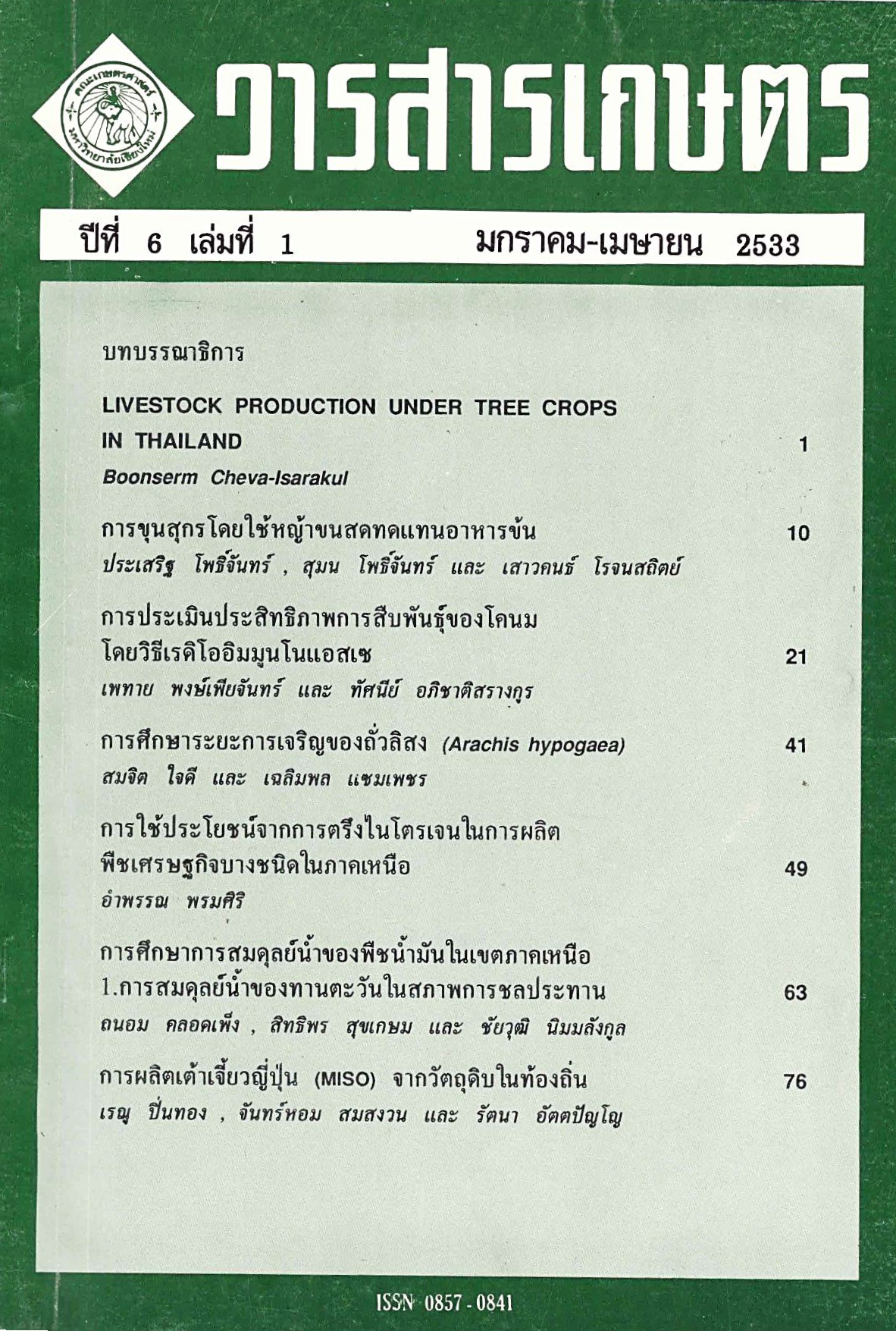
การศึกษาการสมดุลย์น้ำของพืชน้ำมันในเขตภาคเหนือ 1. การสมดุลย์น้ำของทานตะวันในสภาพการชลประทาน
Article Sidebar
Main Article Content
บทคัดย่อ
การศึกษาสมดุลย์น้ำของทานตะวันในสภาพการใช้น้ำชลประทาน ได้ทำการศึกษาที่แปลงทดลองของศูนย์วิจัยเพื่อเพิ่มผลผลิตทางการเกษตร คณะเกษตรศาสตร์ มหาวิทยาลัยเชียงใหม่ เมื่อปลายเดือนธันวาคม 2529 โดยทำการปลูกทานตะวันพันธุ์ Hysun # 33 บนร่องแบบแถวคู่ มีระยะปลูกเป็น 75 x 25 ซม. หลังงอกแล้ว 15 วัน ใส่ปุ๋ยผสมเกรด 15-15-15 และบอแรกซ์ในอัตรา 32 และ 2 กก./ไร่ ตามลำดับ โดยวิธีโรยเป็นแถวด้านข้างของแถวปลูกแล้วพรวนดินกลบ (side-banding) ในขณะเดียวกันก็ได้ศึกษาถึงสภาพการชลประทาน โดยแบ่งการชลประทานออกเป็น 3 ระยะคือ 7,10, และ 14 วัน/ครั้ง ปริมาณน้ำที่ให้แต่ละครั้งคือ 50 มม. ในแต่ละแปลงทดลองจะติดตั้งไลซิมิเตอร์ (lysimeter) ไว้เพื่อเก็บข้อมูลการใช้น้ำ พร้อมทั้งเก็บข้อมูลทางอุตุนิยมวิทยาต่าง ๆ และทำการวัดปริมาณความชื้นในดินทุก ๆ ระยะ 10 ซม. ถึงระดับลึก 50 ซม. ทุกครั้งก่อนและหลังการชลประทาน 1 วัน พร้อมกันนี้ก็ได้สุ่มเก็บตัวอย่างพืชเพื่อศึกษาการเจริญทุก ๆ สัปดาห์จนกระทั่งถึงช่วงเก็บเกี่ยว
ผลการศึกษาพบว่า ตลอดฤดูปลูกของทานตะวันจะมีการใช้น้ำไป 307.3 มม. และช่วงออกดอกเป็นช่วงที่มีการใช้น้ำสูงสุด เช่นเดียวกันกับค่าการคายระเหยจริงและค่าสัมประสิทธิ์การใช้น้ำ ซึ่งจะมีค่าสูงสุดเป็น 5.4 มม./วัน และ 1.5 ตามละดับ ส่วนประสิทธิภาพในการใช้น้ำเมื่อเทียบกับผลผลิตเมล็ดของทานตะวัน จะมีค่าเฉลี่ยเป็น 0.8 กก./ลบ.ม. ค่าเฉลี่ยปริมาณความชื้นในดินและปริมาณการดูดกลืนน้ำไปใช้ของทานตะวันจะแตกต่างกันออกไปตามระยะเวลาของการชลประทาน และพบว่าทานตะวันพันธุ์นี้สามารถให้ผลผลิตของเมล็ดได้ในอัตรา 472,475, และ 441 กก./ไร่ สำหรับระยะของการชลประทาน 7, 10, และ 14 วัน/ครั้ง ตามลำดับ ทั้งยังพบว่าทานตะวันจะมีอัตราการเจริญสูงสุดเมื่อมีการชลประทานทุก ๆ 10 วัน
Article Details
เอกสารอ้างอิง
Doorenbos, J. and Kassem, A.H. (1979). Yield response to water. FAO Irri. Drain. Paper # 33. FAO, Rome. Italy.
Doorenbos, J.and Pruitt, W.O. (1977). Guidelines for predicting crop water requirements. FAO Irri.Drain. Paper # 24. FAO, Rome Italy.
Frere, M. and Popov, G.F. (1979). Agrometeorological crop monitoring and forcasting. FAO, Rome, Italy.
Gregory, P.J., Lake, J.V. and Rose, D.A. (Eds). (1987). Root development and function. Cambridge University Press. Cambridge, UK.
Klodpeng, T., Sukasame, C. and Nimmalungkul, C. (1985). Rooting depth and rooting density of some upland crops under rainfed condition. Final Report Submitted to the ACNARP-THAILAND Project.
Klodpeng, T. and Morris, R.A. (1984). Drainage of a Tropaqalf before and after water extraction by a crop. Soil Sci. Soc. Am. J. 48: 632-635.
Kramer, P.J. (1969) .Plant and soil water relationships: A modern synthesis. McGraw-Hill Inc., New York, U.S.A.
Levitt, J. (1980). Responese of plants to environmental stresses, Vol. II. Academic Press, New York, U.S.A.
Lomas, J., Schlesinger, E.and Lewis, J. (1974). Effect of environmental and crop factors on the evapotranspiration rate and water use efficiency of maize. Agric. Met. 13: 239-251.
Penman, H.L. (1956). Evaporation-An introductory survey. Neth J. Agric. Sci. 4: 9-29.
Sukkasem, S., Manajuti, D. and Sukasame, C. (1985). The use of agrometeorological data for estimating water requirements of upland rainfed crops in the upper northern Thailand. Final Report Submitted to the ACNARP-THAILAND Project.
