
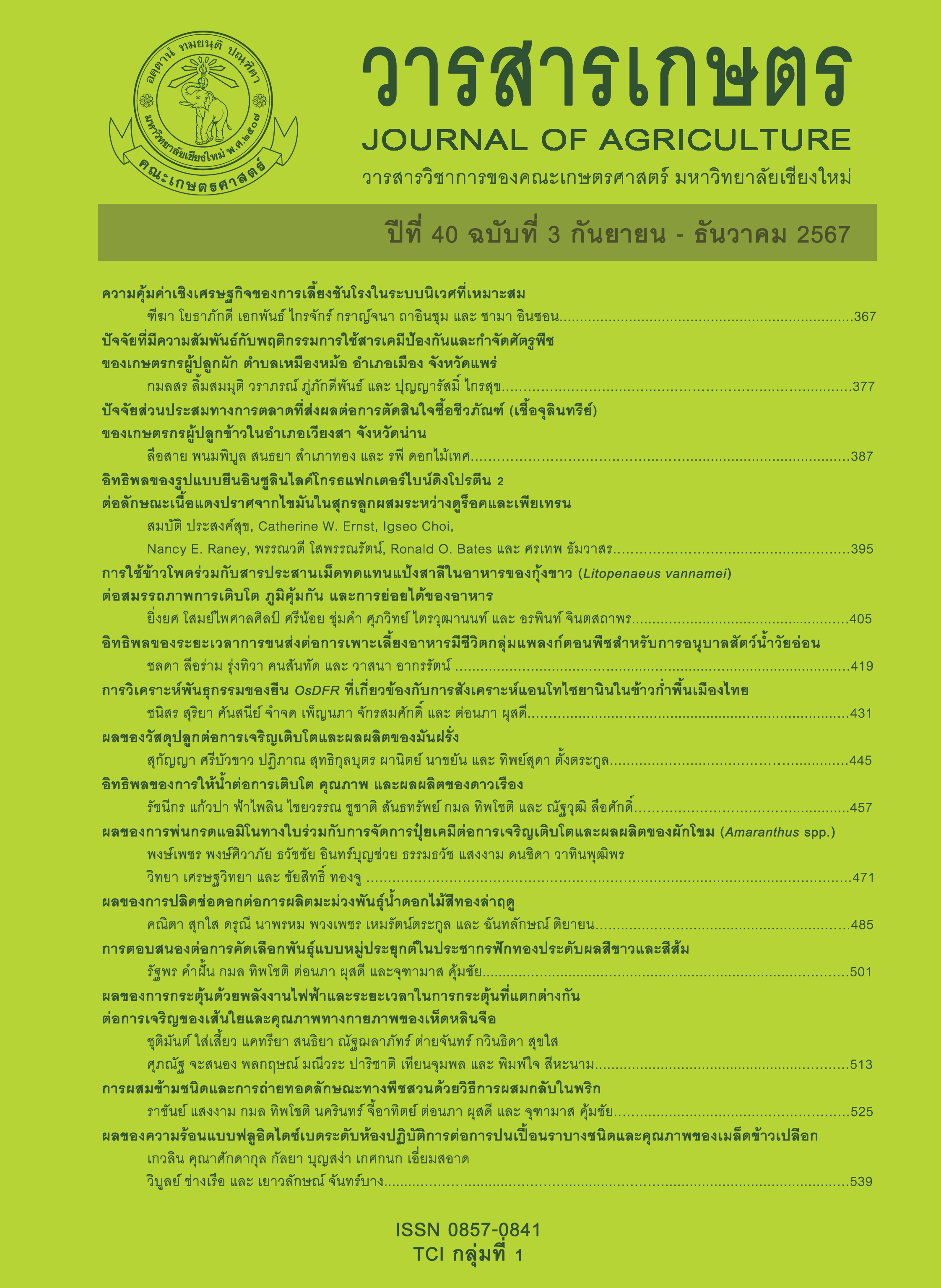
การตอบสนองต่อการคัดเลือกพันธุ์แบบหมู่ประยุกต์ในประชากรฟักทองประดับผลสีขาวและสีส้ม
Article Sidebar
Main Article Content
บทคัดย่อ
ประชากร 2 กลุ่มของฟักทองประดับผลสีขาวและสีส้ม (Cucurbita pepo L.) ถูกเก็บจากไร่เกษตรกร
ในภาคเหนือของประเทศไทย แล้วนำมาคัดเลือกแบบหมู่ประยุกต์ จำนวน 3 รอบ โดยมีจุดประสงค์เพื่อเพิ่มจำนวนผลต่อต้นและความถี่ของสีผิวของทั้ง 2 ประชากร นำเมล็ดของประชากรเริ่มต้น (M0) และ ประชากรที่ผ่านการคัดเลือก (M1, M2 และ M3) ของทั้ง 2 ประชากร ปลูกประเมินในการทดลองที่แยกกัน ณ ศูนย์วิจัย บูรณาการ สาธิตและฝึกอบรมนวัตกรรมการเกษตร คณะเกษตรศาสตร์ มหาวิทยาลัยเชียงใหม่ ในช่วงเดือนพฤศจิกายน 2563 - มกราคม 2564 โดยวางแผนการทดลองแบบสุ่มในบล็อกสมบูรณ์ ผลการศึกษาพบว่า ประชากรทั้ง 2 กลุ่มสีผลที่ผ่านการคัดเลือก 3 รอบ (M3) มีจำนวนผลต่อต้นเพิ่มขึ้นจากประชากรเริ่มต้น (M0) โดยในประชากรกลุ่มผลสีขาวมีอัตราเพิ่มขึ้น 1.7 ผลต่อต้นต่อรอบการคัดเลือก การตอบสนองร้อยละ 88.6 และในประชากรกลุ่มผลสีส้มมีอัตราเพิ่มขึ้น 1.7 ผลต่อต้นต่อรอบการคัดเลือก การตอบสนองร้อยละ 97.9 นอกจากนี้ความถี่ของผลสีขาวในประชากรกลุ่มผลสีขาวที่ผ่านการคัดเลือก 3 รอบ เพิ่มขึ้นร้อยละ 33.3 และในประชากรกลุ่มผลสีส้มมีความถี่ของผลสีส้มเพิ่มขึ้นร้อยละ 27.0 ค่าสหสัมพันธ์ของลักษณะทางพืชสวนที่มีค่าบวกและมีความแตกต่างอย่างมีนัยสำคัญทางสถิติ ในประชากรกลุ่มผลสีขาว และสีส้มพบว่าแสดงออกคล้ายกัน จากการศึกษานี้ชี้ให้เห็นว่า การคัดเลือกพันธุ์แบบหมู่ประยุกต์สามารถเพิ่มจำนวนผลต่อต้นและความถี่ของผลสีขาวและส้มในประชากรฟักทองประดับได้ ซึ่งประชากรที่ผ่านการปรับปรุงนี้สามารถใช้เป็นแหล่งพันธุกรรมสำหรับสกัดสายพันธุ์แท้ต่อไปได้
Article Details

อนุญาตภายใต้เงื่อนไข Creative Commons Attribution-NonCommercial-NoDerivatives 4.0 International License.
เอกสารอ้างอิง
Abd El-Hadi, A.H., K.A. Zaied and M.S. Albrifcany. 2015. Heterosis and gene action studies of some yield and yield component traits in squash. Journal of Agricultural Chemistry and Biotechnology 6(5): 127-136.
Bratsch, T. 2009. Specialty crop profile: Pumpkins. Virginia Cooperative Extension, Blackburg, Virginia. 8 p.
El-Shoura, A.M. and M.Y. Abed. 2018. Heterosis and combining ability for development of squash hybrids (Cucurbita pepo L.). Journal of Plant Production 9(12): 1181-1187.
Globerson, D. 1969. The inheritance of white fruit and stem color in summer squash Cucurbita pepo L. Euphytica 18(2): 249-255.
Gomez, K.A. and A.A. Gomez. 1984. Statistical Procedures for Agricultural Research. 2nd ed. John Wiley & Sons, New York. 680 p.
Hazra, P., A.K. Mandal, A.K. Dutta and H.H. Ram. 2007. Breeding pumpkin (Cucurbita moschata Duch. ex Poir.) for fruit yield and other characters. International Journal of Plant Breeding 1(1): 51-64.
Hussanun, S., K. Lertrat and B. Suriharn. 2012. Response to four cycles of modified mass selection to increase total anthocyanin content in kernels of purple waxy corn populations. Khon Kaen Agriculture Journal 40(Suppl.4): 65-71. (in Thai)
Intavaree, N., K. Lertrat and B. Suriharn. 2014. Responses to three cycles of modified mass selection for resistance to yellow leaf curl in a cucumber population. Khon Kaen Agriculture Journal 42(4): 473-480. (in Thai)
Ketthaisong, D., K. Lertrat and B. Suriharn. 2009. Modified mass selection for prolificacy in small ear waxy corn Khon Kaen composite population. Khon Kaen Agriculture Journal 37(Suppl.): 33-36. (in Thai)
Robinson, R.W. 2000. Rationale and methods for producing hybrid cucurbit seed. Journal of New Seeds 1(3-4): 1-47.
Samphantharak, K. 2003. Plant Breeding: Basics, Methods, and Concepts. Department of Agronomy, Faculty of Agriculture, Kasetsart University, Bangkok. 237 p. (in Thai)
Singh, M.K., V.B. Singh, G.C. Yadav and P. Kumar. 2019. Studies on variability, heritability (narrow sense) and genetic advance analysis for growth, yield and quality traits in pumpkin (Cucurbita moschata Duch. ex. Poir). Journal of Pharmacognosy and Phytochemistry 8(3): 3621-3624.
Sriubon, C. 2023. Ornamental pumpkins sell well during the Chinese New Year festival. (Online). Available: https://chiangmai.doae.go.th/doilo/?page_id=289 (August 23, 2023).
Wessel-Beaver, L. 2005. Release of “Soler” tropical pumpkin. The Journal of Agriculture of the University of Puerto Rico 89(3-4): 263-266.
Wien, H.C., S.C. Stapleton, D.N. Maynard, C. McClurg, and D. Riggs. 2004. Flowering, sex expression, and fruiting of pumpkin (Cucurbita sp.) cultivars under various temperatures in greenhouse and distant field trials. HortScience 39(2): 239-242.
Yong, H., J. Tang, X. Zhao, F. Zhang, Z. Yang, Y. Li, M. Li, D. Zhang, Z. Hao, J. Weng, J. Han, B. Peng and X. Li. 2020. Effect of five modified mass selection cycles on combining ability in two Chinese maize populations. Euphytica 216: 57, doi: 10.1007/s10681-202-02591-0.
