
Evaluation of Optimal Conditions for Bromelain Enzyme Activity from Ananas comosus (L.) Merr. cv. Phuket
Article Sidebar
Main Article Content
Abstract
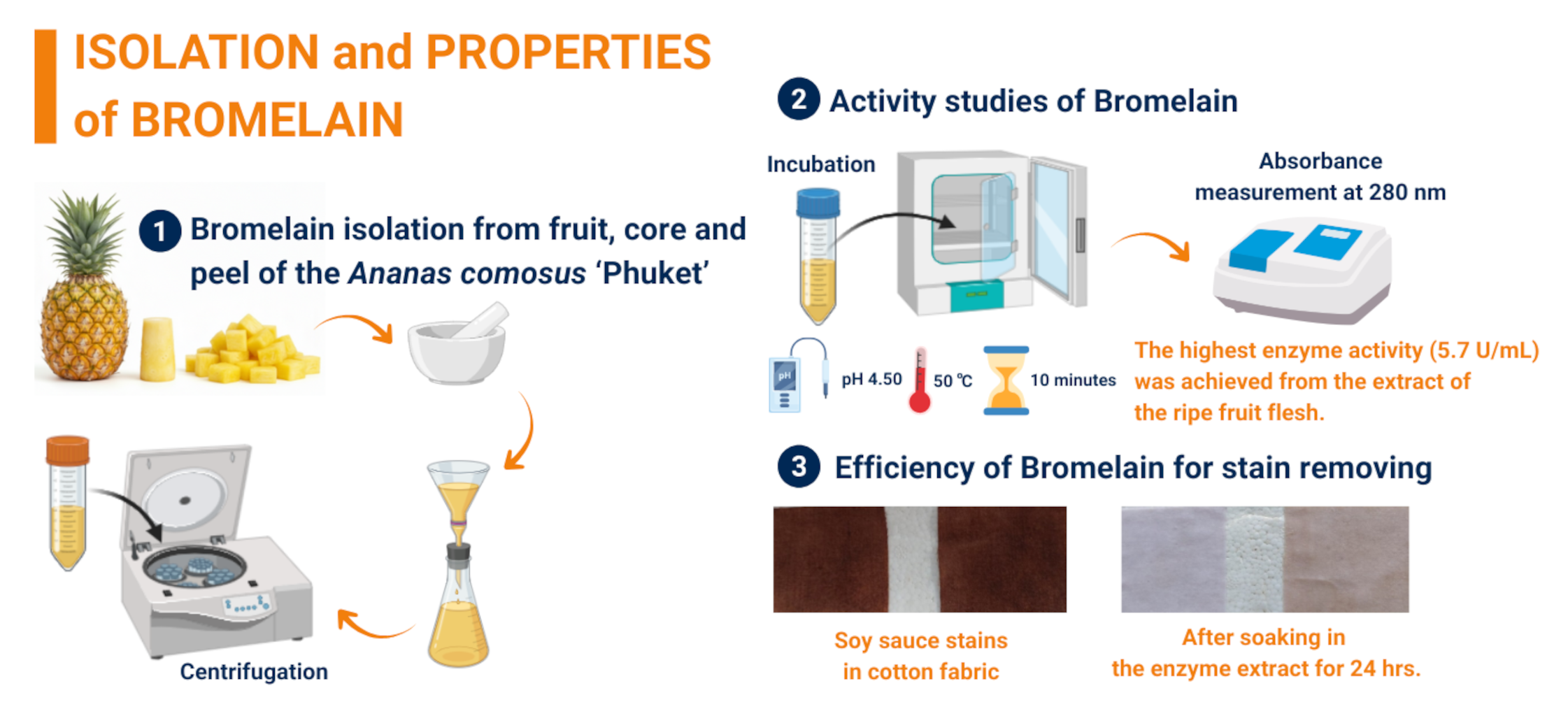
Bromelain is a general term for proteolytic enzymes containing sulfhydryl groups at the active site, derived from pineapple (Ananas comosus (L.) Merr.), which function in the hydrolysis of proteins. This study aimed to compare the activities of crude bromelain extracts obtained from the fruit, core, and peel of the A. comosus (L.) Merr. cv. Phuket, as well as to investigate the differences between unripe and ripe pineapples. The activity of crude bromelain was determined by measuring the amount of tyrosine released, compared with a tyrosine standard, and expressed in units per milliliter of enzyme. The results revealed that the highest enzyme activity was observed in the extract from the ripe fruit flesh under optimal conditions: pH 4.5, 50 °C and 10 minutes of incubation when using casein as a substrate, which yielded enzyme activity of 5.4 and 5.7 units per milliliter, respectively. Additionally, the efficiency of the crude enzyme extract at pH 4.5 and incubated at 50 °C was evaluated for removing soy sauce stains from cotton fabric. It was found that crude bromelain effectively removed stains, with the highest efficiency observed after soaking the fabric in the enzyme extract for 24 hours. These findings indicate that bromelain from the fruit flesh of A. comosus (L.) Merr. cv. Phuket has high potential for application in the detergent industry and could be further developed into enzyme-based textile care products in the future.
Article Details

This work is licensed under a Creative Commons Attribution-NonCommercial-NoDerivatives 4.0 International License.
Authors retain the copyright of articles published in Wichcha Journal Nakhon Si Thammarat Rajabhat University. All published articles are distributed under the Creative Commons Attribution–NonCommercial–NoDerivatives License (CC BY-NC-ND 4.0) (https://creativecommons.org/licenses/by-nc-nd/4.0/). Under this license, readers are permitted to read, download, and share the articles for non-commercial purposes, provided that proper attribution to the original source is given and the content is not modified or altered. All contents of the articles, including text, tables, figures, equations, and other illustrations, are the sole responsibility of the authors. The views and opinions expressed in the articles do not necessarily reflect those of the editorial board or the publisher.
References
จารุพันธ์ ทองแถม. (2526). สับปะรดและอุตสาหกรรมสับปะรดในประเทศไทย. กรุงเทพฯ: ภาควิชาพืชสวน คณะเกษตร มหาวิทยาลัยเกษตรศาสตร์.
ภาวิณีย์ เจริญยิ่ง. (2559). สับปะรดภูเก็ต. สืบค้นเมื่อ 5 พฤษภาคม 2566, จาก: https://www.khaosod.co.th/technologychaoban/techno/plants-vegetables-fruit/article_6226.
มนตรี กล้าขาย. (2559). เกษตรหลังเกษียณ ปลูกสับปะรดในถุงพลาสติกพลิกวิกฤตให้เป็นโอกาส. เทคโนโลยีชาวบ้าน, 28(625), 41-42.
อาภัสสร ศิริจริยวัตร และกาญจนาพร นนทะลุน. (2563). กิจกรรมการย่อยโปรตีนของสารสกัดหยาบจากส่วนต่าง ๆ ของสับปะรดและมะละกอ. แก่นเกษตร, 28(พิเศษ 1), 1887-1092.
Arshad, Z.I.M., Amid, A., Yusof, F., Jaswir, I., Ahmad, K. and Loke, S.P. (2014). Bromelain: An overview of industrial application and purification strategies. Applied Microbiology and Biotechnology, 98(17), 7283-7297, doi: https://doi.org/10.1007/s00253-014-5889-y.
Babu, B.R., Rastogi, N.K. and Raghavarao, K.S.M.S. (2008). Liquid-liquid extraction of bromelain and polyphenol oxidase using aqueous two-phase system. Chemical Engineering and Processing, 47(1), 83-89, doi: https://doi.org/10.1016/j.cep.2007.08.006.
Bhagavathy, S., Gayathridevi, R., Pushya, K. and Jeniffer, J. (2019). Screening, optimization and antimicrobial activity of bromelain from Ananas comosus. International Journal of Scientific Development and Research, 4(8), 233-240.
Bonner, P.L.R. (2007). Protein purification. London: Taylor and Francis Group.
Dubey, R., Reddy, S. and Murthy, N.Y.S. (2012). Optimization of activity of bromelain. Asian Journal of Chemistry, 24(4), 1429-1431.
Gu, Y. (2024). The effect of buffer pH on enzyme activity. Theoretical and Natural Science, 33, 137-147, doi: https://doi.org/10.54254/2753-8818/33/20240893.
Harrach, T., Eckert, K., Schulze-Forster, K., Nuck, R., Grunow, D. and Maurer, H.R. (1995). Isolation and partial characterization of basic proteinases from stem bromelain. Journal of Protein Chemistry, 14(1), 41-52, doi: https://doi.org/10.1007/BF01902843.
Hebbar, H.U., Hemavathi, A.B., Sumana, B. and Raghavarao K.S.M.S. (2011). Reverse micellar extraction of bromelain from pineapple (Ananas comosus L. merryl) waste: Scale-up, reverse micelles characterization and mass transfer studies. Separation Science and Technology, 46(10), 1656-1664, doi: https://doi.org/10.1080/01496395.2011.572110.
Hossain, M.M., Lee, S.I. and Kim, I.H. (2015). Effects of bromelain supplementation on growth performance, nutrient digestibility, blood profiles, faecal microbial shedding, faecal score and faecal noxious gas emission in weanling pigs. Veterinarni Medicina, 60(10), 544-552, doi: https://doi.org/10.17221/8493-VETMED.
Jutamongkon, R. and Charoenrein, S. (2010). Effect of temperature on the stability of fruit bromelain from smooth cayenne pineapple. Agriculture and Natural Resources, 44(5), 943-948.
Kavitha, S., Kumar, S.A., Yogalakshmi, K.N., Kaliappan, S. and Banu, J.R. (2013). Effect of enzyme secreting bacterial pretreatment on enhancement of aerobic digestion potential of waste activated sludge interceded through EDTA. Bioresource Technology, 150, 210-219, doi: https://doi.org/10.1016/j.biortech.2013.10.021.
Ketnawa, S., Chaiwut, P. and Rawdkuen, S. (2011). Aqueous two-phase extraction of bromelain from pineapple peels (‘Phu Lae’ cultv.) and its biochemical properties. Food Science and Biotechnology, 20(5), 1219-1226, doi: https://doi.org/10.1007/s10068-011-0168-5.
Ketnawa, S., Chiwut, P. and Rawduken, S. (2012). Pineapple wastes: A potential source for bromelain extraction. Food and Bioproducts Processing, 90(3), 385-391, doi: https://doi.org/10.1016/j.fbp.2011.12.006.
Koh, J., Kang, S.-M., Kim, S.-J., Cha, M.-K. and Kwon, Y.-J. (2006). Effect of pineapple protease on the characteristics of protein fibers. Fibers and Polymers, 7(2), 180-185, doi: https://doi.org/10.1007/BF02908264.
Martins, B.C., Rescolino, R., Coelho, D.F., Zanchetta, B., Tambourgi, E.B. and Silveira, E. (2014). Characterization of bromelain from Ananas comosus agroindustrial residues purified by ethanol fractional precipitation. Chemical Engineering Transactions, 37, 781-786, doi: https://doi.org/10.3303/CET1437131.
Mohan, R., Sivakumar, V., Rangasamy, T. and Muralidharan, C. (2016). Optimisation of bromelain enzyme extraction from pineapple (Ananas comosus) and application in process industry. American Journal of Biochemistry and Biotechnology, 12(3), 188-195, doi: https://doi.org/10.3844/ajbbsp.2016.188.195.
Mohapatra, A., Rao, V.M. and Ranjan, M. (2013). Comparative study of the increased production and characterization of bromelain from the peel, pulp and stem pineapple (Anannus commas). International Journal of Advanced Research and Technology, 2, 249-279.
More, K., Popalghat, S., Yadav, S. and Namekar, T. (2019). Extraction and partial purification of bromelain from fruit and crown of pineapple (Ananas comosus) and it’s application as a meat tenderizer. International Journal of Pharmacy and Biological Sciences, 9(3), 1361-1367.
Murachi, T. and Neuratii, H. (1960). Fractionation and specificity studies on stem bromelain. Journal of Biological Chemistry, 235(1), 99-107, doi: https://doi.org/10.1016/S0021-9258(18)69593-6.
Muthuganesan, N. (n.d.). Biodetergents. Retrieved 24 March 2024, from: https://www.slideshare.net/slideshow/biodetergents/215498336.
Poh, S.S. and Abdul Majid, F.D. (2011). Thermal stability of free bromelain and bromelain-polyphenol complex in pineapple juice. International Food Research Journal, 18(3), 1051-1060.
Sangkharak, K., Wangsirikul, P., Pichid, N., Yunu, T. and Prasertsan, P. (2016). Partitioning of bromelain from pineapple stem (Smooth Cayenne) by aqueous two phase system and its application for recovery and purification of polyhydroxyalkanoate. Chiang Mai Journal of Science, 43(4), 794-807.
Sawant, P. and Thumar, J. (2023). Impact of substrate pH and enzyme-substrate incubation time on protease from a new halo-tolerant Bor S17B13 found in the mangroves of Western India. Acta Scientific Microbiology, 6(3), 3-9, doi: https://doi.org/10.31080/ASMI.2023.06.1210.
Silvestre, M.P.C., Carreira, R.L., Silva, M.R., Corgosinho, F.C., Monteiro, M.R.P., Morais, H.A. (2012). Effect of pH and temperature on the activity of enzymatic extracts from pineapple peel. Food and Bioprocess Technology, 5, 1824-1831, doi: https://doi.org/10.1007/s11947-011-0616-5.
Singh, L.R., Devi, Y.R. and Devi, S.K. (2003). Enzymological characterization of pineapple extract for potential application in oak tasar (Antheraea proylei J.) silk cocoon cooking and reeling. Electronic Journal of Biotechnology, 6(3), 198-207, doi: https://doi.org/10.2225/vol6-issue3-fulltext-4.
Sivakumar, V. and Kumar, D. (2012). Leather bioprocess intensification: Ultrasound assisted novel enzymatic hair-loosening system for leather processing. Indian Journal of Biotechnology, 11(3), 326-329.
Vallés, D., Furtado, S. and Cantera, A.M.B. (2007) Characterization of news proteolytic enzymes from ripe fruits of Bromelia antiacantha bertol. (Bromeliaceae). Enzyme and Microbial Technology, 40(3), 409-413, doi: https://doi.org/10.1016/j.enzmictec.2006.07.011.
Walsh, G. (2014). Proteins: Biochemistry and biotechnology. (2nd ed). New York: John Wiley & Sons Ltd.
