Assessment of Species Diversity, Nutritional Content, and Antioxidant Activity of Indigenous Vegetables in the Rice Noodles with Fish Curry Sauce Dish from Nakhon Si Thammarat, Thailand
Article Sidebar
Main Article Content
Abstract
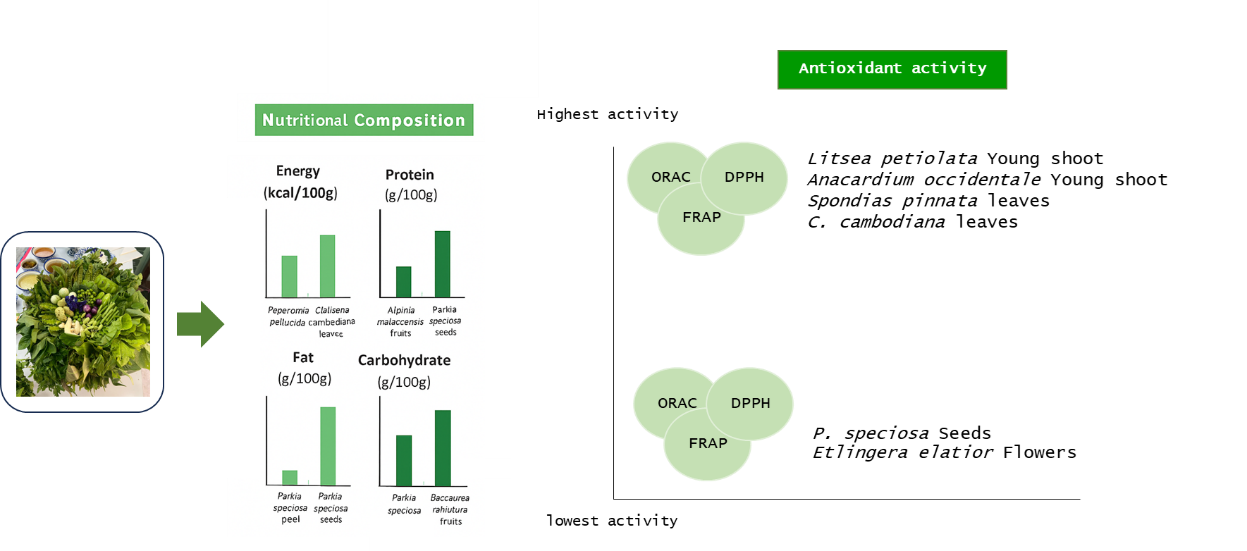
This study assessed the species diversity, nutritional content, and antioxidant activity of 25 indigenous vegetables used with a traditional dish of rice noodles with fish curry sauce from Nakhon Si Thammarat, Thailand. Significant differences (p < 0.05) were found in energy, protein, fat, carbohydrate, and ash contents. Clausena cambodiana leaves had the highest energy content (448.53±34.44 kcal/100 g), while Peperomia pellucida leaves had the lowest (288.77±0.02 kcal/100 g). Parkia speciosa seeds exhibited the highest protein content (28.61±0.05 g/100 g), while Alpinia malaccensis fruits had the lowest (7.43±0.04 g/100 g). Fat content was highest in P. speciosa seeds (17.18±0.07 g/100 g) and undetectable in its peel (0.00±0.00 g/100 g). Carbohydrates content was highest in Baccaurea ramiflora fruits (82.05±0.12 g/100 g) and lowest in P. pellucida leaves (48.85±0.08 g/100 g). P. pellucida leaves also showed the highest ash content (23.84±0.01 g/100 g). Antioxidant capacity, analyzed by ORAC, FRAP, and DPPH assays, showed distinct variations depending on the plant part. Leaves and young shoots, such as those from Litsea petiolata and Anacardium occidentale, demonstrated the highest antioxidant capacity, which correlated with their high flavonoid and phenolic compound content. Spondias pinnata and Clausena cambodiana leaves also showed high ORAC and FRAP values. Fruits, including Ficus botryocarpa and Baccaurea ramiflora, had moderate antioxidant activity, while P. speciosa seeds displayed lower values. The peel of P. speciosa performed better than its seed, particularly in the FRAP and DPPH assays. Flowers, represented by Etlingera elatior, exhibited relatively low antioxidant and nutrient levels. These findings highlight the superior nutritional and antioxidant properties of leaves and young shoots, emphasizing their importance for functional food and dietary applications.
Article Details

This work is licensed under a Creative Commons Attribution-NonCommercial-NoDerivatives 4.0 International License.
Authors retain the copyright of articles published in Wichcha Journal Nakhon Si Thammarat Rajabhat University. All published articles are distributed under the Creative Commons Attribution–NonCommercial–NoDerivatives License (CC BY-NC-ND 4.0) (https://creativecommons.org/licenses/by-nc-nd/4.0/). Under this license, readers are permitted to read, download, and share the articles for non-commercial purposes, provided that proper attribution to the original source is given and the content is not modified or altered. All contents of the articles, including text, tables, figures, equations, and other illustrations, are the sole responsibility of the authors. The views and opinions expressed in the articles do not necessarily reflect those of the editorial board or the publisher.
References
Aster, K.G.V., Castillo, J.R.B., Cheng, S.R., Trillana, J.P.L., Varlez, Y.M.B. and Mercado, J.M.T. (2023). Sawsawan: Explicating the culinary heritage significance of Philippine condiments using bibliometrics (1972-2018). Journal of Ethnic Foods, 10, 19, doi: https://doi.org/10.1186/s42779-023-00186-3.
Bailey, L.H. (1963). The standard encyclopedia of horticulture (volume 1, 2, and 3). (2nd ed). New York: The Macmillan Company.
Benzie, I.F.F. and Strain, J.J. (1996). The ferric reducing ability of plasma (FRAP) as a measure of “antioxidant power: The frap assay”. Analytical Biochemistry, 239(1), 70-76, doi: https://doi.org/10.1006/abio.1996.0292.
Chamnian, K., Chamnian, M., Mukharak, T., Boonkwan, S. and Nuktreepong, N. (2024). Marketing models and digital marketing communication guidelines for business of rice noodles in fish curry sauce, Nakhon Si Thammarat province. Journal of Multidisciplinary in Humanities and Social Sciences, 7(4), 2352-2370.
Cole, A., Pethan, J. and Evans, J. (2023). The role of agricultural systems in teaching kitchens: An integrative review and thoughts for the future. Nutrients, 15(18), 4045, doi: https://doi.org/10.3390/nu15184045.
Fieldhourse, P. (2002). Food and nutrient custom and culture. (2nd ed). Canada: Stanley Thomes (Publishers) Ltd.
Gulcin, İ. and Alwasel, S.H. (2023). DPPH radical scavenging assay. Processes, 11(8), 2248, doi: https://doi.org/10.3390/pr11082248.
Jung, S., Rickert, D.A., Deak, N.A., Aldin, E.D., Reckmor, J., Johnson, L.A. and Murphy, P.A. (2003). Comparison of kjeldahl and dumas methods for determining protein contents of soybean products. Journal of the American Oil Chemist’s Society, 80(12), 1169-1173, doi: https://doi.org/10.1007/s11746-003-0837-3.
Kennedy, G., Kanter, R., Chotiboriboon, S., Covic, N., Delormier, T., Longvah, T., Maundu, P., Omidvar, N., Vish, P. and Kuhnlein, H. (2021). Traditional and indigenous fruits and vegetables for food system transformation. Current Development in Nutrition, 5(8), nzab092, doi: https://doi.org/10.1093/cdn/nzab092.
McLoughlin, C., McKie, V.A. and McCleary, B.V. (2023). Validation of the test method-determination of available carbohydrates in cereal and cereal products, dairy products, vegetables, fruit, and related food products and animal feeds: Collaborative study, final action 2020.07. Journal of AOAC International, 106(2), 370-383, doi: https://doi.org/10.1093/jaoacint/qsac116.
Ou, B., Hampsch-Woodill, M. and Prior, R.L. (2001). Development and validation of an improved oxygen radical absorbance capacity assay using fluorescein as the fluorescent probe. Journal of Agricultural and Food Chemistry, 49(10), 4619-4626, doi: https://doi.org/10.1021/jf010586o.
Pem, D. and Jeewon, R. (2015). Fruit and vegetable intake: Benefits and progress of nutrition education interventions-narrative review article. Iranian Journal of Public Health, 44(10), 1309-1321.
Putra, F.K.K., Putra, M.K. and Novianti, S. (2023). Taste of asean: Traditional food images from Southeast Asian countries. Journal of Ethnic Foods, 10, 20, doi: https://doi.org/10.1186/s42779-023-00189-0.
Sintupachee, S., Rattanachoo, P. and Promproa, S. (2022). Alpha-mangostin quality and quantity analysis in Nakhon Si Thammarat mangosteen pericarp using thin-layer chromatography. Malaysian Journal of Sustainable Agricultures, 6(1), 51-56, doi: https://doi.org/10.26480/mjsa.01.2022.51.56.
Szerlauth, A., Muráth, S., Viski, S. and Szilagyi, I. (2019). Radical scavenging activity of plant extracts from improved processing. Heliyon, 5(11), e02763, doi: https://doi.org/10.1016/j.heliyon.2019.e02763.
Thomas, A., Alpha, A., Barczak, A. and Zakhia-Rozis, N. (2022). Sustainable food systems for food security, need for combination of local and global approaches. Versailles: Quæ Publisher, Inc.
Varzakas, T. and Antoniadou, M. (2024). A holistic approach for ethics and sustainability in the food chain: The gateway to oral and systemic health. Foods, 13(8), 1224, doi: https://doi.org/10.3390/foods13081224.
Yakoh, K. (2023). Antioxidant activity of indigenous vegetables in Suratthani province. Wichcha Journal Nakhon Si Thammarat Rajabhat University, 42(1), 93-103, doi: https://doi.org/10.65217/wichchajnstru.2023.v42i1.256643.
Zocchi, D.M., Sulaiman, N., Prakofjewa, J., Sõukand, R. and Pieroni, A. (2024). Local wild food plants and food products in a multi-cultural region: An exploratory study among diverse ethnic groups in Bessarabia, Southern Moldova. Sustainability, 16(5), 1968, doi: https://doi.org/10.3390/su16051968.
