
การประเมินความหลากหลาย ปริมาณสารอาหาร และฤทธิ์ต้านอนุมูลอิสระของผักพื้นบ้านในเมนูขนมจีนเมืองนครศรีธรรมราช ประเทศไทย
Article Sidebar
Main Article Content
บทคัดย่อ
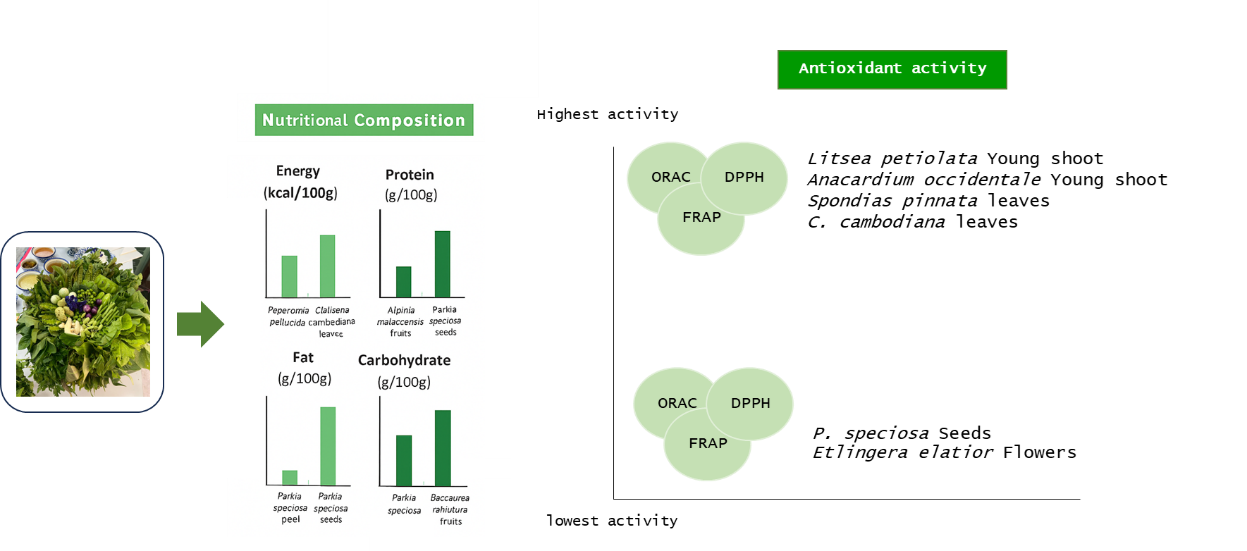
การศึกษานี้มีวัตถุประสงค์เพื่อประเมินความหลากหลายของชนิดพืช ปริมาณสารอาหาร และฤทธิ์ต้านอนุมูลอิสระของผักพื้นบ้าน 25 ชนิด ที่ใช้ในเมนูขนมจีนแกงป่าในจังหวัดนครศรีธรรมราช ประเทศไทย ผลการศึกษาพบว่ามีความแตกต่างกันอย่างมีนัยสำคัญทางสถิติ (p < 0.05) ในด้านพลังงาน โปรตีน ไขมัน คาร์โบไฮเดรต และเถ้า (ash content) โดยใบของหมุรุย (Clausena cambodiana) มีปริมาณพลังงานสูงที่สุด (448.53±34.44 กิโลแคลอรีต่อ 100 กรัม) ในขณะที่ใบของกระสัง (Peperomia pellucida) มีค่าต่ำที่สุด (288.77±0.02 กิโลแคลอรีต่อ 100 กรัม) เมล็ดสะตอ (Parkia speciosa) มีปริมาณโปรตีนสูงที่สุด (28.61±0.05 กรัมต่อ 100 กรัม) ในขณะที่ผลของข่าป่า (Alpinia malaccensis) มีค่าต่ำที่สุด (7.43±0.04 กรัมต่อ 100 กรัม) ปริมาณไขมันสูงที่สุดในเมล็ดสะตอ (17.18±0.07 กรัมต่อ 100 กรัม) ขณะที่เปลือกไม่มีไขมัน (0.00±0.00 กรัมต่อ 100 กรัม) ปริมาณคาร์โบไฮเดรตสูงที่สุดในผลของมะไฟ (Baccaurea ramiflora) (82.05±0.12 กรัมต่อ 100 กรัม) และต่ำที่สุดในใบของกระสัง (48.85±0.08 กรัมต่อ 100 กรัม) ใบของกระสังยังมีปริมาณเถ้าสูงที่สุด (23.84±0.01 กรัมต่อ 100 กรัม) อีกด้วย ความสามารถในการต้านอนุมูลอิสระซึ่งวิเคราะห์โดยวิธี ORAC FRAP และ DPPH มีความแตกต่างกันอย่างชัดเจนขึ้นอยู่กับส่วนของพืช เช่น ใบของทัมมัง (Litsea petiolate) และยอดอ่อนของมะม่วงหิมพานต์ (Anacardium occidentale) แสดงฤทธิ์ต้านอนุมูลอิสระสูงสุด ซึ่งสัมพันธ์กับปริมาณฟลาโวนอยด์และสารฟีนอลิกที่สูง ใบของมะกอก (Spondias pinnata) และหมุรุยก็มีค่าการทดสอบ ORAC และ FRAP สูงเช่นกัน ผลไม้ เช่น ลูกชิ้ง (Ficus botryocarpa) และมะไฟ แสดงฤทธิ์ต้านอนุมูลอิสระในระดับปานกลาง ขณะที่เมล็ดสะตอมีค่าต่ำกว่า อย่างไรก็ตามเปลือกของสะตอมีฤทธิ์สูงกว่าเมล็ด โดยเฉพาะในการทดสอบด้วยวิธี FRAP และ DPPH ดอกไม้ ซึ่งในที่นี้ คือ ตัวอย่างของดาหลา (Etlingera elatior) พบว่ามีระดับสารอาหารและฤทธิ์ต้านอนุมูลอิสระค่อนข้างต่ำ ผลการศึกษานี้แสดงให้เห็นว่าใบและยอดอ่อนมีคุณค่าทางโภชนาการและฤทธิ์ต้านอนุมูลอิสระสูงกว่าส่วนอื่นของพืช จึงมีความสำคัญในการนำมาเป็นวัตถุดิบที่มีศักยภาพสำหรับการพัฒนาอาหารฟังก์ชันและการประยุกต์ใช้ด้านโภชนาการ
Article Details

อนุญาตภายใต้เงื่อนไข Creative Commons Attribution-NonCommercial-NoDerivatives 4.0 International License.
เนื้อหาและข้อมูลในบทความที่ลงตีพิมพ์ในวารสารวิชชา มหาวิทยาลัยราชภัฏนครศรีธรรมราช ถือเป็นข้อคิดเห็นและความรับผิดชอบของผู้เขียนบทความโดยตรง ซึ่งกองบรรณาธิการวารสารไม่จำเป็นต้องเห็นด้วยหรือร่วมรับผิดชอบใด ๆ
บทความ ข้อมูล เนื้อหา รูปภาพ ฯลฯ ที่ได้รับการตีพิมพ์ในวารสารวิชชา มหาวิทยาลัยราชภัฏนครศรีธรรมราช ถือเป็นลิขสิทธ์ของวารสารวิชชา มหาวิทยาลัยราชภัฏนครศรีธรรมราช หากบุคคลหรือหน่วยงานใดต้องการนำข้อมูลทั้งหมดหรือส่วนหนึ่งส่วนใดไปเผยแพร่ต่อหรือเพื่อการกระทำการใด ๆ จะต้องได้รับอนุญาตเป็นลายลักษณ์อักษรจากวารสารวิชชา มหาวิทยาลัยราชภัฏนครศรีธรรมราชก่อนเท่านั้น
The content and information in the article published in Wichcha journal Nakhon Si Thammarat Rajabhat University, It is the opinion and responsibility of the author of the article. The editorial journals do not need to agree. Or share any responsibility.
เอกสารอ้างอิง
Aster, K.G.V., Castillo, J.R.B., Cheng, S.R., Trillana, J.P.L., Varlez, Y.M.B. and Mercado, J.M.T. (2023). Sawsawan: Explicating the culinary heritage significance of Philippine condiments using bibliometrics (1972-2018). Journal of Ethnic Foods, 10, 19, doi: https://doi.org/10.1186/s42779-023-00186-3.
Bailey, L.H. (1963). The standard encyclopedia of horticulture (volume 1, 2, and 3). (2nd ed). New York: The Macmillan Company.
Benzie, I.F.F. and Strain, J.J. (1996). The ferric reducing ability of plasma (FRAP) as a measure of “antioxidant power: The frap assay”. Analytical Biochemistry, 239(1), 70-76, doi: https://doi.org/10.1006/abio.1996.0292.
Chamnian, K., Chamnian, M., Mukharak, T., Boonkwan, S. and Nuktreepong, N. (2024). Marketing models and digital marketing communication guidelines for business of rice noodles in fish curry sauce, Nakhon Si Thammarat province. Journal of Multidisciplinary in Humanities and Social Sciences, 7(4), 2352-2370.
Cole, A., Pethan, J. and Evans, J. (2023). The role of agricultural systems in teaching kitchens: An integrative review and thoughts for the future. Nutrients, 15(18), 4045, doi: https://doi.org/10.3390/nu15184045.
Fieldhourse, P. (2002). Food and nutrient custom and culture. (2nd ed). Canada: Stanley Thomes (Publishers) Ltd.
Gulcin, İ. and Alwasel, S.H. (2023). DPPH radical scavenging assay. Processes, 11(8), 2248, doi: https://doi.org/10.3390/pr11082248.
Jung, S., Rickert, D.A., Deak, N.A., Aldin, E.D., Reckmor, J., Johnson, L.A. and Murphy, P.A. (2003). Comparison of kjeldahl and dumas methods for determining protein contents of soybean products. Journal of the American Oil Chemist’s Society, 80(12), 1169-1173, doi: https://doi.org/10.1007/s11746-003-0837-3.
Kennedy, G., Kanter, R., Chotiboriboon, S., Covic, N., Delormier, T., Longvah, T., Maundu, P., Omidvar, N., Vish, P. and Kuhnlein, H. (2021). Traditional and indigenous fruits and vegetables for food system transformation. Current Development in Nutrition, 5(8), nzab092, doi: https://doi.org/10.1093/cdn/nzab092.
McLoughlin, C., McKie, V.A. and McCleary, B.V. (2023). Validation of the test method-determination of available carbohydrates in cereal and cereal products, dairy products, vegetables, fruit, and related food products and animal feeds: Collaborative study, final action 2020.07. Journal of AOAC International, 106(2), 370-383, doi: https://doi.org/10.1093/jaoacint/qsac116.
Ou, B., Hampsch-Woodill, M. and Prior, R.L. (2001). Development and validation of an improved oxygen radical absorbance capacity assay using fluorescein as the fluorescent probe. Journal of Agricultural and Food Chemistry, 49(10), 4619-4626, doi: https://doi.org/10.1021/jf010586o.
Pem, D. and Jeewon, R. (2015). Fruit and vegetable intake: Benefits and progress of nutrition education interventions-narrative review article. Iranian Journal of Public Health, 44(10), 1309-1321.
Putra, F.K.K., Putra, M.K. and Novianti, S. (2023). Taste of asean: Traditional food images from Southeast Asian countries. Journal of Ethnic Foods, 10, 20, doi: https://doi.org/10.1186/s42779-023-00189-0.
Sintupachee, S., Rattanachoo, P. and Promproa, S. (2022). Alpha-mangostin quality and quantity analysis in Nakhon Si Thammarat mangosteen pericarp using thin-layer chromatography. Malaysian Journal of Sustainable Agricultures, 6(1), 51-56, doi: https://doi.org/10.26480/mjsa.01.2022.51.56.
Szerlauth, A., Muráth, S., Viski, S. and Szilagyi, I. (2019). Radical scavenging activity of plant extracts from improved processing. Heliyon, 5(11), e02763, doi: https://doi.org/10.1016/j.heliyon.2019.e02763.
Thomas, A., Alpha, A., Barczak, A. and Zakhia-Rozis, N. (2022). Sustainable food systems for food security, need for combination of local and global approaches. Versailles: Quæ Publisher, Inc.
Varzakas, T. and Antoniadou, M. (2024). A holistic approach for ethics and sustainability in the food chain: The gateway to oral and systemic health. Foods, 13(8), 1224, doi: https://doi.org/10.3390/foods13081224.
Yakoh, K. (2023). Antioxidant activity of indigenous vegetables in Suratthani province. Wichcha Journal Nakhon Si Thammarat Rajabhat University, 42(1), 93-103, doi: https://doi.org/10.65217/wichchajnstru.2023.v42i1.256643.
Zocchi, D.M., Sulaiman, N., Prakofjewa, J., Sõukand, R. and Pieroni, A. (2024). Local wild food plants and food products in a multi-cultural region: An exploratory study among diverse ethnic groups in Bessarabia, Southern Moldova. Sustainability, 16(5), 1968, doi: https://doi.org/10.3390/su16051968.
