
In Vitro Propagation of Banana NAK (Musa acuminata cv Red Dacca)
Article Sidebar
Main Article Content
Abstract
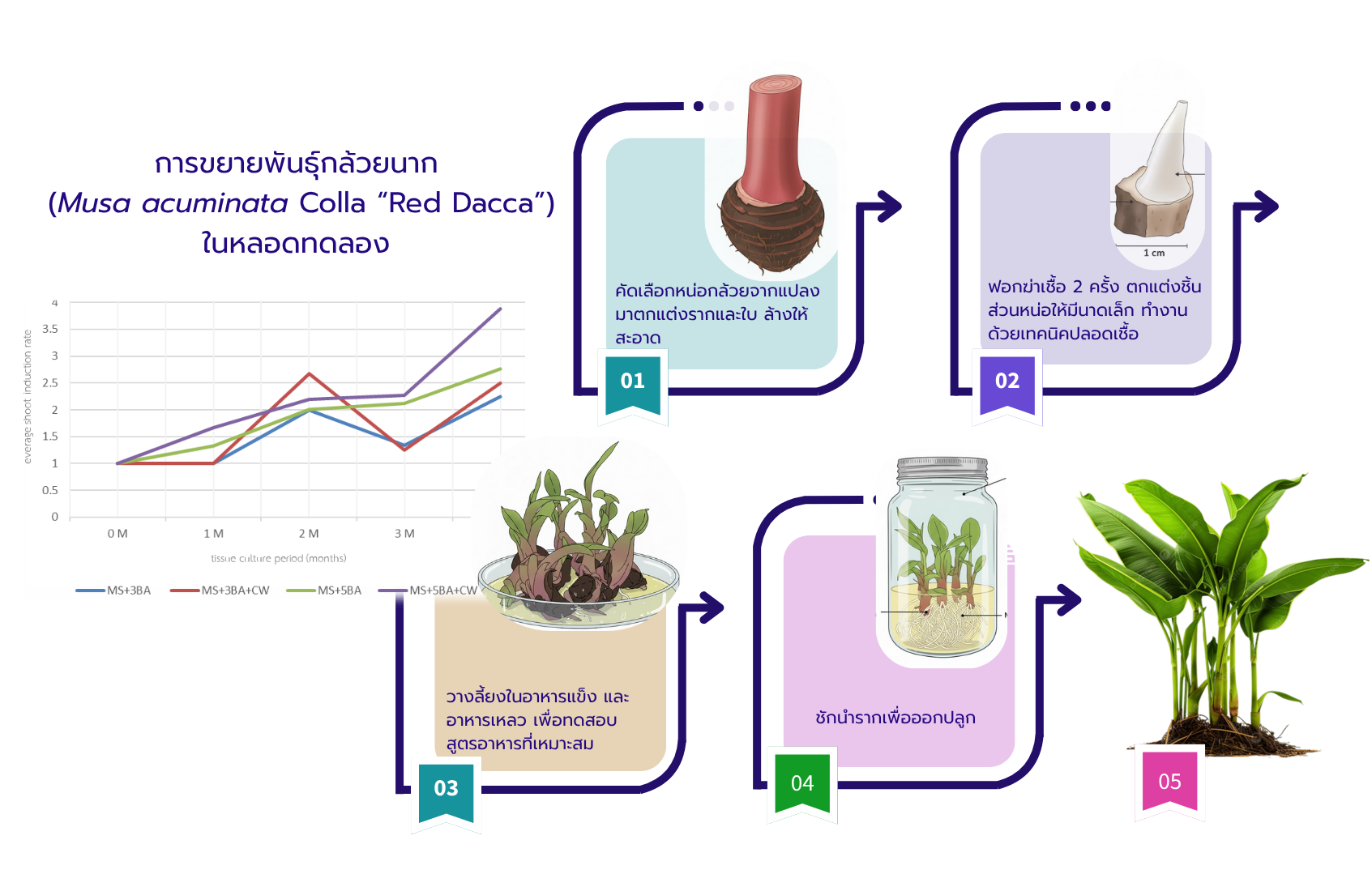
Banana NAK (Musa acuminata cv Red Dacca) is a rare and highly nutritious fruit. Conventional propagation through suckers is insufficient for large-scale commercial cultivation. This study focuses on an efficient method for in vitro propagation of this banana species. Trimmed suckers were sterilized with 25% and 10% Clorox for 35 and 15 minutes, respectively, and cultured on solid Murashige and Skoog (MS) medium supplemented with 3 and 5 mg/L of benzyladenine (BA), with or without 100 mL of coconut water, to induce shoot formation. After four months of culture, MS medium supplemented with 5 mg/L BA and 100 mL coconut water produced the highest shoot induction, averaging 31.7 shoots with a monthly shoot rate of 3.9, which was significantly different from the other treatments. For multiple shoot induction, 1/2MS liquid medium supplemented with 3 mg/L BA, coconut water and polyvinylpyrrolidone (PVP) achieved the highest shoot multiplication, 47.3 shoots per explant, which was not significantly different from the treatment containing 5 mg/L BA. When shoots were transferred to solid MS medium containing 1 mg/L IBA (Indole-3-butyric acid), 100% rooting was achieved. Furthermore, the plants acclimatized successfully with a survival rate of 100% upon transplantation. The result of this research indicate that in vitro propagation can effectively enhance the production of banana NAK, supporting its commercial cultivation.
Article Details

This work is licensed under a Creative Commons Attribution-NonCommercial-NoDerivatives 4.0 International License.
Authors retain the copyright of articles published in Wichcha Journal Nakhon Si Thammarat Rajabhat University. All published articles are distributed under the Creative Commons Attribution–NonCommercial–NoDerivatives License (CC BY-NC-ND 4.0) (https://creativecommons.org/licenses/by-nc-nd/4.0/). Under this license, readers are permitted to read, download, and share the articles for non-commercial purposes, provided that proper attribution to the original source is given and the content is not modified or altered. All contents of the articles, including text, tables, figures, equations, and other illustrations, are the sole responsibility of the authors. The views and opinions expressed in the articles do not necessarily reflect those of the editorial board or the publisher.
References
ชุติมา กาบแก้ว. (2565). การพัฒนาผลิตภัณฑ์พาสต้ากึ่งสำเร็จรูปจากแป้งกล้วยน้ำว้าพันธุ์ มะลิอ่อง. วารสารวิทยาศาสตร์วิศวกรรมศาสตร์และเทคโนโลยี, 2(2), 11-19.
นิดาพร สุธัญญรัตน์ สุพรรนี อะโอกิ และขวัญเดือน รัตนา. (2559). การเพาะเลี้ยงเนื้อเยื่อและการ วิเคราะห์ความคงตัวของระดับพลอยด์ดีของกล้วยน้ำว้ามะลิอ่อง. Journal of Food Health and Bioenvironmental Science, 9(3), 1-14.
ผกาพรรณ บุญเต็ม และจินตนา อาจสันเที๊ยะ. (2563). ประโยชน์ของกล้วยต่อสุขภาพ. APHEIT Journal of Nursing and Health, 2(1), 20-29.
รัตนา ขามฤทธิ์ และจิตรกร ปรีแม่น. (2562). การฟอกฆ่าเชื้อที่ผิวและการชักนำให้เกิดต้นจากไรโซมของไพลในหลอดทดลอง. แก่นเกษตร, 47(1), 1393-1398.
รุจิรา แสงแข. (2566). การศึกษาต้นทุนและผลตอบแทนจากการปลูกกล้วยหอมทองปลอดสารพิษ ในเขตพื้นที่อำเภอท่ายาง จังหวัดเพชรบุรี. วารสารลวะศรี, 7(1), 122-137.
อรพิน เสละคร สุดารัตน์ สุตพันธ์ คงเดช พะสีนาม และธันวมาส กาศสนุก. (2563). ความเข้มข้นของน้ำมะพร้าวที่เหมาะสมต่อการแตกยอดของกล้วยนากภายใต้สภาวะปลอดเชื้อ. วารสารวิทยาศาสตร์และเทคโนโลยี มรย., 5(1), 28-33.
Ahmed, S., Sharma, A., Bhushan, B., Wali, V.K., Bakshi, P. and Singh, A.K. (2014). Studies on hardening and acclimatization of micropropagated plantlets of banana cv. Grand Naine. The Bioscan, 9(3), 965-967.
Amente, G. and Chimdessa, E. (2021). Control of browning in plant tissue culture: A review. Journal of Scientific Agriculture, 5(1), 67-71, doi: https://doi.org/10.25081/jsa.2021.v5.7266.
Kumar, A., Kumari, P. and Shukla, L.N. (2012). In vitro rooting in the tissue culture raised plantlets of Malbhog cultivar of banana. Indian Journal of Innovations and Developments, 1(9), 665-668.
Lazim, M.I.M., Badruzaman, N.A., Peng, K.S. and Long, K. (2015). Quantification of cytokinins in coconut water from different maturation stages of Malaysia's coconut (Cocos nucifera L.) varieties. Journal of Food Processing and Technology, 6(11), doi: https://doi.org/10.4172/2157-7110.1000515.
Mardhikasari, S., Yunus, A. and Samanhudi, S. (2020). Modification of media for banana in vitro propagation with foliar fertilizer and coconut water in cv. Rajabulu. Caraka Tani: Journal of Sustainable Agriculture, 35(1), 23-32, doi: https://doi.org/10.20961/carakatani.v35i1.27756.
Muhammad, A., Rashid, H., Hussain, I. and Naqvi, S.M.S. (2007). Proliferation-rate effects of BAP and kinetin on banana (Musa spp. AAA Group) ‘Basrai’. HortScience, 42(5), 1253-1255, doi: https://doi.org/10.21273/HORTSCI.42.5.1253.
Murashige, T. and Skoog, F. (1962). A revised medium for rapid growth and bio assays with tobacco tissue cultures. Physiologia Plantarum, 15(3), 473-497, doi: https://doi.org/10.1111/j.1399-3054.1962.tb08052.x.
Permadi, N., Nurzaman, M., Alhasnawi, A.N., Doni, F. and Julaeha, E. (2023). Managing lethal browning and microbial contamination in Musa spp. tissue culture: Synthesis and perspectives. Horticulturae, 9(4), 453, doi: https://doi.org/10.3390/horticulturae9040453.
Prabhuling, G. and Sathyanarayana, B.N. (2017). Optimization of explants density for tissue culture propagation of banana cv. ‘GRANDE NAINE’. International Journal of Agricultural Sciences, 13(1), 71-76, doi: https://doi.org/10.15740/HAS/IJAS/13.1/71-76.
Red Banana Produce Market. (2023). Global red banana produce market research report-segmented by nature (organic and conventional); distribution channel (supermarket/hypermarkets, speciality stores, and online retail); and region-size, share, growth analysis | forecast (2023-2030). Retrieved 31 December 2024, from: https://virtuemarketresearch.com/report/red-banana-produce-market.
Sudheer, W.N., Praveen, N., Al-Khayri, J.M. and Jain, S.M. (2022). Role of plant tissue culture medium components. In Chandra Rai, A., Kumar, A., Modi, A., and Singh, M. (Eds.). Advances in plant tissue culture: Current developments and future trends, pp. 51-83. Massachusetts: Academic Press.
Suman, S. (2017). Plant tissue culture: A promising tool of quality material production with special reference to micropropagation of banana. Biochemical and Cellular Archives, 17(1), 1-26.
Swangpol, S.C., Viboonjun, U., Kongsawadworakul, P., Chuenwarin, P., Inta, W. and Traiperm, P. (2016). Taxonomic notes on ornamental bananas in Thailand. In International Symposium on Tropical and Subtropical Ornamentals 1167, (pp. 169-176). Leuven: International Society for Horticultural Science.
Taghizadeh, M. and Dastjerdi, M.G. (2020). Inhibition of browning problem during the callogenesis of Spartium junceum L. Ornamental Horticulture, 27, 68-77, doi: https://doi.org/10.1590/2447-536x.v27i1.2230.
Titov, S., Bhowmik, S.K., Mandal, A., Alam, S. and Uddin, S.N. (2006). Control of phenolic compound secretion and effect of growth regulators for organ formation from Musa spp. cv. Kanthali floral bud explants. American Journal of Biochemistry and Biotechnology, 2(3), 97-104, doi: https://doi.org/10.3844/ajbbsp.2006.97.104.
Zamarripa, M. (2019). 7 Red banana benefits (and how they differ from yellow ones). Retrieved 31 December 2024, from: https://www.healthline.com/nutrition/red-bananas.
