
Genetic Diversity of Cocoa Varieties in Nakhon Si Thammarat Province Assessed by AFLP Markers
Article Sidebar
Main Article Content
Abstract
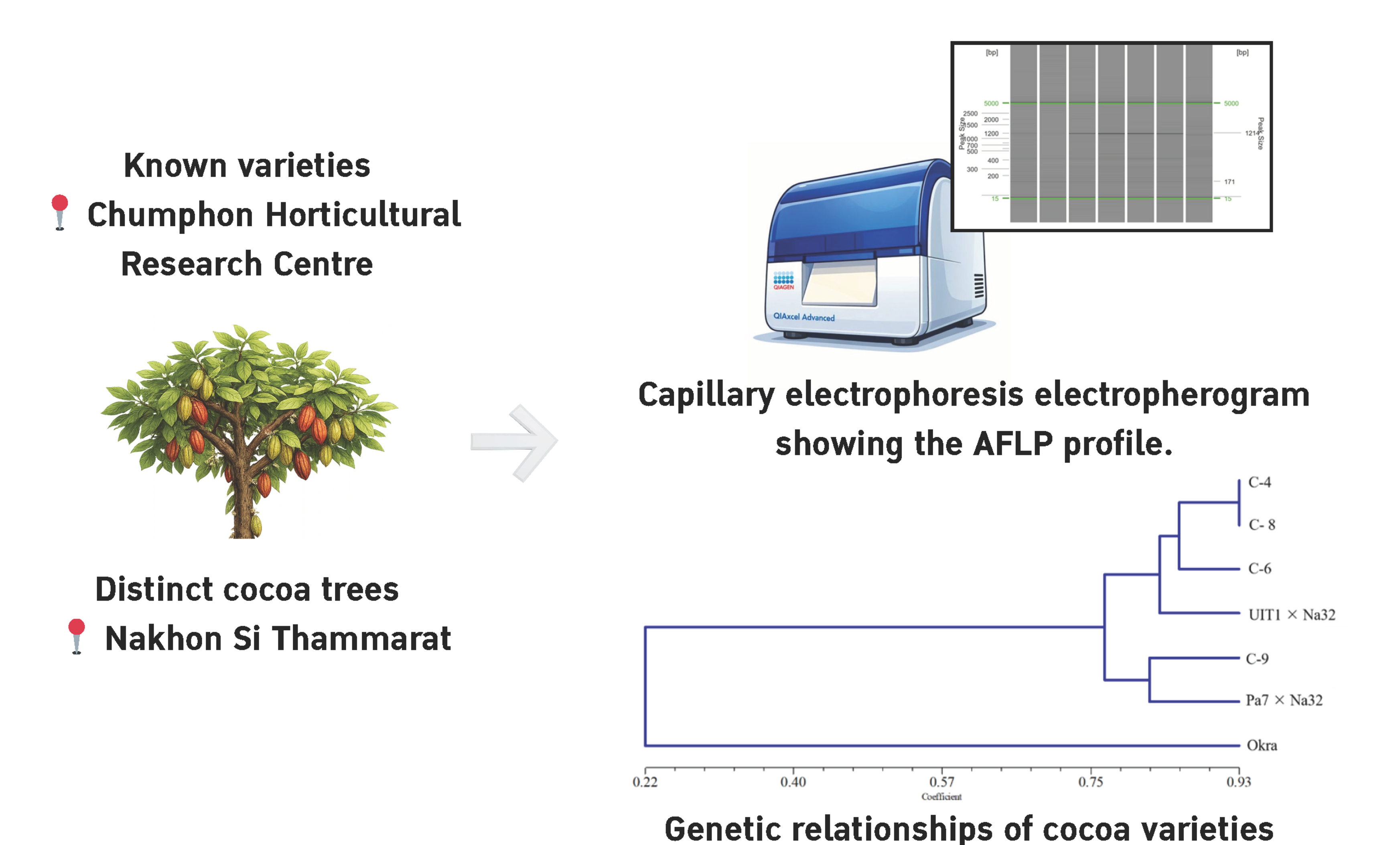
The genetic diversity of Theobroma cacao L. was investigated using amplified fragment length polymorphism (AFLP) markers. DNA was analyzed from six cocoa samples: two known varieties (Pa7 × Na32 and UIT1 × Na32) obtained from the Chumphon Horticultural Research Centre and four farmer-grown trees (C-4, C-6, C-8, and C-9) collected from Nakhon Si Thammarat Province. Three primer combinations (E-AAC/M-CTC, E-AAG/M-CTA, and E-AAC/M-CTA) yielded an average of 4.67 polymorphic bands per combination, with E-AAC/M-CTC producing the highest number of polymorphic bands (9). The mean polymorphism information content (PIC) value was 0.32, and E-AAG/M-CTA exhibited the highest PIC value (0.37), indicating that it was the most informative primer combination for genetic diversity assessment in this study. Cluster analysis using the unweighted pair group method with arithmetic mean (UPGMA) separated the samples into two major clusters, with the second cluster serving as an outgroup. Within Cluster I, two subclusters were identified, revealing close genetic relationships between farmer-grown trees and the known varieties. The findings provide useful information for identifying genetic origins of local cocoa and support appropriate selection for propagation and processing in Nakhon Si Thammarat Province.
Article Details

This work is licensed under a Creative Commons Attribution-NonCommercial-NoDerivatives 4.0 International License.
เนื้อหาและข้อมูลในบทความที่ลงตีพิมพ์ในวารสารวิชชา มหาวิทยาลัยราชภัฏนครศรีธรรมราช ถือเป็นข้อคิดเห็นและความรับผิดชอบของผู้เขียนบทความโดยตรง ซึ่งกองบรรณาธิการวารสารไม่จำเป็นต้องเห็นด้วยหรือร่วมรับผิดชอบใด ๆ
บทความ ข้อมูล เนื้อหา รูปภาพ ฯลฯ ที่ได้รับการตีพิมพ์ในวารสารวิชชา มหาวิทยาลัยราชภัฏนครศรีธรรมราช ถือเป็นลิขสิทธ์ของวารสารวิชชา มหาวิทยาลัยราชภัฏนครศรีธรรมราช หากบุคคลหรือหน่วยงานใดต้องการนำข้อมูลทั้งหมดหรือส่วนหนึ่งส่วนใดไปเผยแพร่ต่อหรือเพื่อการกระทำการใด ๆ จะต้องได้รับอนุญาตเป็นลายลักษณ์อักษรจากวารสารวิชชา มหาวิทยาลัยราชภัฏนครศรีธรรมราชก่อนเท่านั้น
The content and information in the article published in Wichcha journal Nakhon Si Thammarat Rajabhat University, It is the opinion and responsibility of the author of the article. The editorial journals do not need to agree. Or share any responsibility.
References
จุติพร อัศวโสวรรณ วีระเกียรติ ทรัพย์มี และจุฑามาศ ศุภพันธ์. (2568). การทดสอบคุณภาพผ้าสีธรรมชาติที่ย้อมด้วยสีผงจากเปลือกฝักโกโก้ (Theobroma cacao) โดยการใช้สารช่วยติดสี. วารสารวิชชา มหาวิทยาลัยราชภัฏนครศรีธรรมราช, 44(2), 30-43, doi: https://doi.org/10.65217/wichchajnstru.2025.v44i2.264813.
เทคโนโลยีชาวบ้าน. (2567). “โกโก้ไทย” ฝ่าวิกฤต…โอกาสทะยานสู่ตลาดโลก. สืบค้นเมื่อ 1 พฤษภาคม 2567, จาก: https://www.khaosod.co.th/technologychaoban/techno-news/article_ 276150.
สถาบันวิจัยพืชสวน กรมวิชาการเกษตร. (2564). การจัดการความรู้ เทคโนโลยีการผลิตโกโก้. นนทบุรี: การันตี.
Afoakwa, E.O. (2014). Cocoa production and processing technology. Boca Raton: CRC Press.
Doyle, J.J. and Doyle, J.L. (1987). A rapid DNA isolation procedure for small quantities of fresh leaf tissue. Phytochemical Bulletin, 19(1), 11-15.
El-Esawi, M.A., Germaine, K., Bourke, P. and Malone, R. (2016). AFLP analysis of genetic diversity and phylogenetic relationships of Brassica oleracea in Ireland. Comptes Rendus Biologies, 339(5-6), 163-170, doi: https://doi.org/10.1016/j.crvi.2016.03.002.
Google Maps. (2024). Thailand. Retrieved 11 November 2024, from: https://maps.app.goo.gl/zoxGyZw1EQTL6NpLA.
Korzun, V. (2002). Use of molecular markers in cereal breeding. Cellular and Molecular Biology Letters, 7(2B), 811-820.
Liu, K. and Muse, S.V. (2004). PowerMarker: An integrated analysis environment for genetic marker analysis. Bioinformatics, 21(9), 2128-2129, doi: https://doi.org/10.1093/bioinformatics/bti282.
Nurmansyah, Alghamdi, S.S., Migdadi, H.M., Khan, M.A. and Afzal, M. (2020). AFLP-based analysis of variation and population structure in mutagenesis induced faba bean. Diversity, 12(8), 303, doi: https://doi.org/10.3390/d12080303.
Paun, O. and Schönswetter, P. (2012). Amplified fragment length polymorphism (AFLP) - An invaluable fingerprinting technique for genomic, transcriptomic and epigenetic studies. Methods Molecular Biology, 862, 75-87, doi: https://doi.org/10.1007/978-1-61779-609-8_7.
Rohlf, F.J. (2000). NTSYS-pc V2.10e numerical taxonomy and multivariate analysis system. New York: Exeter Software.
Ronning, C.M., Schnell, R.J. and Kuhn, D.N. (1995). Inheritance of random amplified polymorphic DNA (RAPD) markers in Theobroma cacao L. Journal of the American Society for Horticultural Science, 120(4), 681-686 doi: https://doi.org/10.21273/JASHS.120.4.681.
Saunders, J.A., Hemeida, A.A. and Mischke, S. (2000). USDA DNA fingerprinting programme for identification of Theobroma cacao accessions. In Proceedings of the International Workshop on New Technologies and Cocoa Breeding (pp. 112-118). Sabah: Malaysian Cocoa Board.
Sneath, P.H.A. and Sokal, R.R. (1973). Numerical taxonomy: The principles and practice of numerical classification. San Francisco: W.H. Freeman and Company.
Syahri, Y.F., Rauf, M., Paembonan, S.A., Larekeng, S.H. and Cahyaningsih, Y.F. (2019). RAPD amplification on cocoa (Theobroma cacao L.) from East Kolaka, Southeast Sulawesi Province. IOP Conference Series: Earth and Environmental Science, 270, 012052, doi: https://doi.org/10.1088/1755-1315/270/1/012052.
Vos, P., Hogers, R., Bleeker, M., Reijans, M., van de Lee, T., Hornes, M., Friters, A., Pot, J., Peleman, J., Kuiper, M. and Zabeau, M. (1995). AFLP: A new technique for DNA fingerprinting. Nucleic Acids Research, 23(21), 4407-4414, doi: https://doi.org/10.1093/nar/23.21.4407.
