
ความหลากหลายทางพันธุกรรมของสายพันธุ์โกโก้ที่นำมาแปรรูปในจังหวัดนครศรีธรรมราช ด้วยเครื่องหมายเอเอฟแอลพี
Article Sidebar
Main Article Content
บทคัดย่อ
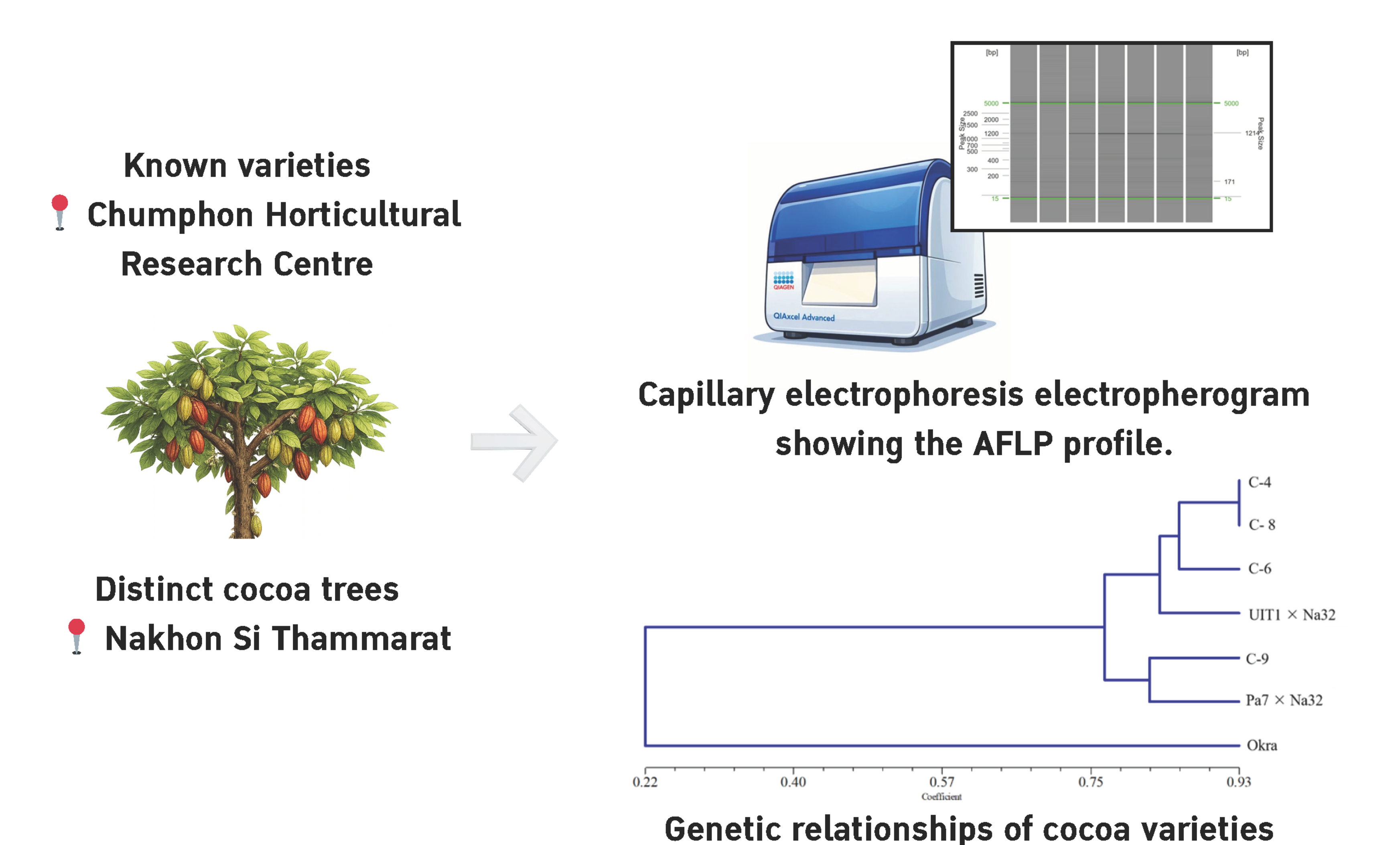
การตรวจสอบความหลากหลายทางพันธุกรรมของสายพันธุ์โกโก้ (Theobroma cacao L.) ด้วยเครื่องหมายเอเอฟแอลพี (amplified fragment length polymorphism: AFLP) ทำการวิเคราะห์ดีเอ็นเอจากตัวอย่างโกโก้จำนวน 6 ตัวอย่าง ได้แก่ พันธุ์ที่ทราบชื่อ 2 พันธุ์ คือ Pa7 × Na32 และ UIT1 × Na32 จากศูนย์วิจัยพืชสวนชุมพร และต้นโกโก้จากสวนเกษตรกรในจังหวัดนครศรีธรรมราชจำนวน 4 ต้น คือ C-4 C-6 C-8 และ C-9 โดยใช้คู่ไพรเมอร์เอเอฟแอลพีจำนวน 3 คู่ ได้แก่ E-AAC/M-CTC E-AAG/M-CTA และ E-AAC/M-CTA ผลการวิเคราะห์พบแถบดีเอ็นเอที่แตกต่างกัน (polymorphic bands) เฉลี่ย 4.67 แถบต่อคู่ไพรเมอร์ โดยคู่ไพรเมอร์ E-AAC/M-CTC ให้จำนวนแถบดีเอ็นเอที่แตกต่างกันสูงสุด 9 แถบ ค่าความแตกต่างของไพรเมอร์ในการจำแนก (polymorphism information content: PIC) เฉลี่ยเท่ากับ 0.32 และคู่ไพรเมอร์ E-AAG/M-CTA ให้ค่า PIC สูงสุดเท่ากับ 0.37 ซึ่งบ่งชี้ว่าเป็นคู่ไพรเมอร์ที่ให้ข้อมูลมากที่สุดในการประเมินความหลากหลายทางพันธุกรรมของโกโก้ในการศึกษานี้ เมื่อวิเคราะห์ความสัมพันธ์ทางพันธุกรรมด้วยการจัดกลุ่มโดยใช้วิธี unweighted pair group method with arithmetic mean (UPGMA) พบว่าสามารถจำแนกตัวอย่างโกโก้ออกเป็น 2 กลุ่มหลักอย่างชัดเจน โดยกลุ่มที่ 2 เป็นกลุ่มควบคุม (outgroup) และกลุ่มที่ 1 สามารถแบ่งออกเป็น 2 กลุ่มย่อยตามความใกล้ชิดทางพันธุกรรม แสดงให้เห็นความสัมพันธ์ระหว่างต้นโกโก้จากแปลงเกษตรกรกับพันธุ์ที่ทราบชื่อ ข้อมูลจากการศึกษานี้มีความสำคัญต่อการสนับสนุนข้อมูลพันธุกรรมเพื่อระบุแหล่งที่มาและสายพันธุ์ของโกโก้ในพื้นที่ ตลอดจนเป็นข้อมูลประกอบการคัดเลือกเพื่อการขยายพันธุ์และการแปรรูปโกโก้ในจังหวัดนครศรีธรรมราชอย่างเหมาะสม
Article Details

อนุญาตภายใต้เงื่อนไข Creative Commons Attribution-NonCommercial-NoDerivatives 4.0 International License.
เนื้อหาและข้อมูลในบทความที่ลงตีพิมพ์ในวารสารวิชชา มหาวิทยาลัยราชภัฏนครศรีธรรมราช ถือเป็นข้อคิดเห็นและความรับผิดชอบของผู้เขียนบทความโดยตรง ซึ่งกองบรรณาธิการวารสารไม่จำเป็นต้องเห็นด้วยหรือร่วมรับผิดชอบใด ๆ
บทความ ข้อมูล เนื้อหา รูปภาพ ฯลฯ ที่ได้รับการตีพิมพ์ในวารสารวิชชา มหาวิทยาลัยราชภัฏนครศรีธรรมราช ถือเป็นลิขสิทธ์ของวารสารวิชชา มหาวิทยาลัยราชภัฏนครศรีธรรมราช หากบุคคลหรือหน่วยงานใดต้องการนำข้อมูลทั้งหมดหรือส่วนหนึ่งส่วนใดไปเผยแพร่ต่อหรือเพื่อการกระทำการใด ๆ จะต้องได้รับอนุญาตเป็นลายลักษณ์อักษรจากวารสารวิชชา มหาวิทยาลัยราชภัฏนครศรีธรรมราชก่อนเท่านั้น
The content and information in the article published in Wichcha journal Nakhon Si Thammarat Rajabhat University, It is the opinion and responsibility of the author of the article. The editorial journals do not need to agree. Or share any responsibility.
เอกสารอ้างอิง
จุติพร อัศวโสวรรณ วีระเกียรติ ทรัพย์มี และจุฑามาศ ศุภพันธ์. (2568). การทดสอบคุณภาพผ้าสีธรรมชาติที่ย้อมด้วยสีผงจากเปลือกฝักโกโก้ (Theobroma cacao) โดยการใช้สารช่วยติดสี. วารสารวิชชา มหาวิทยาลัยราชภัฏนครศรีธรรมราช, 44(2), 30-43, doi: https://doi.org/10.65217/wichchajnstru.2025.v44i2.264813.
เทคโนโลยีชาวบ้าน. (2567). “โกโก้ไทย” ฝ่าวิกฤต…โอกาสทะยานสู่ตลาดโลก. สืบค้นเมื่อ 1 พฤษภาคม 2567, จาก: https://www.khaosod.co.th/technologychaoban/techno-news/article_ 276150.
สถาบันวิจัยพืชสวน กรมวิชาการเกษตร. (2564). การจัดการความรู้ เทคโนโลยีการผลิตโกโก้. นนทบุรี: การันตี.
Afoakwa, E.O. (2014). Cocoa production and processing technology. Boca Raton: CRC Press.
Doyle, J.J. and Doyle, J.L. (1987). A rapid DNA isolation procedure for small quantities of fresh leaf tissue. Phytochemical Bulletin, 19(1), 11-15.
El-Esawi, M.A., Germaine, K., Bourke, P. and Malone, R. (2016). AFLP analysis of genetic diversity and phylogenetic relationships of Brassica oleracea in Ireland. Comptes Rendus Biologies, 339(5-6), 163-170, doi: https://doi.org/10.1016/j.crvi.2016.03.002.
Google Maps. (2024). Thailand. Retrieved 11 November 2024, from: https://maps.app.goo.gl/zoxGyZw1EQTL6NpLA.
Korzun, V. (2002). Use of molecular markers in cereal breeding. Cellular and Molecular Biology Letters, 7(2B), 811-820.
Liu, K. and Muse, S.V. (2004). PowerMarker: An integrated analysis environment for genetic marker analysis. Bioinformatics, 21(9), 2128-2129, doi: https://doi.org/10.1093/bioinformatics/bti282.
Nurmansyah, Alghamdi, S.S., Migdadi, H.M., Khan, M.A. and Afzal, M. (2020). AFLP-based analysis of variation and population structure in mutagenesis induced faba bean. Diversity, 12(8), 303, doi: https://doi.org/10.3390/d12080303.
Paun, O. and Schönswetter, P. (2012). Amplified fragment length polymorphism (AFLP) - An invaluable fingerprinting technique for genomic, transcriptomic and epigenetic studies. Methods Molecular Biology, 862, 75-87, doi: https://doi.org/10.1007/978-1-61779-609-8_7.
Rohlf, F.J. (2000). NTSYS-pc V2.10e numerical taxonomy and multivariate analysis system. New York: Exeter Software.
Ronning, C.M., Schnell, R.J. and Kuhn, D.N. (1995). Inheritance of random amplified polymorphic DNA (RAPD) markers in Theobroma cacao L. Journal of the American Society for Horticultural Science, 120(4), 681-686 doi: https://doi.org/10.21273/JASHS.120.4.681.
Saunders, J.A., Hemeida, A.A. and Mischke, S. (2000). USDA DNA fingerprinting programme for identification of Theobroma cacao accessions. In Proceedings of the International Workshop on New Technologies and Cocoa Breeding (pp. 112-118). Sabah: Malaysian Cocoa Board.
Sneath, P.H.A. and Sokal, R.R. (1973). Numerical taxonomy: The principles and practice of numerical classification. San Francisco: W.H. Freeman and Company.
Syahri, Y.F., Rauf, M., Paembonan, S.A., Larekeng, S.H. and Cahyaningsih, Y.F. (2019). RAPD amplification on cocoa (Theobroma cacao L.) from East Kolaka, Southeast Sulawesi Province. IOP Conference Series: Earth and Environmental Science, 270, 012052, doi: https://doi.org/10.1088/1755-1315/270/1/012052.
Vos, P., Hogers, R., Bleeker, M., Reijans, M., van de Lee, T., Hornes, M., Friters, A., Pot, J., Peleman, J., Kuiper, M. and Zabeau, M. (1995). AFLP: A new technique for DNA fingerprinting. Nucleic Acids Research, 23(21), 4407-4414, doi: https://doi.org/10.1093/nar/23.21.4407.
