
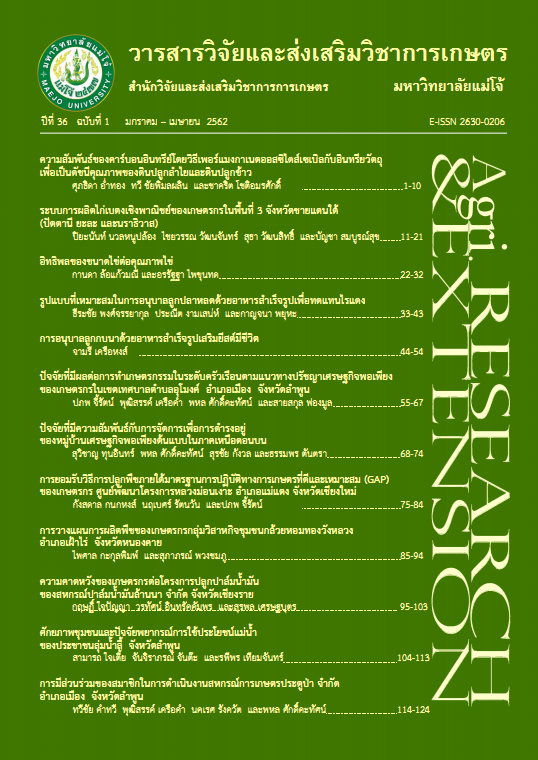
การอนุบาลลูกกบนาด้วยอาหารสำเร็จรูปเสริมยีสต์มีชีวิต
คำสำคัญ:
การอนุบาล, กบนา, ยีสต์มีชีวิตบทคัดย่อ
ศึกษาการอนุบาลลูกกบนาด้วยอาหารสำเร็จรูปเสริมยีสต์มีชีวิต วางแผนการทดลองแบบสุ่มตลอด(Completely randomized design) แบ่งการทดลองเป็น6 ชุดการทดลองๆ ละ 3 ซ้ำ แต่ละชุดการทดลองให้อาหารสำเร็จรูปผสมยีสต์ต่างกัน คือ ไม่ผสมยีสต์ และผสมยีสต์มีชีวิต1x10⁵, 1x10⁶ , 1x10⁷, 1x10⁸ และ 1x10⁹ เซลล์ต่อมิลลิลิตร ต่ออาหาร 1 กรัม พบว่าลูกอ๊อดกบนาที่เลี้ยงด้วยอาหารสำเร็จรูปผสมยีสต์ 1x10⁹ เซลล์ต่อมิลลิลิตร มีน้ำหนักเฉลี่ยสุดท้ายสูงที่สุดแตกต่างอย่างมีนัยสำคัญทางสถิติ (p<0.05) กับลูกกบนาที่เลี้ยงด้วยอาหารเสริมยีสต์ระดับอื่นๆ แต่ในขณะเดียวกันอาหารสำเร็จรูปผสมยีสต์ 1x10⁹ เซลล์ต่อมิลลิลิตร ทำให้อัตรารอดตายต่ำกว่าอย่างมีนัยสำคัญ ทางสถิติ (p<0.05) กับชุดควบคุม การเสริมยีสต์มีชีวิตเป็นการเพิ่มต้นทุน แต่ทำให้กำไรและผลตอบแทนการลงทุนลดต่ำลง จึงสรุปได้ว่าการเสริมยีสต์มีชีวิตในอาหารสำเร็จรูปไม่มีความเป็นไปได้ในเชิงเศรษฐกิจ แม้การใช้ปริมาณยีสต์ปริมาณมากที่สุดจะมีน้ำหนักสุดท้ายสูงกว่ากลุ่มอื่น
เอกสารอ้างอิง
APHA AWWA and WPCF. 1992. Standard Methods for the Examination of Water and Wastewater 18thed. Washington D.C.: American Public Health Association. 1360 p.
Department of Fisheries. 2015. Fisheries Statistics of Thailand 2013. Bangkok: Information and Communication Center, Department of Fisheries, Ministry of Agriculture and Cooperatives. 87 p. [in Thai]
Lawson, T.B. 1995. Fundamentals of Aquaculture Engineering. New York: Chapman & Hall. 355 p.
Oliva-Teles, A. and P. Goncalves. 2001. Partial replacement of fishmeal by brewer’s yeast Saccaromyces cerevisae in diets for sea bass Dicentrarchus labrax juveniles. Aquaculture 202: 269-278.
Rumsey, G.L., S.G. Hughes and J.L. Kinsella. 1990. Use of dietary yeast Saccharomyces cerevisiae nitrogen by lake trout. Aquaculture 21: 205-209.
Rumsey, G.L., J.E. Kinsella, K.J. Shetty and S.G Hughes. 1991. Effect of high dietary concentrations of brewer’s dried yeast on growth performance and liver uricase in rainbow trout. Animal Feed Science and Technology 33 :177-183.
Thaksin, Y. 2005. Cage Culture Frog (Rana rugulosa Wiegmann) Fed on Diets with Varying Levels of Top-dressed Fish Oil. 18 p. In Technical Paper No. 4/2005. Bangkok: Department of Fisheries, Ministry of Agriculture and Cooperatives. [in Thai]
Thaksin, Y. and P. Somsueb. 2005. Partial Replacement of Fish Meal by Corn in Raising Frogs (Rana rugulosa Wiegmann) in Cages. 24 p. In Technical Paper No. 5/2005. Bangkok: Department of Fisheries, Ministry of Agriculture and Cooperatives. [in Thai]
Tookwinas, S. 1985. Acute toxicity of nitrite and ammonia on some coastal organism larvae. pp. 190-195. In Proceeding of the Seminar on Fisheries 1985 16-18 September 1985. Bangkok: Department of Fisheries, Ministry of Agriculture and Cooperatives. [in Thai]
Uppanuncha, A., W. Khuncharoen, S. Sripat and P. Somsueb. 2008. Use of Brewers Yeast (Saccharomyces cerevisiae) for Increasing Feed Efficiency of Common Lowland Frog, Rana rugulosa Wiegmann, 1935. 24 p. In Technical Paper No. 12/2008. Bangkok: Department of Fisheries, Ministry of Agriculture and Cooperatives. [in Thai]
ดาวน์โหลด
เผยแพร่แล้ว
รูปแบบการอ้างอิง
ฉบับ
ประเภทบทความ
สัญญาอนุญาต
ลิขสิทธิ์ (c) 2019 วารสารวิจัยและส่งเสริมวิชาการเกษตร

อนุญาตภายใต้เงื่อนไข Creative Commons Attribution-NonCommercial-NoDerivatives 4.0 International License.
บทความนี้ได้รับการเผยแพร่ภายใต้สัญญาอนุญาต Creative Commons Attribution-NonCommercial-NoDerivatives 4.0 International (CC BY-NC-ND 4.0) ซึ่งอนุญาตให้ผู้อื่นสามารถแชร์บทความได้โดยให้เครดิตผู้เขียนและห้ามนำไปใช้เพื่อการค้าหรือดัดแปลง หากต้องการใช้งานซ้ำในลักษณะอื่น ๆ หรือการเผยแพร่ซ้ำ จำเป็นต้องได้รับอนุญาตจากวารสาร