
กิจกรรมต้านจุลินทรีย์ก่อโรคข้าวของ Bacillus velezensis และการสร้างสารลดแรงตึงผิวทางชีวภาพ
DOI:
https://doi.org/10.14456/jare-mju.2025.46คำสำคัญ:
จุลินทรีย์ก่อโรคข้าว, Bacillus velezensis, ฤทธิ์ต้านจุลินทรีย์, สารลดแรงตึงผิวทางชีวภาพบทคัดย่อ
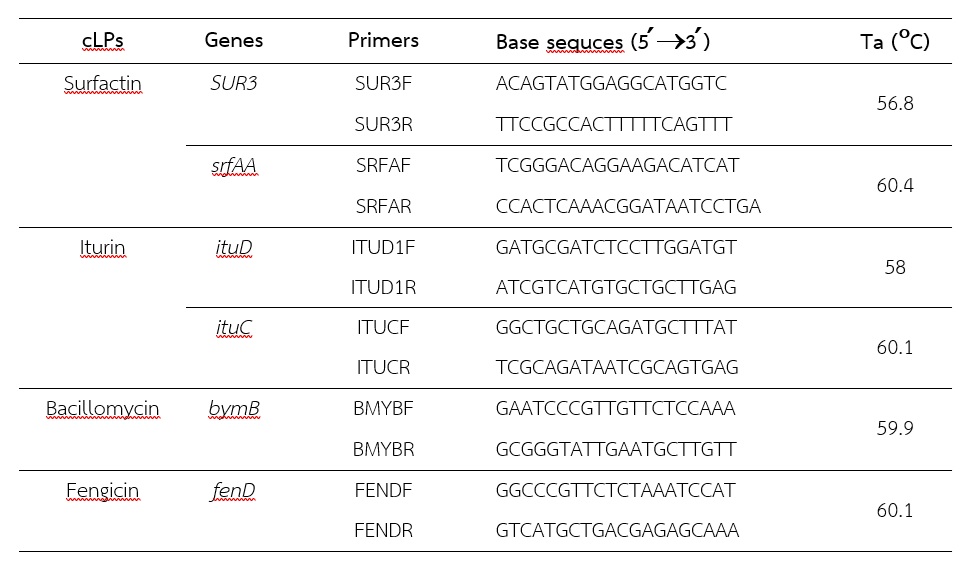
การศึกษานี้มีวัตถุประสงค์เพื่อศึกษาฤทธิ์ของ Bacillus velezensis ในการยับยั้ง Xanthomonas oryzae pv. oryzae เชื้อแบคทีเรียสาเหตุโรคขอบใบแห้ง และ Pyricularia oryzae เชื้อราสาเหตุโรคใบไหม้ ซึ่งเป็นจุลินทรีย์ก่อโรคที่สำคัญในข้าว และการผลิตสารลดแรงตึงผิวทางชีวภาพของ Bacillus velezensis โดย B. velezensis ทั้ง 7 ไอโซเลต ที่ทดสอบแสดงฤทธิ์ต้าน X. oryzae pv. oryzae และ P. oryzae เมื่อทดสอบโดยวิธี spot on lawn assay, agar well assay และ dual cultures การตรวจสอบความสามารถในการผลิตสาร ลดแรงตึงผิวชีวภาพ โดยใช้ความไม่ชอบน้ำของเซลล์ กิจกรรมการเกิดอิมัลชัน และยีนที่เกี่ยวข้องกับการสร้างสาร cyclic lipopeptides (cLPs) ผลการยึดเกาะของเซลล์แบคทีเรียกับเฮกซาเดเคน และการเกิดอิมัลชันของน้ำมันมะกอกยืนยันว่าแบคทีเรีย B. velezensis ทั้ง 7 ไอโซเลต สามารถผลิตสารลดแรงตึงผิวทางชีวภาพได้ นอกจากนี้ยังตรวจพบ PCR products ของยีนที่เกี่ยวข้องกับการสังเคราะห์ cLPs 6 ชนิด ซึ่งประกอบด้วย SUR3, srfA, ituD, ituC, fenD และ bmyB ที่ควบคุมการผลิตสารลดแรงตึงผิวทางชีวภาพที่ยับยั้งจุลินทรีย์ ได้แก่ surfactin, iturin, fengycin และ bacillomycin ในการทดสอบความปลอดภัยของ B. velezensis ใช้การทดสอบความไวต่อยาปฏิชีวนะ พบว่า B. velezensis ที่ใช้ในการศึกษาไวต่อยาปฏิชีวนะ penicillin, ciprofloxacin, tetracyclin, tigecyclin และvancomycin อีกทั้ง B. velezensis ยังไม่อยู่ในทะเบียนรายชื่อเชื้อก่อโรคในคนและสัตว์ ตามพระราชบัญญัติเชื้อโรคและพิษ จากสัตว์ พ.ศ. 2558 ผลการทดลองนี้สามารถบ่งชี้ว่า B. velezensis มีประโยชน์และปลอดภัยสำหรับเป็นสารควบคุมชีวภาพทางการเกษตร
เอกสารอ้างอิง
Agersø, Y., B. Stuer-Lauridsen, K. Bjerre, M.G. Jensen, E. Johansen, M. Bennedsen, E. Brockmann and B. Nielsen. 2018. Antimicrobial susceptibility testing and tentative epidemiological cutoff values for five Bacillus species relevant for use as animal feed additives or for plant protection. Applied and Environmental Microbiology 84(19): e01108–18. https://doi.org/10.1128/AEM.01108-18
Celandroni, F., S. Salvetti, S.A. Gueye, D. Mazzantini, A. Lupetti, S. Senesi and E. Ghelardi. 2016. Identification and pathogenic potential of clinical Bacillus and Paenibacillus isolates. PloS one 11(3): e0152831. https://doi.org/10.1371/journal.pone0152831
Chen, L., Y.D. Wu, X.Y. Chong, Q.H. Xin, D.X. Wang and K. Bian. 2020. Seed-borne endophytic Bacillus velezensis LHSB1 mediate the biocontrol of peanut stem rot caused by Sclerotium rolfsii. Journal of Applied Microbiology 128(3): 803–813. https://doi.org/10.1111/jam.14508
Division of Rice Research and Development. 2016. Rice Knowledge Bank: rice diseases and control. [Online]. Available http://www.ricethailand.go.th/rkb3/title-index.php-file=content.php&id= 112-1.htm (July 31, 2022). [in Thai]
Klayraung, S., S. Jariangprasert, P. Niamsup and N. Wongkattiya. 2017. Isolation and Screening for Biological Activities of Lichen- Associated Bacteria Collected from Agricultural Sites. 97 p. In Research Report. Chiang Mai: Maejo University. [in Thai]
Lim, S.M., M.Y. Yoon, G.J. Choi, Y.H. Choi, K.S. Jang, T.S. Shin and J.C. Kim. 2017. Diffusible and volatile antifungal compounds produced by an antagonistic Bacillus velezensis G341 against various phytopathogenic fungi. The Plant Pathology Journal 33(5): 488. https://doi.org/10.5423%2FPPJ.OA.04. 2017.0073
Luna, V.A., D.S. King, J. Gulledge, A.C. Cannons, P.T. Amuso and J. Cattani. 2007. Susceptibility of Bacillus anthracis, Bacillus cereus, Bacillus mycoides, Bacillus pseudomycoides and Bacillus thuringiensis to 24 antimicrobials using Sensititre® automated microbroth dilution and Etest® agar gradient diffusion methods. Journal of Antimicrobial Chemotherapy 60(3): 555–567. https://doi.org/10.1093/jac/dkm213
Mora, I., J. Cabrefiga and E. Montesinos. 2015. Cyclic lipopeptide biosynthetic genes and products, and inhibitory activity of plant-associated Bacillus against phytopathogenic bacteria. PLoS One 10(5): e0127738. https://doi.org/10.1371/journal.pone. 0127738
Mouafi, F.E., M.M.A. Elsoud and M.E. Moharam. 2016. Optimization of biosurfactant production by Bacillus brevis using response surface methodology. Biotechnology Reports 9: 31–37. https://doi.org/10.1016/j.btre.2015.12.003
Nanjundan, J., R. Ramasamy, S. Uthandi and M. Ponnusamy. 2019. Antimicrobial activity and spectroscopic characterization of surfactin class of lipopeptides from Bacillus amyloliquefaciens SR1. Microbial Pathogenesis 128: 374–380. https://doi.org/10.1016/j.micpath.2019.01.037
Niemhom, N., and C. Kittiwongwattana. 2023. Biocontrol potential, genome and nonribosomal peptide synthetase gene expression of Bacillus velezensis 2211. Current Applied Science and Technology 23(3): 1–17 https://doi.org/10.55003/cast.2022.03.23.005
Płaza, G., J. Chojniak, K. Rudnicka, K. Paraszkiewicz and P. Bernat. 2015. Detection of biosurfactants in Bacillus species: genes and products identification. Journal of Applied Microbiology 119(4): 1023–1034. https://doi.org/10.1111/jam.12893
Rabbee, M.F., M.S. Ali, J. Choi, B.S. Hwang, S.C. Jeong and K.H. Baek. 2019. Bacillus velezensis: a valuable member of bioactive molecules within plant microbiomes. Molecules 24(6): 1046. https://doi.org/10.3390/molecules24061046
Royal Thai Government Gazette. 2018. List of disease that wish to be controlled section18 [2018]. [Online]. Available https://ratchakitcha.soc.go.th/documents/17064620.pdf (July 31, 2022). [in Thai]
Shafi, J., H. Tian and M. Ji. 2017. Bacillus species as versatile weapons for plant pathogens: a review. Biotechnology & Biotechnological Equipment 31(3): 446–459. https://doi.org/10.1080/13102818. 2017.1286950
Syahriansyah, U.K.M. and A. Hamzah. 2016. Determination of optimum conditions and stability study of biosurfactant produced by Bacillus subtilis UKMP-4M5. Malaysian Journal of Analytic Science 20(5): 986–1000. http://dx.doi.org/10.17576/mjas-2016-2005-03
Weber, D.J., S.M. Saviteer, W.A. Rutala, C.A. Thomann. 1988. In vitro susceptibility of Bacillus spp. to selected antimicrobial agents. Antimicrob Agents Chemother 32(5): 642–645
Ye, M., X. Tang, R. Yang, H. Zhang, F. Li, F. Tao, L. Fei and Z. Wang. 2018. Characteristics and application of a novel species of Bacillus: Bacillus velezensis. ACS Chemical Biology 13(3): 500–505. https://pubs.acs.org/doi/10.1021/acschembio.7b00874
Yu, F., Y. Shen, Y. Qin, Y. Pang, H. Fan, J. Peng and X. Liu. 2022. Isolation and purification of antibacterial lipopeptides from Bacillus velezensis YA215 isolated from sea mangroves. Frontiers in Nutrition 9: 1064764. https://doi.org/10.3389/fnut.2022.1064764
Zhou, J., Y. Xie, Y. Liao, X. Li, Y. Li, S. Li and Y.Q. He. 2022. Characterization of a Bacillus velezensis strain isolated from Bolbostemmatis Rhizoma displaying strong antagonistic activities against a variety of rice pathogens. Frontiers in Microbiology 13: 983781. https://doi.org/10.3389/fmicb.2022.983781
ดาวน์โหลด
เผยแพร่แล้ว
รูปแบบการอ้างอิง
ฉบับ
ประเภทบทความ
สัญญาอนุญาต
ลิขสิทธิ์ (c) 2025 วารสารวิจัยและส่งเสริมวิชาการเกษตร

อนุญาตภายใต้เงื่อนไข Creative Commons Attribution-NonCommercial-NoDerivatives 4.0 International License.
บทความนี้ได้รับการเผยแพร่ภายใต้สัญญาอนุญาต Creative Commons Attribution-NonCommercial-NoDerivatives 4.0 International (CC BY-NC-ND 4.0) ซึ่งอนุญาตให้ผู้อื่นสามารถแชร์บทความได้โดยให้เครดิตผู้เขียนและห้ามนำไปใช้เพื่อการค้าหรือดัดแปลง หากต้องการใช้งานซ้ำในลักษณะอื่น ๆ หรือการเผยแพร่ซ้ำ จำเป็นต้องได้รับอนุญาตจากวารสาร