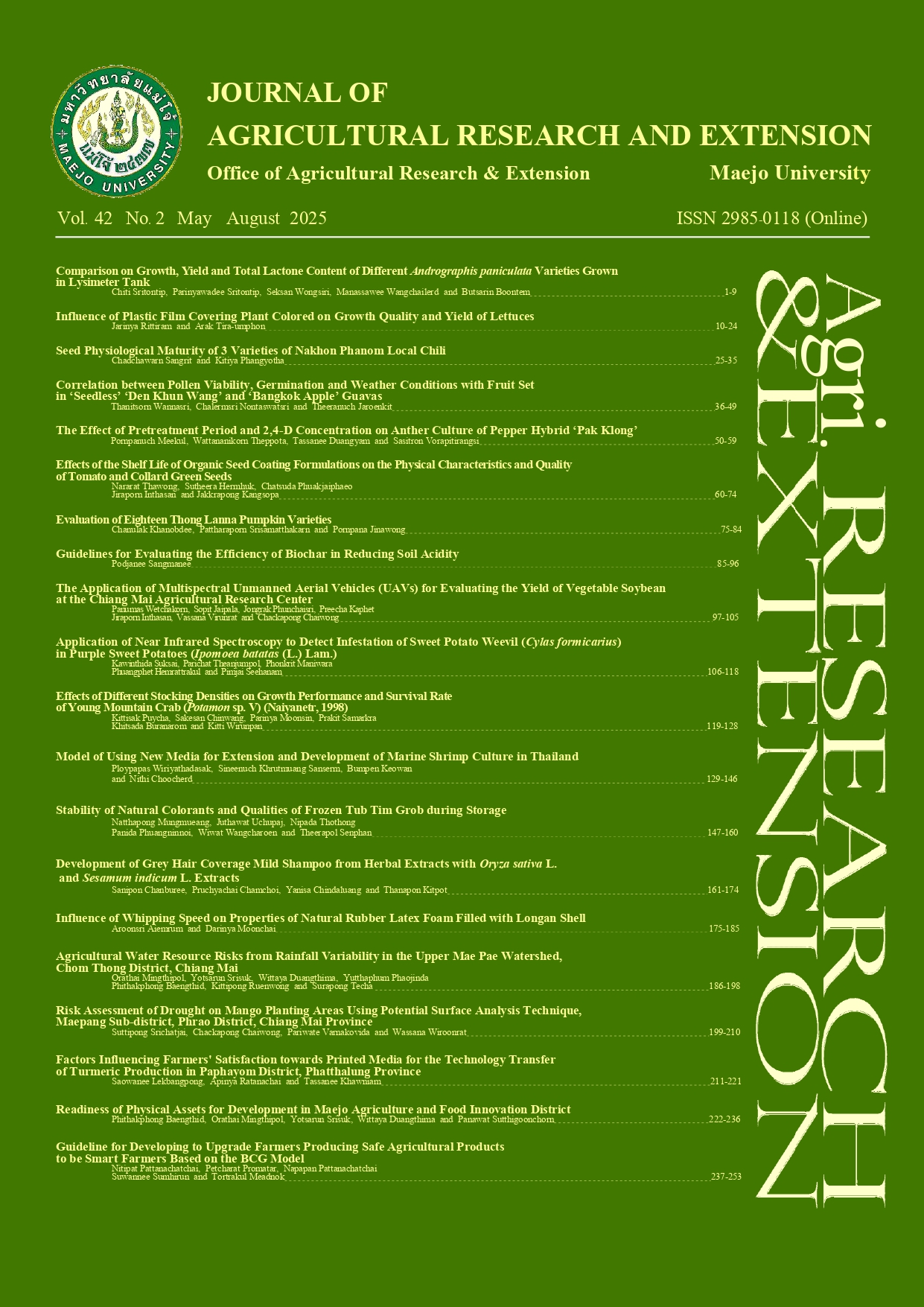
แนวทางการประเมินประสิทธิภาพการใช้ถ่านชีวภาพเพื่อลดความเป็นกรดของดิน
DOI:
https://doi.org/10.14456/jare-mju.2025.28คำสำคัญ:
ดินกรด , ถ่านชีวภาพ , อัตราแม่นยำ , การเจริญเติบโตบทคัดย่อ
ถ่านชีวภาพที่ทำจากวัสดุทางการเกษตรและอุตสาหกรรมเกษตรหลายชนิดควรมีวิธีการประมาณอัตราที่ใช้เพื่อเป็นแนวทางสำหรับเกษตรกร ดังนั้น ในการศึกษานี้จึงมีวัตถุประสงค์เพื่อหาอัตราการใส่ถ่านชีวภาพที่เหมาะสมและประเมินศักยภาพของการใช้ถ่านชีวภาพจากการเจริญเติบโตของพืชในระยะเริ่มต้น โดยแบ่งเป็น 3 ขั้นตอน คือ (1) การหาอัตราที่เหมาะสมของถ่านชีวภาพก่อนคัดเลือกมาทดลองกับการปลูกพืชในกระถาง (2) คุณสมบัติทางเคมีและกายภาพของถ่านชีวภาพ และ (3) ประเมินการตอบสนองของพืช การศึกษาแรกเป็นการบ่มดินกรดที่ทราบอัตราความต้องการปูน (LR) ร่วมกับถ่านชีวภาพที่เตรียมจากก้อนเชื้อเห็ดเก่า (Spent Mushroom Substrate: SMS) และกะลามะพร้าว (Coconut Shell: CS) ที่ผสมกับปูนขาว (Slaked Lime: L) ประกอบด้วย 5 กรรมวิธี ได้แก่ ควบคุม SMS 0.5LR, SMS 0.75LR, CS:L (3:1) LR และ CS:L (1:1) LR วางแผนการทดลองแบบสุ่มสมบูรณ์ จำนวน 3 ซ้ำ ผลการศึกษาพบว่า กรรมวิธี SMS 0.5LR และ CS:L (1:3) LR เป็นกรรมวิธีที่ทำให้ค่า pH เพิ่มขึ้นไม่เกิน 7.5 จึงคัดเลือกกรรมวิธีดังกล่าว ขั้นตอนต่อมาวางแผนการทดลองแบบสุ่มสมบูรณ์ มี 4 กรรมวิธี จำนวน 6 ซ้ำ ดังนี้ ควบคุม ปูนขาวอัตรา LR, SMS 0.5LR, และ CS:L (1:3) LR และใส่ปุ๋ยเคมีตามอัตราแนะนำ โดยพิจารณาการตอบสนองของข้าวโพดฝักอ่อน (Zea mays L.) ด้านการเจริญเติบโต ความเขียวของใบ อาการขาดธาตุอาหารพืช การศึกษาพบว่า การใช้ถ่านชีวภาพทั้งสองชนิดทำให้การเจริญเติบโตของข้าวโพดฝักอ่อน ไม่แตกต่างจากการใช้ปูนขาว
เอกสารอ้างอิง
Abeba, K.S., G.T. Abera and K. Chimdessa. 2024. Examining the effect of combined biochar and lime rates on selected soil physicochemical properties of acid soils in Gimbi district, Western Ethiopia. Applied and Environment Soil Science 4440448. https://doi.org/10.1155/2024/4440448
Adekiya, A.O., B.B. Ayorinde and T. Ogunbode. 2024. Combined lime and biochar application enhances cowpea growth and yield in tropical Alfisol. Scientific Reports. 14(1): 1389. https://doi.org/10.1038/s41598-024-52102-7
ASTM International. 2009. ASTM D2867-09: Standard Test Method for Total Ash Content of Activated Carbon. Annual Book of ASTM Standards. West Conshohocken: ASTM International. 4 p.
ASTM International. 2017. ASTM D2867-17: Standard Test Methods for Moisture in Activated Carbon. Annual Book of ASTM Standards. West Conshohocken: ASTM International. 3 p.
Bolan, N., A.K. Sarmah, S. Bordoloi, S. Bolan, L. Padhye, L. Van Zwieten, P. Sooriyakumar, B.A. Khan, M. Ahmad, Z. Solaiman, J. Rinklebe, H. Wang, B.P. Singh and K.H.M. Siddique. 2023. Soil acidification and the liming potential of biochar. Environmental Pollution 317: 120632. https://doi.org/10.1016/j.envpol.2022.120632
Castilla-Caballero D., J. Barraza-Burgos, S. Gunasekaran, A. Roa-Espinosa, J. Colina- Márquez, F. Machuca-Martínez, A. Hernández-Ramírez and S. Vázquez-Rodríguez. 2020. Experimental data on the production and characterization of biochars derived from coconut-shell wastes obtained from the Colombian Pacific Coast at low temperature pyrolysis. Data in Brief 28: 104855. https://doi.org/10.1016/j.dib.2019.104855
Department of Agriculture. 2005. Fertilizer recommendation for economic crops: Academic document no. 8/2005. [Online]. Available https://ebook.lib.ku.ac.th/ebook27/ebook/2011-004-0028/ (December 31, 2024). [in Thai]
Dharmakeerthi, R.S., J.A.S. Chandrasiri and V.U. Edirimanne. 2012. Effect of rubber wood biochar on nutrition and growth of nursery plants of Hevea brasiliensis established in an Ultisol. SpringerPlus 1: 84. https://doi.org/10.1186/2193-1801-1-84
Giovannetti, M., A., Salviolo di Fossalunga, I.A. Stringlis, S. Proietti and V. Fiorillo. 2023. Unearthing soil-plant-mocrobiota crosstalk: looking back to move forward. Frontiers in Plant Science 13: 1082752. https://doi.org/10.3389/fpls.2022.1082752
Godlewska, P., S.O. Yong and P. Oleszczuk. 2021. The dark of black gold: ecotoxicological aspects of biochar and biochar-amended soils. Journal of Hazardous Materials 403: 123833. https://doi.org/10.1016/j.jhazmat.2020.123833
Kissel, D.E., R.A. Isaac, R. Hitchcock, L.S. Sonon and P.F. Vendrell. 2007. Implementation of soil lime requirement by single-addition titration method. Communication in Soil Science and Plant Analysis 38: 1341–1352. https://doi.org/10.1080/00103620701328735
Kissel, D.E., L. Sonon and M. Cabrela. 2012. Rapid measurement of soil pH buffering capacity. Soil Science Society of America Journal 76: 694-699. https://doi.org/10.2136/sssaj2011.0091
Land Development Department. 2015. State of soil and land resources of Thailand. [Online]. Available https://e-library.ldd.go.th/library/flip/bib9456f/bib9456f. html (December 31, 2024). [in Thai]
Liu, M., D.E. Kissel, M.L. Cabrera and P.F. Vendrell. 2005. Soil lime requirement by direct titration with single addition of calcium hydroxide. Soil Science Society of America Journal 69: 522–530. https://doi.org/10.2136/sssaj2005.0522
Shaaban, A., S.M. Se, N.M.M. Mitan and M.F. Dimin. 2013. Characterization of biochar derived from rubber wood sawdust through slow pyrolysis on surface porosities and functional groups. Procedia Engineering 68: 365–371. https://doi.org/10.1016/j.proeng.2013.12.193
Sims, J.T. 1996. Lime Requirement. pp. 491–515. In Sparks, D.L. (ed.). Methods of Soil Analysis, Part 3 Chemical Methods. Madison, Wisconsin: Soil Science Society of America. Inc.
Singh, B., M.M. Dolk, Q. Shen and M. Camp-Arbestain. 2017. Biochar pH, Electrical Conductivity and Liming Potential. pp. 23–38. In Singh, B. (ed.). Biochar: A Guide to Analytical Methods. Clayton South, Victoria: CSIRO Publishing.
Suriyawong, P., S. Chuetor, H. Samae, S. Piriyakarnsakul, M. Amin, M. Furuuchi, M. Hata, M. Inerb and W. Phairuang. 2023. Airborne particulate matter from biomass burning in Thailand: recent issues, challenges, and options. Heliyon 9(3): e14261. https://doi.org/10.1016/j.heliyon.2023.e14261
Thompson, J., D. Kissel, M. Cabrera and L. Sonon. 2010. Equilibration reaction from single addition of base to determine soil lime requirement. Soil Science Society of America Journal 74: 663–669. https://doi.org/10.2136/sssaj2009.0168
Tusar, H.M., M.K. Udding, S. Mia, A.A. Suhu, S.B.A. Alam, S. Kaaim, N.A. Sairi, Z. Alam and F. Anwar. 2023. Biochar-acid soil interactions-a review. Sustainability 15: 13366. https://doi.org/10.3390/su151813366.
ดาวน์โหลด
เผยแพร่แล้ว
รูปแบบการอ้างอิง
ฉบับ
ประเภทบทความ
สัญญาอนุญาต
ลิขสิทธิ์ (c) 2025 วารสารวิจัยและส่งเสริมวิชาการเกษตร

อนุญาตภายใต้เงื่อนไข Creative Commons Attribution-NonCommercial-NoDerivatives 4.0 International License.
บทความนี้ได้รับการเผยแพร่ภายใต้สัญญาอนุญาต Creative Commons Attribution-NonCommercial-NoDerivatives 4.0 International (CC BY-NC-ND 4.0) ซึ่งอนุญาตให้ผู้อื่นสามารถแชร์บทความได้โดยให้เครดิตผู้เขียนและห้ามนำไปใช้เพื่อการค้าหรือดัดแปลง หากต้องการใช้งานซ้ำในลักษณะอื่น ๆ หรือการเผยแพร่ซ้ำ จำเป็นต้องได้รับอนุญาตจากวารสาร