
ผลของกระบวนการอบแห้งต่อคุณภาพ และคุณค่าทางโภชนาการ ของผงปลาปรุงรสจากเศษเนื้อปลาแซลมอนจากโรงงานอุตสาหกรรม
DOI:
https://doi.org/10.14456/jare-mju.2025.52คำสำคัญ:
ผลพลอยได้จากอุตสาหกรรมอาหาร , ปลาแซลมอน, ผงปลาปรุงรส , การอบแห้งบทคัดย่อ
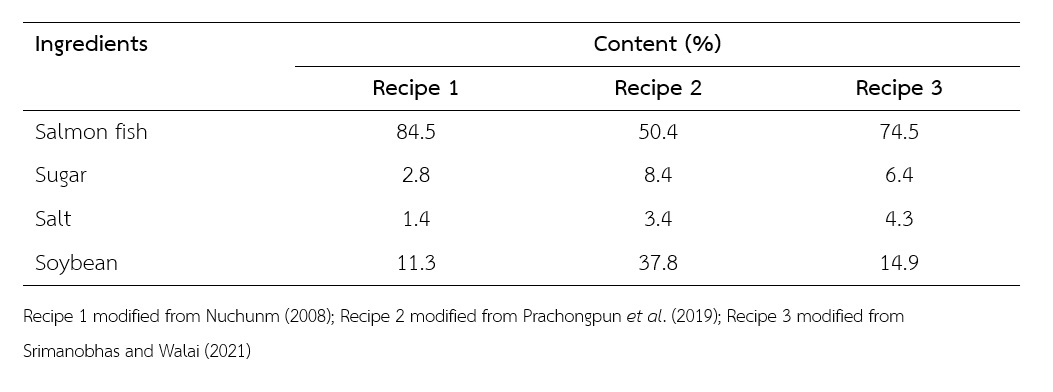
การวิจัยครั้งนี้มีวัตถุประสงค์เพื่อศึกษาระยะเวลา ที่เหมาะสมในการอบแห้ง คุณลักษณะทางกายภาพ-เคมี คุณค่าทางโภชนาการ และคุณลักษณะทางประสาทสัมผัสของผลิตภัณฑ์ผงปลาปรุงรสจากเศษเนื้อปลาแซลมอน จากโรงงานอุตสาหกรรม โดยทำการศึกษาผลิตภัณฑ์ผงปลาปรุงรสจำนวน 3 สูตร โดยให้คะแนนแบบ 9 Point Hedonic Scale พบว่าสูตรที่ 2 (เนื้อปลาแซลมอนร้อยละ 50.4 น้ำตาลทรายร้อยละ 8.4 เกลือสมุทรร้อยละ 3.4 และซอสถั่วเหลืองร้อยละ 37.8) ได้รับคะแนนการยอมรับทางประสาทสัมผัสสูงที่สุดทุกคุณลักษณะ (p≤0.05) มีค่าสี (L* a* b*) เท่ากับ 73.74, 10.12 และ 24.06 ตามลำดับ ค่าความเป็นกรด-ด่าง (pH) เท่ากับ 5.60 ปริมาณน้ำอิสระ (aw) เท่ากับ 0.46 และค่าความชื้น เท่ากับ 9.45 จึงนำสูตรที่ 2 มาศึกษาระยะเวลาในการอบแห้ง 4 ระดับ คือ 9, 10, 11 และ12 ชั่วโมง ที่อุณหภูมิ 70 องศาเซลเซียส ผลการศึกษาการยอมรับทางประสาทสัมผัสพบว่า การอบแห้งที่ระยะเวลา 12 ชั่วโมง ได้รับคะแนนความชอบสูงที่สุด (p≤0.05) ปริมาณความชื้นของผลิตภัณฑ์ในระยะเวลาการอบ 9, 10, 11 และ 12 ชั่วโมง อยู่ระหว่างร้อยละ 4.99–9.15 และมีปริมาณน้ำอิสระอยู่ระหว่าง 0.27–0.40 มีความเป็นกรด-ด่าง (pH) เท่ากับ 7.52–8.04 แสดงให้เห็นว่าผลของอุณหภูมิที่ใช้ ในการอบแห้งมีผลต่อคุณลักษณะทางกายภาพและความชอบของผู้บริโภค นอกจากนั้นเมื่อนำผลิตภัณฑ์ที่อบแห้งที่ระยะเวลา 12 ชั่วโมง ไปวิเคราะห์คุณค่าทางโภชนาการ พบว่าผลิตภัณฑ์ผงปลาแซลมอนปรุงรสที่ 100 กรัม มีพลังงาน 403.87 กิโลแคลอรี โปรตีนร้อยละ 62.65 ไขมันร้อยละ 10.51 เถ้าร้อยละ 7.18 คาร์โบไฮเดรตร้อยละ 14.67 ปริมาณน้ำตาลเท่ากับ 10.09 กรัม แร่ธาตุ ได้แก่ โซเดียม 2,832 มก. และแคลเซียม 55.42 มก.
เอกสารอ้างอิง
Association of Official Analytical Chemists. 2019. Official Methods of Analysis of the Association of the Official Analysis Chemists. 21sted. Maryland: AOAC International. 771 p.
Cheunbarn, T. and S. Cheunbarn. 2024. Efficiency and satisfaction of small household compost bin for organic and food waste. Journal of Agri. Research & Extension 41(2): 185–198. [in Thai]
Food and Drug Administration. 2018. Notification of Ministry of Public Health (No. 392) B.E. 2561 (2018) Issued by Virtue of the Food Act B.E. 2522 Re: Nutrition Labelling (No.3). [Online]. Available https://food.fda.moph.go.th/media.php?id=509409180571017216&name=No. 392.pdf (January 16, 2025).
Mahae, N., D. Pichairat and N. Khachenpukd. 2021. Product development of rice seasoning (Furikake) from crispy friedseabass (Lates calcarifer) skin. KKU Science Journal 49(1): 30–39. [in Thai]
Morida, K. and M. Khamwachiraphitak. 2023. Development of rice seasoning (FURIKAKE): Mala flavored supplemented with dried fish. VRU Research and Development Journal Science and Technology 18(1): 101–113. [in Thai]
Mouritsen, G.O. and L.L.P. Jose. 2018. World cuisine of seaweeds: science meets gastronomy. International Journal of Gastronomy and Food Science 14: 55–65.
Nuchunm, R. 2008. Development of Rice Seasoning (Furikake) from Sepat-Siam (Trichogaster pectoralis). Master Thesis. Silpakorn University. 182 p. [in Thai]
Postharvest Technology Innovation Center. 2003. Water activity with shelf-life control of food products. [Online]. Available https://www.phtnet.org/2003/09/26/ (January 14, 2025).
Prachongpun, P., A. Jamphon, T. Muangtuek and S.R. Kim. 2019. Nutritional Value and Some Characteristics of Commercial Furikake Containing Fish Meat. pp. 367–375. In Proceedings of 57th Kasetsart University Annual Conference: Plants, Animals, Veterinary Medicine, Agricultural Extension and Home Economics. Bangkok: Kasetsart University. [in Thai]
Prachongpun, P., L. Pankaew and R. Chunhom. 2023. Production calcium-supplemened snack from salmon fishbone power through extrusion process. VRU Research and Development Journal Science and Technology 18(3): 185–197. [in Thai]
Rahman, M.S. 2007. Handbook of Food Preservation. 2nd edition. Florida: CRC Press Taylor & Francis group. 1068 p.
Ruechakul, W., N. Pansawat and J. Maneerote. 2014. Effect of Rice Bran Oil, Baking Temperature and Time on the Quality of Salmon Crackers from Salmon Trimming. pp. 98–105. In Proceedings of 52nd Kasetsart University Annual Conference: Fisheries, Agricultural Extension and Home Economics. Bangkok: Kasetsart University. [in Thai]
Shafiur Rahman, M. 1999. pH in Food Preservation. pp. 383–396. In Shafiur Rahman, M. (ed.) Handbook of Food Preservation. New York: Marcel Dekker Inc.
Siwawej, S. 2003. Study of Acute and Shorterm Toxicity Test of Liquid Smoke from Bagasse in Wistar Rats. Nakhon Pathom: National Agricultural Extension and Training Center (NAETC). 380 p.
Srimanobhas, K. and W. Kleechaya. 2021. Value-Creation Products from Plasom Pla-nil (Fermented tilapia). 77 p. In Technical Paper No. 2. Bangkok: Ministry of Agriculture and Cooperatives. [in Thai]
Thai Industrial Standards Institute, Ministry of Industry. 1987. Fish Floss, Fish Flake and Dried Ground Fish: Thai Industrial Standard TIS 700-1987. Bangkok: Thai Industrial Standards Institute, Ministry of Industry. 15 p. [in Thai]
Thai Industrial Standards Institute, Ministry of Industry. 2023. Thai Community Product Standard: Rice Seasoning from Fish TCPS 1605/2022. Bangkok: Thai Industrial Standards Institute, Ministry of Industry. 12 p. [in Thai]
United Nations Environment Programme (UNEP). 2021. UNEP food waste index report 2021. [Online]. Available https://wedocs.unep.org/handle/20.500.11822/35280;jsessionid=B711DBAF2A01BD795E689595F65C04CF (August 1, 2022).
Yodjam, S. 2014. Effect of Crude Oil Supplement on Growth, Content of Omega 3 Fatty Acid in Fillet and Oxidative Defense of Buk Siam Catfish. Master Thesis. Maejo University. 77 p. [in Thai]
ดาวน์โหลด
เผยแพร่แล้ว
รูปแบบการอ้างอิง
ฉบับ
ประเภทบทความ
สัญญาอนุญาต
ลิขสิทธิ์ (c) 2025 วารสารวิจัยและส่งเสริมวิชาการเกษตร

อนุญาตภายใต้เงื่อนไข Creative Commons Attribution-NonCommercial-NoDerivatives 4.0 International License.
บทความนี้ได้รับการเผยแพร่ภายใต้สัญญาอนุญาต Creative Commons Attribution-NonCommercial-NoDerivatives 4.0 International (CC BY-NC-ND 4.0) ซึ่งอนุญาตให้ผู้อื่นสามารถแชร์บทความได้โดยให้เครดิตผู้เขียนและห้ามนำไปใช้เพื่อการค้าหรือดัดแปลง หากต้องการใช้งานซ้ำในลักษณะอื่น ๆ หรือการเผยแพร่ซ้ำ จำเป็นต้องได้รับอนุญาตจากวารสาร