
Effect of Drying Process on the Quality and Nutritional Value of Seasoning Powder from Salmon By-Products in Industrial
DOI:
https://doi.org/10.14456/jare-mju.2025.52Keywords:
food industrial by-products, salmon, seasoning fish powder, dryingAbstract
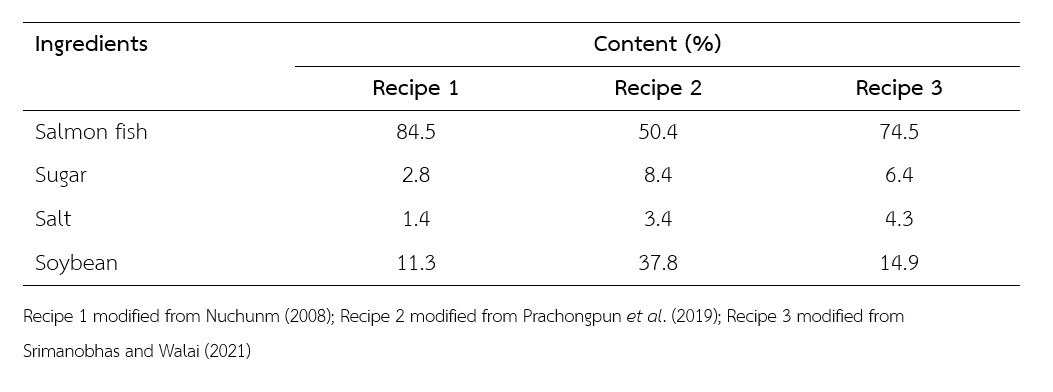
This research aimed to develop a seasoned fish powder product from factory leftover of salmon meat by studying the drying time, physical, chemical characteristics nutritional value and acceptance. Three recipes of seasoned fish powder were studied using a 9-point hedonic scale. It was found that formula 2 (50.4% salmon, 8.4% sugar, 3.4% sea salt, and 37.8% soy sauce) received the highest sensory acceptability scores in all characteristics (p≤0.05). The color values (L* a* b*) were 73.74, 10.12, and 24.06, respectively. The pH was 5.60, the water activity content (aw) was 0.46 and the moisture content was 9.45%. Formula 2 was then tested under four drying times of 9, 10, 11, and 12 hours at 70°C and the sensory acceptance results showed that the sample dried for 12 hours received the highest liking score (p≤0.05). The moisture content of seasoned salmon powder at drying times of 9, 10, 11 and 12 hours was between 4.99–9.15% and the free water content was between 0.27–0.40 and the pH was between 7.52–8.04 indicating that drying temperature affects physical and chemical characteristics and consumer preference. In addition, when the seasoned salmon powder that was dried for 12 hours was analyzed for nutritional value, it was found that 100 grams of seasoned salmon powder contained 403.87 kilocalories of energy, 62.65% protein, 10.51% fat, 7.18% ash, 14.67% carbohydrates, 10.09 grams of sugar, 4.99% of moisture, and minerals including 2,832 milligrams of sodium and 55.42 milligrams of calcium.
References
Association of Official Analytical Chemists. 2019. Official Methods of Analysis of the Association of the Official Analysis Chemists. 21sted. Maryland: AOAC International. 771 p.
Cheunbarn, T. and S. Cheunbarn. 2024. Efficiency and satisfaction of small household compost bin for organic and food waste. Journal of Agri. Research & Extension 41(2): 185–198. [in Thai]
Food and Drug Administration. 2018. Notification of Ministry of Public Health (No. 392) B.E. 2561 (2018) Issued by Virtue of the Food Act B.E. 2522 Re: Nutrition Labelling (No.3). [Online]. Available https://food.fda.moph.go.th/media.php?id=509409180571017216&name=No. 392.pdf (January 16, 2025).
Mahae, N., D. Pichairat and N. Khachenpukd. 2021. Product development of rice seasoning (Furikake) from crispy friedseabass (Lates calcarifer) skin. KKU Science Journal 49(1): 30–39. [in Thai]
Morida, K. and M. Khamwachiraphitak. 2023. Development of rice seasoning (FURIKAKE): Mala flavored supplemented with dried fish. VRU Research and Development Journal Science and Technology 18(1): 101–113. [in Thai]
Mouritsen, G.O. and L.L.P. Jose. 2018. World cuisine of seaweeds: science meets gastronomy. International Journal of Gastronomy and Food Science 14: 55–65.
Nuchunm, R. 2008. Development of Rice Seasoning (Furikake) from Sepat-Siam (Trichogaster pectoralis). Master Thesis. Silpakorn University. 182 p. [in Thai]
Postharvest Technology Innovation Center. 2003. Water activity with shelf-life control of food products. [Online]. Available https://www.phtnet.org/2003/09/26/ (January 14, 2025).
Prachongpun, P., A. Jamphon, T. Muangtuek and S.R. Kim. 2019. Nutritional Value and Some Characteristics of Commercial Furikake Containing Fish Meat. pp. 367–375. In Proceedings of 57th Kasetsart University Annual Conference: Plants, Animals, Veterinary Medicine, Agricultural Extension and Home Economics. Bangkok: Kasetsart University. [in Thai]
Prachongpun, P., L. Pankaew and R. Chunhom. 2023. Production calcium-supplemened snack from salmon fishbone power through extrusion process. VRU Research and Development Journal Science and Technology 18(3): 185–197. [in Thai]
Rahman, M.S. 2007. Handbook of Food Preservation. 2nd edition. Florida: CRC Press Taylor & Francis group. 1068 p.
Ruechakul, W., N. Pansawat and J. Maneerote. 2014. Effect of Rice Bran Oil, Baking Temperature and Time on the Quality of Salmon Crackers from Salmon Trimming. pp. 98–105. In Proceedings of 52nd Kasetsart University Annual Conference: Fisheries, Agricultural Extension and Home Economics. Bangkok: Kasetsart University. [in Thai]
Shafiur Rahman, M. 1999. pH in Food Preservation. pp. 383–396. In Shafiur Rahman, M. (ed.) Handbook of Food Preservation. New York: Marcel Dekker Inc.
Siwawej, S. 2003. Study of Acute and Shorterm Toxicity Test of Liquid Smoke from Bagasse in Wistar Rats. Nakhon Pathom: National Agricultural Extension and Training Center (NAETC). 380 p.
Srimanobhas, K. and W. Kleechaya. 2021. Value-Creation Products from Plasom Pla-nil (Fermented tilapia). 77 p. In Technical Paper No. 2. Bangkok: Ministry of Agriculture and Cooperatives. [in Thai]
Thai Industrial Standards Institute, Ministry of Industry. 1987. Fish Floss, Fish Flake and Dried Ground Fish: Thai Industrial Standard TIS 700-1987. Bangkok: Thai Industrial Standards Institute, Ministry of Industry. 15 p. [in Thai]
Thai Industrial Standards Institute, Ministry of Industry. 2023. Thai Community Product Standard: Rice Seasoning from Fish TCPS 1605/2022. Bangkok: Thai Industrial Standards Institute, Ministry of Industry. 12 p. [in Thai]
United Nations Environment Programme (UNEP). 2021. UNEP food waste index report 2021. [Online]. Available https://wedocs.unep.org/handle/20.500.11822/35280;jsessionid=B711DBAF2A01BD795E689595F65C04CF (August 1, 2022).
Yodjam, S. 2014. Effect of Crude Oil Supplement on Growth, Content of Omega 3 Fatty Acid in Fillet and Oxidative Defense of Buk Siam Catfish. Master Thesis. Maejo University. 77 p. [in Thai]
Downloads
Published
How to Cite
Issue
Section
License
Copyright (c) 2025 Journal of Agricultural Research and Extension

This work is licensed under a Creative Commons Attribution-NonCommercial-NoDerivatives 4.0 International License.
This article is published under a Creative Commons Attribution-NonCommercial-NoDerivatives 4.0 International License (CC BY-NC-ND 4.0), which allows others to share the article with proper attribution to the authors and prohibits commercial use or modification. For any other reuse or republication, permission from the journal and the authors is required.