
Soil Fertilities and Assessment of Carbon Storage in Oil Palm Plantations, Rubber Plantations, Home Gardens and Remnant Forest at Khlong Khanan Sub-district Nuea Khlong District, Krabi Province
DOI:
https://doi.org/10.14456/jare-mju.2026.8Keywords:
soil fertility, carbon storage, agroforestry, remnant forestAbstract
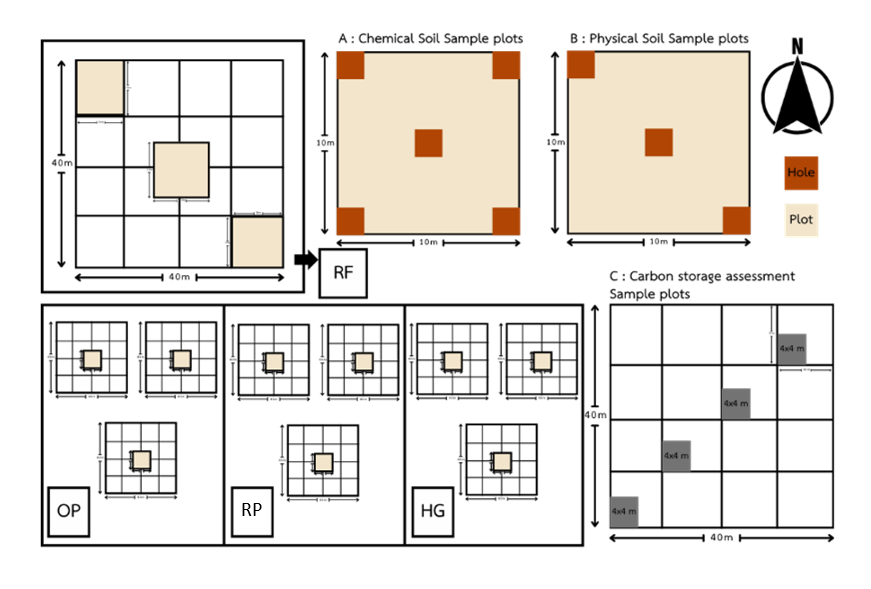
The study of soil fertility and the assessment of carbon storage in oil palm plantations, rubber plantations, home gardens, and remnant forests within the Khlong Khanan sub-district, Nuea Khlong district, Krabi province aimed to examine the chemical and physical properties of the soil, evaluate carbon storage, and analyze the relationship between soil factors under different land use types. Sampling plots measuring 10x10 m were established, and soil samples were collected at depths of 0–5 cm and 20–25 cm for each depth, five subsamples were composited into one sample, resulting in two samples per plot, with three plots per land use type, giving a total of 24 samples for the analysis of soil chemical properties. Soil samples for physical properties were collected using a soil core. Additional plots measuring 40x40 m were established, and tree species composition was recorded to evaluate carbon storage. The study areas consisted of three plots [3 rai (0.48 ha)] each for oil palm plantations, rubber plantations, and home gardens, along with 1 rai (0.16 ha) of remnant forest. The results revealed that soil fertility at a depth of 0–5 cm was higher than that at 20–25 cm, with a tendency to decrease as soil depth increased. The physical properties of the soil in monoculture areas were harder and shallower compared to those in agroforestry areas. The surface soil at 0–5 cm was predominantly sandy loam, while the subsurface soil at 20–25 cm was sandy clay loam. Soil moisture and bulk density values were similar across the land use types, indicating no statistically significant differences. The amount of carbon storage varied among the different land use types. Therefore, most land use guidelines emphasized maximizing land use efficiency in conjunction with conservation and restoration. The findings could be utilized as guidelines for managing agricultural and forest areas toward appropriate and sustainable practices.
References
Boonruengkhao, B. 2018. Biodiversity and Assessment of Carbon Sequestration in Traditional Orchard in Nakhon Si Thammarat Province. Master Thesis. Thaksin University. 205 p. [in Thai]
Chanprom, T., T. Lattirasuvan, T. Yothapakdee, P. Khonkaen, S. Somprakon, N. Khorkha, S. Sukchuai and A. Injan. 2025. Soil properties under Miang tea garden, coffee plantation and remnant forest at Pa Miang village, Chae Son sub-district, Mueang Pan district, Lampang province. Naresuan Agricuture Journal 22(1): 1–14. [in Thai]
Chiarawipa, R., S. Pechkeo, M. Keawdoung and W. Prommee. 2012. Assessment of carbon stock and the potential income of the carbon offset in rubber plantation. Burapha Science Journal 17(2): 96–99. [in Thai]
Chuenjit, C. 2013. Carbon Dioxide Captured in Difference Stand Ages of Oil Palm. Master Thesis. Chulalongkorn University. 73 p. [in Thai]
Faculty of Agriculture Soil Science, Kasetsart University. 2005. Introduction to Soil Science. 10th. Bangkok: Kasetsart University Press. 547 p. [in Thai]
Forest Land Management. 2023. Forest area data project report 2023. Retrieved from https://bit.ly/3PLCOoW [in Thai]
Han, W., J. Chang, H. Jiang, S. Niu, Y. Liu, J. Xu, J. Wu and Y. Ge. 2021. Plant species diversity affects plant nutrient pools by affecting plant biomass and nutrient concentrations in high-nitrogen ecosystems. Basic and Applied Ecology 56: 213–225. Retrieved from https://doi.org/10.1016/j.baae.2021.08.002
Henson, I.E. 1999. Comparative Ecophysiology of Oil Palm and Tropical Rainforest. pp. 9–39. In Germit, S., K.H. Lim, T. Leng and D.L. Kow. (eds.). Oil Palm and the Environment: A Malaysian Perspective. Kuala Lumpur: Malaysian Oil Palm Growers Council.
Islam, K.R. and R.R. Weil. 2000. Land use effects on soil quality in a tropical forest ecosystem of Bangladesh. Agriculture Ecosystems & Environment 79: 9–16. https://doi.org/10.1016/S0167-8809(99)00145-0
Khunrattanasiri, W. 2020. Satellite Imagery for Forest Resource Survey. Bangkok: Department of Forest Management, Faculty of Forestry, Kasetsart University. 349 p. [in Thai]
Kiriratnikom, A. and S. Kiriratnikom. 2024. Carbon storages in tropical rain forest, case study: Ban Papong community forest, Thamod district, Phatthalung province. Wichcha Journal 43(1): 47–50. [in Thai]
Kongmeesup, I. 2020. Interactions between climate change and the world's forest sector. Naresuan Agriculture Journal 17(2): 4–5. [in Thai]
Land Development Department. 2004. Guidelines for the Analysis of Soil, Water, Fertilizers, Plants, Soil Amendments, and Quality Certification. Bangkok: Office of Science for Land Development. 252 p. [in Thai]
Land Development Department. 2007. Guidelines for Soil Management in Krabi. Bangkok: Ministry of Agriculture and Cooperatives. 157 p. [in Thai]
Lattirasuvan, T., S. Tanaka, K. Nakamoto, D. Hattori and K. Sakurai. 2010. Ecological characteristics of home gardens in northern Thailand. TROPICS. 18(4): 171–184.
Lattirasuvan, T. 2012. Soil properties and plant diversity of home gardens in Song district, Phrae province. Thai Journal of Forestry 31(2): 19–23. [in Thai]
Limsakul, A., S. Ngodngam, N. Sriburin, P. Suwanee and R. Phaisan. 2018. Development of Carbon Sequestration and Exchange Assessment Methods under the Carbon Sequestration and Exchange Assessment Tool/Method Development Project. 112 p. In Research Report. Bangkok: Department of Environmental Quality Promotion. [in Thai]
Maharjan, M., S. Ayer, S. Timilsina, P. Ghimire, S. Bhatta, N. Thapa, Y.P. Timilsina, S. Lama, V.K. Yadav and C.C. Okolo. 2024. Impact of agroforestry intervention on carbon stock and soil quality in mid-hills of Nepal. Soil Security 16: 100164. https://doi.org/10.1016/j.soisec.2024.100164
Ogawa, H., K. Yoda, K. Ogino and T. Kira. 1965. Comparative ecological studies on three main types of forest vegetation in Thailand. II. Plant Biomass. Nature and Life in Southeast Asia 4: 49–80.
Pattanathaworn, W. 2021. The study of soil carbon in Thailand. Retrieved from http://oss101.ldd.go.th/osr_data&service/OSR_PDF/TB_SSK_Distribute/D_SSK63-002.pdf [in Thai]
Pearson, T. and S. Brown. 2005. Guide de mesure et de suivi du carbone dans les forêts et prairies herbeuses. Arlington, VA: Winrock International. 38 p.
Phomsenwong, B., S. Khamyong, N. Anongrak and P. Huttagosol. 2019. Soil characteristics derived from limestone between agricultural and forest lands in Mae Tao watershed, Mae Sot district, Tak province. Journal of Agriculture 35(2): 248–249. [in Thai]
Prakunhangsit, S. 2002. Water management for plants. Advanced Agriculture 15(4): 59–62. [in Thai]
Somprakon, S., T. Yothapakdee, I. Howpinjai, P. Painkhit, S. Yodkeaw, K. Kruama and T. Lattirasuvan. 2024. Soil fertility and estimation of carbon sequestration in forest restoration at age 8 years in Phrae province. Thai Journal of Forestry 43(1): 167–179. [in Thai]
Srethasirote, B., R. Tawon, L. Poangjit and S. Soontornwong. 2011. REDPLUS: Hot Issues in the World Negotiation Arena Concepts and Formats Appropriate for Thai Society. Bangkok: Good Governance for Social Development and the Environment Institute (GSEI). 152 p. [in Thai]
Tanaka, J.R.G. and M.A. Liebig. 2010. Fallow effects on soil carbon and greenhouse gas flux in central North Dakota. Retrieved from https://acsess. onlinelibrary.wiley.com/doi/epdf/10.2136/sssaj2008.0368
Thailand Greenhouse Gas Management Organization (Public Organization). 2016. Thailand Voluntary Emission Reduction Program Reference Manual: Forestry and Agriculture Sector. 3rd ed. Bangkok: Thailand Greenhouse Gas Management Organization (Public Organization). 65 p. [in Thai]
The Intergovernmental Panel on Climate Change (IPCC). 2006. Guidelines for national greenhouse gas inventories: chapter 4 forest land. Retrieved from https://www.ipccnggip.iges.or.jp/public/2006gl/pdf/4_Volume4/V4_04_Ch4_Forest_Land.pdf
Triphattanasuwan, P., S. Diloksumpun, D. Staporn and J. Rattanakaew. 2008. Carbon Storage in Biomass of Some Tree Species Planted at the Pu Parn Royal Development Study Centre, Sakon Nakhon Province. 18 p. In Research Report. Bangkok: Department of National Parks, Wildlife and Plant Conservation. [in Thai]
Downloads
Published
How to Cite
Issue
Section
License
Copyright (c) 2026 Journal of Agricultural Research and Extension

This work is licensed under a Creative Commons Attribution-NonCommercial-NoDerivatives 4.0 International License.
This article is published under a Creative Commons Attribution-NonCommercial-NoDerivatives 4.0 International License (CC BY-NC-ND 4.0), which allows others to share the article with proper attribution to the authors and prohibits commercial use or modification. For any other reuse or republication, permission from the journal and the authors is required.