
การศึกษาห่วงโซ่อุปทานไก่แดงในพื้นที่จังหวัดภาคใต้ตอนบนของประเทศไทย
DOI:
https://doi.org/10.14456/jare-mju.2026.11คำสำคัญ:
ห่วงโซ่อุปทาน, ไก่แดง , พ่อค้ารวบรวม , ผู้บริโภคบทคัดย่อ
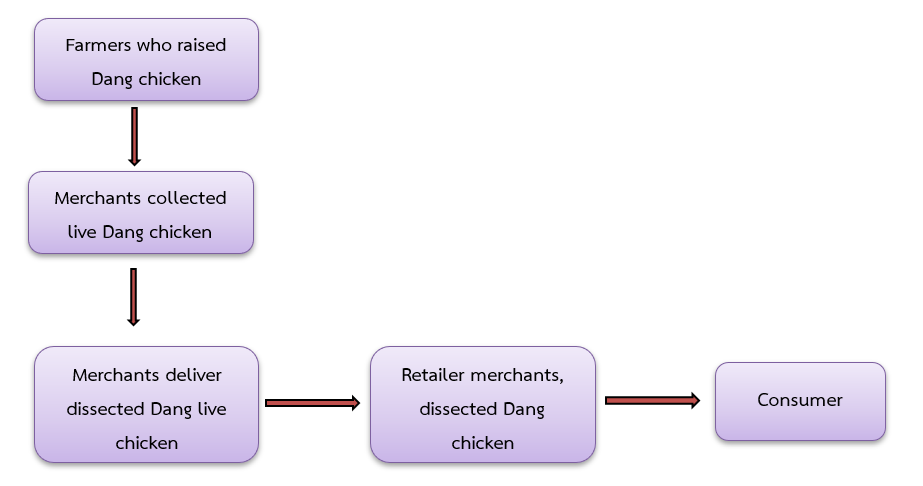
งานวิจัยนี้มีวัตถุประสงค์ เพื่อศึกษาห่วงโซ่อุปทานไก่แดงในพื้นที่จังหวัดภาคใต้ตอนบนของประเทศไทย โดยเก็บรวบรวมข้อมูลจากการสัมภาษณ์แบบมีโครงสร้างกับเกษตรกรผู้เลี้ยงไก่แดง จำนวน 60 ราย พ่อค้ารวบรวม จำนวน 20 ราย ผู้ค้าส่ง/ค้าปลีก จำนวน 20 ราย และผู้บริโภค จำนวน 400 ราย ในพื้นที่จังหวัดนครศรีธรรมราช สุราษฎร์ธานี และชุมพร พบว่าด้านการผลิต เกษตรกรเลี้ยงไก่แดงระยะเวลาเฉลี่ย 16 สัปดาห์ น้ำหนักตัวเฉลี่ย 1.5–1.6 กิโลกรัม ด้านช่องทางการจัดจำหน่าย เกษตรกรส่วนใหญ่นิยมจำหน่ายไก่แดง ให้แก่พ่อค้ารวบรวมในท้องถิ่น เนื่องจากมีความสะดวก ในการติดต่อสื่อสารและมีความเชื่อมั่นจากการเป็นคู่ค้าระยะยาว นอกจากนี้ยังมีช่องทางการจำหน่ายอื่น ๆ ได้แก่ การจำหน่ายโดยตรงให้แก่ผู้ค้าส่ง/ค้าปลีก ผู้บริโภค และร้านอาหารในท้องถิ่น ราคาจำหน่ายไก่แดงมีชีวิตเฉลี่ย 70–80 บาทต่อกิโลกรัม และจะปรับสูงขึ้นเป็น 90–100 บาทต่อกิโลกรัม ในช่วงเทศกาลสำคัญ เช่น เทศกาลตรุษจีน และเทศกาล เช็งเม้ง โดยมีผู้ค้าส่งบางรายทำหน้าที่เป็นผู้รวบรวมไก่มีชีวิตด้วย ในขณะที่ไก่แดงชำแหละมีราคาจำหน่ายเฉลี่ย 110–125 บาทต่อกิโลกรัม สำหรับผู้บริโภคส่วนใหญ่จะซื้อไก่แดงจากผู้ค้าปลีกในตลาดสดหรือตลาดนัดชุมชน ในราคาเฉลี่ย 120–150 บาทต่อกิโลกรัม ทั้งนี้พบว่า ห่วงโซ่อุปทานไก่แดง ประกอบด้วย เกษตรกรรายย่อยและกลุ่มเครือข่าย พ่อค้ารวบรวมไก่มีชีวิต ผู้ค้าส่ง/ค้าปลีก ผู้ประกอบการร้านค้าหรือร้านอาหาร และผู้บริโภคปลายทาง ทั้งนี้ควรมีการส่งเสริมให้เกษตรกรรวมกลุ่มกันในรูปแบบสหกรณ์หรือกลุ่มความร่วมมืออย่างเป็นระบบ เพื่อยกระดับประสิทธิภาพในการดำเนินงาน โดยมุ่งเน้นการวางแผนการผลิตอย่างเหมาะสม การพัฒนาและขยายช่องทางการตลาด ตลอดจนการสร้างกลไกในการแลกเปลี่ยนและถ่ายทอดองค์ความรู้ระหว่างสมาชิกภายในกลุ่ม อันจะนำไปสู่ความเข้มแข็งและความยั่งยืนของการพัฒนาในระยะยาว
เอกสารอ้างอิง
Boonman, C. and S. Weesaphe. 2009. The Evaluation of Feasibility of Native Chicken Production for Commerce in the Community Level Case Study: MaiMa-Dan Grilled Chicken, Baan-Kean Grilled Chicken and Native Chicken Trading in the Market of Srisaket, Yasothorn, and Ubon Ratchathani Province. 69 p. In Research Report. Bangkok: The Thailand Research Fund (TRF). [in Thai]
Chankong, J., N. Chuaychu-noo and P. Maliwan. 2022. Supply chain of native chicken: case study in Nakhon Sri Thammarat province. PRAWARUN AGRICULTURAL JOURNAL 19(2): 66–73. [in Thai]
Cochran, W.G. 1953. Sampling Techniques. New York: John Wiley & Sons, Inc. 356 p.
Information and Statistics Group, Information and Communication Technology Center, Department of Livestock Development. 2023. Database system for farmers. Retrieved from https://ict.dld.go.th/webnew/index.php/th/service-ict/report/413-report-thailand-livestock/reportservey2566/1800-province-2023 [in Thai]
Laopaiboon, B., M. Duangjinda, T. Vongpralab, P. Sanchaisuriya, K. Nantachaiand and W. Boonkum. 2010. Testing of growth performances and meat tenderness in crossbred chicken from Thai indigenous sire and commercial dam. Khon Kaen Agriculture Journal 38: 373–384. [in Thai]
Nualhnuplong, P., C. Wattanachant, S. Wattansit and B. Somboonsuke. 2019. Market structure marketing channel and supply chain of Betong chicken in Pattani, Yala and Narathiwat provinces. Journal of Agricultural Research and Extension 36(3): 78–85. [in Thai]
Phromnoi, S. and S. Phattanakunanan. 2017. Genetic diversity of native chicken in Uttaradit province for sustainable of utilization and conservation. Journal of Mahanakorn Veterinary Medicine 12(2): 67–77.
Pongvichai, S. 2008. Statistical Data Analysis by Computer. Bangkok: Chulalongkorn University Printing House. 479 p. [in Thai]
Relucio, J.A. 2021. Value chain analysis of native chicken in selected Barangay of Partido. Technium 3(6): 50–66.
Saenkhunthow, U., C. Prasert and K. Nonta. 2016. Study on the System of Production and Marketing of Thai Native Chicken In Mahasarakham Province. Retrieved from http://region4.dld.go.th/webnew/images/stories/vichakarn/04-2-04-60.pdf [in Thai]
Sentangsedtee. 2018. Dang Surat chickens. Retrieved from https://www.sentangsedtee.com/farming-trendy/article_96095 [in Thai]
Songsang, A., K. Tunthikapong, R. Sompong and T. Jeendoung. 2015. Comparison of production performance, carcass, meat quality and consumer acceptance on Dang Suratthani Thai native chicken and colon chicken raised in commercial production and the supplementation of rubber seed meat to replace soybean meal in diet formulas. Retrieved from http://kb.tsu.ac.th/jspui/bitstream/123456789/3390/1/Aporn%20Songsang%2000202771.pdf [in Thai]
Wongsuthavas, S. and K. Sombun. 2009. Feasibility Study of the Using of Native Chicken or Native Hybrid Chicken for Commercial in Community Level: Sakon Nakhon Province. 77 p. In Research Report. Bangkok: The Thailand Research Fund (TRF). [in Thai]
Yotapakdee, T., P. Proburomand, S. Phannarong, P. Boonyasana, N. Rukprayoon and S. Chotinan. 2023. Efficiency improvement of value chain management on commercial native chickens of farmer groups in the upper northern provinces of Thailand. Khon Kaen Agriculture Journal 51(2): 231–243. [in Thai]
ดาวน์โหลด
เผยแพร่แล้ว
รูปแบบการอ้างอิง
ฉบับ
ประเภทบทความ
สัญญาอนุญาต
ลิขสิทธิ์ (c) 2026 วารสารวิจัยและส่งเสริมวิชาการเกษตร

อนุญาตภายใต้เงื่อนไข Creative Commons Attribution-NonCommercial-NoDerivatives 4.0 International License.
บทความนี้ได้รับการเผยแพร่ภายใต้สัญญาอนุญาต Creative Commons Attribution-NonCommercial-NoDerivatives 4.0 International (CC BY-NC-ND 4.0) ซึ่งอนุญาตให้ผู้อื่นสามารถแชร์บทความได้โดยให้เครดิตผู้เขียนและห้ามนำไปใช้เพื่อการค้าหรือดัดแปลง หากต้องการใช้งานซ้ำในลักษณะอื่น ๆ หรือการเผยแพร่ซ้ำ จำเป็นต้องได้รับอนุญาตจากวารสาร