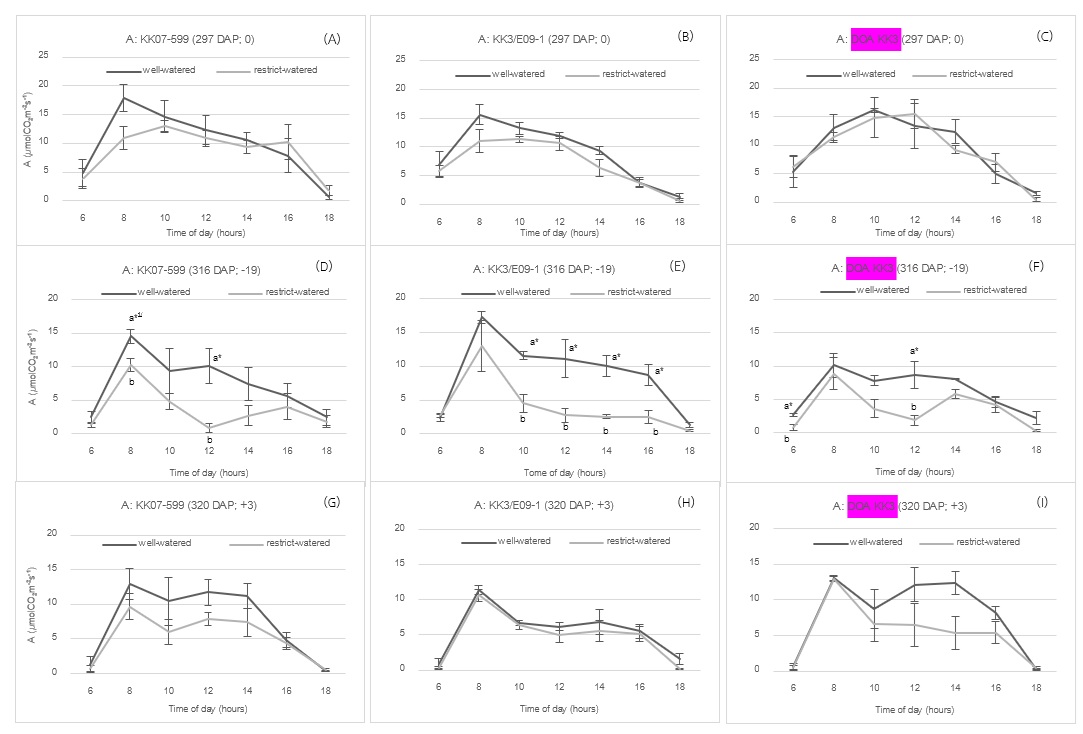
การเปลี่ยนแปลงในรอบวันของพารามิเตอร์การสังเคราะห์ด้วยแสงในอ้อยโคลนดีเด่น ภายใต้สภาวะขาดน้ำและการฟื้นตัวที่ระยะแก่ ในภาคตะวันออกเฉียงเหนือของประเทศไทย
DOI:
https://doi.org/10.14456/jare-mju.2026.26คำสำคัญ:
อัตราการสังเคราะห์ด้วยแสงสุทธิ, อัตราการคายน้ำ , ค่าชักนำการเปิด-ปิดปากใบ , สภาวะเครียดจากการขาดน้ำ , การเปลี่ยนแปลงในรอบวันบทคัดย่อ
ความเข้าใจเกี่ยวกับการเปลี่ยนแปลงในรอบวันของการสังเคราะห์ด้วยแสงในอ้อย ภายใต้สภาวะขาดน้ำและการฟื้นตัวหลังได้รับน้ำอีกครั้งมีความสำคัญต่อการรับทราบถึงกลไกการปรับตัวของพืชภายใต้สภาวะดังกล่าว อย่างไรก็ตาม ความรู้ด้านการสังเคราะห์ด้วยแสงในรอบวันของอ้อยในประเทศไทยยังมีจำกัด ดังนั้น การทดลองนี้จึงมีวัตถุประสงค์เพื่อประเมินการเปลี่ยนแปลงในรอบวันของพารามิเตอร์การสังเคราะห์ด้วยแสงของอ้อยโคลนดีเด่น (KK07-599 และ KK3/E09-1) และพันธุ์ กวก. ขอนแก่น 3 ที่ระยะแก่ ภายใต้สภาวะแล้งและการฟื้นตัวหลังได้รับน้ำอีกครั้ง ดำเนินการ ณ ศูนย์วิจัยพืชไร่ขอนแก่น จังหวัดขอนแก่น ปี พ.ศ. 2566 โดยปลูกอ้อยในวงบ่อซีเมนต์ด้วยการจัดการการให้น้ำ 2 รูปแบบ คือ (1) ให้น้ำตามความต้องการของพืช (2) งดการให้น้ำนาน 19 วัน (เมื่ออ้อยมีอายุ 298–316 วันหลังปลูก เพื่อชักนำการขาดน้ำ) และให้น้ำอีกครั้งเมื่ออ้อยมีอายุ 317 วันหลังปลูก เพื่อบันทึกข้อมูลการฟื้นตัวหลังการได้รับน้ำอีกครั้งในวันที่ 3 หรืออ้อย มีอายุ 320 วันหลังปลูก จากการศึกษาพบว่า การขาดน้ำทำให้อ้อยทุกพันธุ์/โคลนมีค่าอัตราการสังเคราะห์ด้วยแสงสุทธิ อัตราการคายน้ำ และค่าชักนำการเปิด-ปิดปากใบลดลงเมื่อเปรียบเทียบกับอ้อยที่ได้น้ำตามปกติ โดยค่าพารามิเตอร์ดังกล่าว มีค่าน้อยสุดในช่วงเช้าตรู่และช่วงเย็น แต่มีค่าสูงสุดในช่วงเช้าและช่วงกลางวัน ซึ่งค่าอัตราการสังเคราะห์ด้วยแสงสุทธิของอ้อยที่ได้รับน้ำตามปกติมีค่า 10–15 µmol CO2 m-2 s-1 ขณะที่ กลุ่มอ้อยที่ขาดน้ำมีค่าน้อยกว่า 10 µmolCO2 m-2 s-1 ทั้งนี้พบว่า ค่าความเข้มข้นของคาร์บอนไดออกไซด์ในใบของอ้อยกลุ่มขาดน้ำมีค่ามากที่สุดในช่วงเช้าตรู่หรือช่วงพลบค่ำ (ประมาณ 300–400 µmol mol-1) การเปลี่ยนแปลงในรอบวันของพารามิเตอร์การสังเคราะห์ด้วยแสงของอ้อยทุกพันธุ์/โคลนที่ดำเนินการศึกษาในครั้งนี้ไม่ได้บ่งชี้ถึงความต้านทานต่อสภาวะแล้ง แต่พบว่าเมื่ออ้อยได้รับน้ำอีกครั้งจะสามารถฟื้นฟูพารามิเตอร์การสังเคราะห์ด้วยแสงให้ใกล้เคียงกับกลุ่มอ้อยที่ได้รับน้ำตามปกติ ซึ่งแสดงให้เห็นถึงศักยภาพการปรับตัว ของอ้อยในเขตอาศัยน้ำฝนที่ส่วนใหญ่นิยมเพาะปลูกในช่วงปลายฤดูฝนและต้องเผชิญกับสภาวะแล้งที่ยาวนานก่อนที่จะได้รับน้ำฝนตกอีกครั้ง นอกจากนี้ การศึกษาถึงความสัมพันธ์ระหว่าง source-sink และการลำเลียงสารอาหารจะช่วยสร้างความเข้าใจต่อการสะสมน้ำตาลภายใต้สภาวะแล้งของอ้อยได้มากยิ่งขึ้น
เอกสารอ้างอิง
Aidar, S.T., S.T. Meirelles, R.F. Oliveira, A.R.M. Chaves and P.I. Fernandes-Júnior. 2014. Photosynthetic response of poikilochlorophyllous desiccation-tolerant Pleurostima purpurea (Velloziaceae) to dehydration and rehydration. Photosynthetica 52(1): 124–133.
Buakom, W., P. KrachaI, S. Gonkhamdee, P. Songsri and N. Jongrungklang. 2020. Responses of rooting and physiological characteristics of sugarcanes grown under mimic drought stress as low water potential at early stage. Khon Kaen Agriculture Journal 48(6): 1442–1457.
Chanachai, S., T. Chinnasaen, P. Jangpol, A. Tippayawat, W. Ponragdee and W. Srathongkan. 2023. The Selection of Sugarcane Promising Clones Series 2018 for Sandy to Loamy Sand Soil in Thailand. p. 98. In Proceeding The 2nd International Conference on Cane and Sugar 2023, 5-7 July 2023, Bangkok Asawin Grand Convention. Bangkok: Thailand Society of Sugar Cane Technologists (TSSCT).
Chaves, M.M., J.S. Pereira, I. Marcow, S.M.L. Rodrigue, C.P.P. Ricardo, M.L. Oscorio, C. Carvalloho and C. Pinharo. 2002. How plants cope with water stress in the field? photosynthesis and growth. Annals of Botany 89(7): 907–916.
Chinnasaen, T., R. Cheakittisak, P. Jungpol, S. Chanachai and C. Pakdeethai. 2021. Studies on agronomic traits and cane yield of sugarcane promising clones under irrigated and rain-fed conditions. Prawarun Agricultural Journal 18(1): 17–26. [in Thai]
De Dios, V.R. 2017. Circadian regulation and diurnal variation in gas exchange. Journal of Plant Physiology 175(1): 3–4.
De Souza, A.P. and M.S. Buckeridge. 2014. Photosynthesis in Sugarcane and Its Strategic Importance to Face the Global Climatic Change. pp. 359–364. In Cortez, L.A.B. (ed.). Sugarcane bioethanol-R&D for Productivity and Sustainability. São Paulo: Editora Edgard Blücher.
De Souza, A.P., A. Grandis, B.C. ArenqueMusa and M.S. Buckeridge. 2018. Diurnal variation in gas exchange and nonstructural carbohydrates throughout sugarcane development. Functional Plant Biology 45(8): 865–876.
Dinh, T.H., H. Takaragawa, K. Watanabe, M. Nakabaru and Y. Kawamitsu. 2019. Leaf photosynthesis response to change of soil moisture content in sugarcane. Journal Sugar Tech 21(6): 949–958.
Dos Santos, C.M., M.D.A. Silva, G.P.P. Lima, F.P.D.A.P. Bortolheiro, M.C. Brunelli, L.A.D. Holanda and R. Oliver. 2014. Physiological changes associated with antioxidant enzymes in response to sugarcane tolerance to water deficit and rehydration. The Journal Sugar Tech. 17(3): 291–304.
Du, Y.C., A. Nose, A. Kondo and K. Wasano. 2000. Diurnal changes in photosynthesis in sugarcane leaves: I. carbon dioxide exchange rate, photosynthetic enzyme activities and metabolite levels relating to the C4 pathway and the Calvin cycle. Plant Production Science 3(1): 3–8.
Gomathi, R., S. Vasantha, G. Hemaprabha, S. Alarmelu and R.M. Shanthi. 2011. Evaluation of elite sugarcane clones for drought tolerance. Journal of Sugarcane Research 1(1): 55–62.
Graça, J.P. da, F.A. Rodrigues, J.R.B. Farias, M.C.N. de Oliveira, C.B. Hoffmann-Campo and S.M. Zingaretti. 2010. Physiological parameters in sugarcane cultivars submitted to water deficit. Brazilian Society of Plant Physiology 22(3): 189–197.
Gupta, A.S., G.A. Berkowitz and P.A. Pier. 1989. Maintenance of photosynthesis at low leaf water potential in wheat. Plant Physiology 89(4): 1358–1365.
Jaiphong, T., J. Tominaga, K. Watanabe, M. Nakabaru, H. Takaragawa, R. Suwa, M. Ueno and Y. Kawamitsu. 2016. Effects of duration and combination of drought and flood conditions on leaf photosynthesis, growth and sugar content in sugarcane. Plant Production Science 19(3): 427–437.
Khonghintaisong, J., P. Songsri and N. Jongrungklang. 2017. Growth and physiological patterns of sugarcane cultivars to mimic drought conditions in late rainy season system. Naresuan University Journal: Science and Technology 2: 102–112. [in Thai]
Lawlor, D.W. and G. Cornic. 2002. Photosynthetic carbon assimilation and associated metabolism in relation to water deficits in higher plants. Plant, Cell & Environment 25(2): 275–294.
certain sugarcane genotypes grown under field conditions as influenced by early drought stress. Agronomy 11(11): 2319.
Liu, Y.Y., J. Li, S.C. Liu, Q. Yu, X.J. Tong, T.T. Zhu, X.X. Gao and L.X. Yu. 2020. Sugarcane leaf photosynthetic light responses and their difference between varieties under high temperature stress. Photosynthetica 58(4): 1009–1018.
Medeiros, D.B., E.C. Silva, R.J.M.C. Nogueira, M.M. Teixeira and M.S. Buckeridge. 2013. Physiological limitations in two sugarcane varieties under water suppression and after recovering. Theoretical and Experimental Plant Physiology 25(3): 213–222.
Moore, P.H. 1995. Temporal and spatial regulation of sucrose accumulation in the sugarcane stem. Australian Journal of Plant Physiology 22: 661–679.
Namwongsa, J., N. Jongrungklang and P. Songsri. 2019. Genotypic variation in root distribution changes and physiological responses of sugarcane induced by drought stress. SABRAO Journal of Breeding and Genetics 51(4): 470–493.
Osborne, C.P. and L. Sack. 2012. Evolution of C4 plants: a new hypothesis for an interaction of CO2 and water relations mediated by plant hydraulics. Philosophical Transactions of the Royal Society B: Biological Sciences. 367(1588): 583–600.
Paisancharoen, K., T. Sansayawichai, S. Luanmanee, S. Thippayarugs, K. Chusorn, J. Chuenrung and C. Pakdeethai. 2012. Water requirement and Kc values of Khon Kaen 3 sugarcane variety. Khon Kaen Agriculture Journal 3(Suppl.): 103–114. [in Thai]
Ribeiro, R.V., R.S. Machado, E.C. Machado, D.F.S.P. Machado, R.M. Filho and M.G.A. Landell. 2013. Revealing drought-resistance and productive patterns in sugarcane genotypes by evaluating both physiological responses and stalk yield. Experimental Agriculture 49(2): 212–224.
Santos, F. and V. Diola. 2015. Physiology. pp. 13–33. In Santos, F., A. Borem and C. Caldas (eds.). Sugarcane Agricultural Production Bioenergy, and Ethanol. Chennai: MPS Limited.
Seo, P.J. and P. Mas. 2015. Stressing the role of the plant circadian clock. Trends in Plant Science 20(4): 230–237.
Silva M.A., J.L. Jifon, J.Ag. Da Silva and V. Sharma. 2007. Use of physiological parameters as fast tools to screen for drought tolerance in sugarcane. Brazilian Journal of Plant Physiology 19(3): 193–201.
Silva, M.A., J.L. Jifon, C.M. Santos, C.J. Jadoski and J.A.G. Da Silva. 2013. Photosynthetic capacity and water use efficiency in sugarcane genotypes subject to water deficit during early growth phase. Brazilian Archives of Biology and Technology 56(5): 735–748.
Suwannarut, W., S. Vialet-Chabrand and E. Kaiser. 2023. Diurnal decline in photosynthesis and stomatal conductance in several tropical species. Frontiers in Plant Science 14(2023): 1–14. https://doi.org/10.3389/fpls.2023.1273802
The Thai Astronomical Society. 2023. Sunrise time and sunset time in 2023-Khon Kaen province. Retrieved from https://thaiastro.nectec.or.th/skyevnt/sunmoon/2023/khonkaen.html [in Thai]
Verma, K.K., K.C. Wu, C.L. Verma, D.M. Li, M.K. Malviya, R.K. Singh, P. Singh, G.L. Chen, X.P. Song and Y.R. Li. 2020. Developing mathematical model for diurnal dynamics of photosynthesis in Saccharum officinarum responsive to different irrigation and silicon application. Peer Journal 8: e10154.
Wang, J., X. Zhang, Z. Han, H. Feng, Y. Wang, J. Kang, X. Han, L. Wang, C. Wang, H. Li and G. Ma. 2022. Analysis of physiological indicators associated with drought tolerance in wheat under drought and re-watering conditions. Antioxidants (Basel) 16(11): 2266.
Wang, J., T. Zhao, B. Yang and S. Zhang. 2017. Sucrose metabolism and regulation in sugarcane. Journal of Plant Physiology & Pathology 5(4): 1–6.
Wu, W., L. Chen, R. Liang, S. Huang, X. Li, B. Huang, H. Luo, M. Zhang, X. Wang and H. Zhu. 2025. The role of light in regulating plant growth, development and sugar metabolism: a review. Frontiers in Plant Science 15: 1–15 https://doi.org/10.3389/fpls.2024.1507628
ดาวน์โหลด
เผยแพร่แล้ว
รูปแบบการอ้างอิง
ฉบับ
ประเภทบทความ
สัญญาอนุญาต
ลิขสิทธิ์ (c) 2026 วารสารวิจัยและส่งเสริมวิชาการเกษตร

อนุญาตภายใต้เงื่อนไข Creative Commons Attribution-NonCommercial-NoDerivatives 4.0 International License.
บทความนี้ได้รับการเผยแพร่ภายใต้สัญญาอนุญาต Creative Commons Attribution-NonCommercial-NoDerivatives 4.0 International (CC BY-NC-ND 4.0) ซึ่งอนุญาตให้ผู้อื่นสามารถแชร์บทความได้โดยให้เครดิตผู้เขียนและห้ามนำไปใช้เพื่อการค้าหรือดัดแปลง หากต้องการใช้งานซ้ำในลักษณะอื่น ๆ หรือการเผยแพร่ซ้ำ จำเป็นต้องได้รับอนุญาตจากวารสาร