
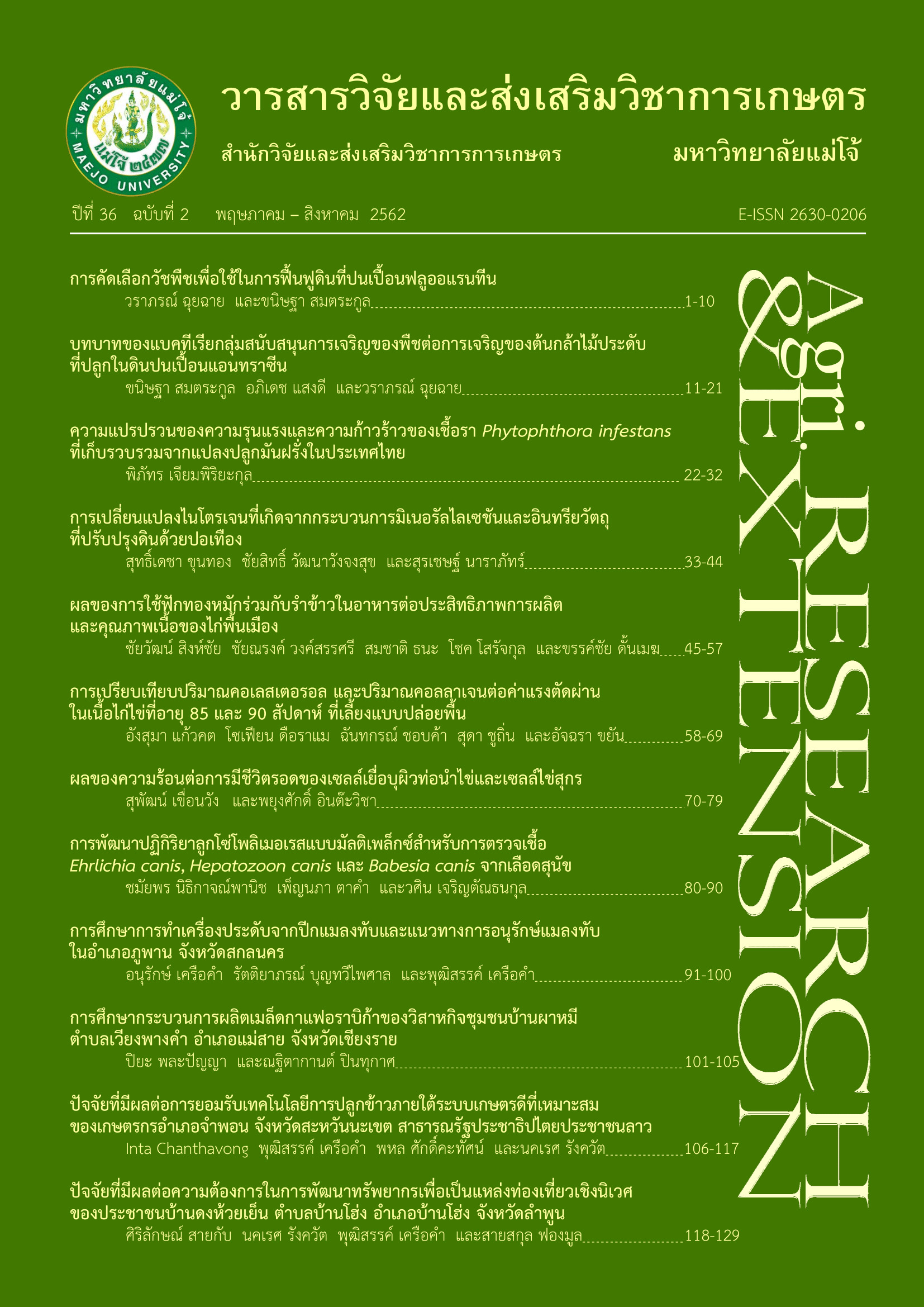
ผลของการใช้ฟักทองหมักร่วมกับรำข้าวในอาหารต่อประสิทธิภาพการผลิต และคุณภาพเนื้อของไก่พื้นเมือง
คำสำคัญ:
ฟักทองหมัก, หัวเชื้อจุลินทรีย์, ประสิทธิภาพ, การผลิต, คุณภาพเนื้อ, ไก่ประดู่หางดำเชียงใหม่บทคัดย่อ
วัตถุประสงค์ของการวิจัยครั้งนี้ เพื่อศึกษาถึงผลของการใช้ฟักทองหมักร่วมกับรำข้าวในอาหารต่อประสิทธิภาพการผลิต และคุณภาพเนื้อไก่ประดู่หางดำเชียงใหม่ กระบวนการหมักฟักทองทำได้โดยการผสมฟักทองกับน้ำในอัตราส่วน 2:1 ร่วมกับกากน้ำตาล 1.0% (w/v) และหัวเชื้อจุลินทรีย์ในอัตราส่วน 0.1% (w/v) ซึ่งประกอบด้วยจุลินทรีย์ 3 กลุ่ม คือ กลุ่มที่ผลิตเอนไซม์เซลลูเลส ได้แก่ Trichoderma spp. กลุ่มที่ผลิตเอนไซม์ อะไมเลส ได้แก่ Rhizopus oryzae Mucor spp. และยีสต์ Saccharomyces cerevisiae ทำการหมักไว้ในภาชนะปิดสนิทเป็นระยะเวลา 7 วัน ผลการทดลองพบว่าฟักทองที่ผ่านการหมักมีคุณค่าทางโภชนะ คือ โปรตีน 18.05% ไขมัน 7.23% เยื่อใย 18.92% และวัตถุแห้ง 6.19% จากการใช้ฟักทองหมักผสมรำหยาบทดแทนอาหารข้นสำเร็จรูปโปรตีน 19% ในอัตราส่วน 10, 20 และ 30% ในการเลี้ยงไก่จำนวน 30 ตัวต่อกลุ่ม อายุเริ่มต้น 14 วัน น้ำหนักเฉลี่ยเริ่มต้น 112 กรัมต่อตัว เป็นระยะเวลา 4-12 สัปดาห์ พบว่าการเจริญเติบโตและประสิทธิภาพการผลิตของไก่ประดู่หางดำ เช่น การเจริญเติบโตเฉลี่ย ประสิทธิภาพการเปลี่ยนอาหารเป็นน้ำหนักตัว ในทุกกลุ่มไม่แตกต่างกันอย่างมีนัยสำคัญทางสถิติ (P>0.05) ในขณะที่ค่าอาหารในการเลี้ยงไก่เมื่อมีการเสริมฟักทองหมักในอาหารข้น 10, 20 และ 30% มีต้นทุนค่าอาหารลดลงเท่ากับ 25.19, 38.20 และ 49.05% ตามลำดับ คุณภาพซากเนื้ออกไก่พบว่า ปริมาณของกรดอะมิโนไม่แตกต่างกันอย่างมีนัยสำคัญทางสถิติ ในขณะที่กรดไขมันพบว่ามีการสะสมกรดโอเลอิก (C18:1) กรดสเตียริค (C18:0) และกรดอะราคิโดนิก (C20:4) เพิ่มขึ้นในเนื้อไก่เมื่อได้รับอาหารข้นที่มีการเสริมฟักทองหมัก
เอกสารอ้างอิง
Adamafio, N.A., M. Sakyiamah and J. Tettey. 2010. Fermentation in cassava (Manihot esculenta Crantz) pulp juice improves nutritive value of cassava peel. African Journal of Biochemistry Research 4(3): 51-56.
Akinfemi, A., O.A. Adu and F. Doherty. 2010. Conversion of sorghum stover into animal feed with white-rot fungi: Pleurotus ostreatus and Pleurotus pulmonarius. African Journal of Biochemistry Research 9(11): 1706-1712.
Al-maadhidi, J.F., M. Al-khatib, S.R. Farhan and H. Fahim. 2010. Effect of different nitrogen sources supplement on the final crude protein yield from fermented corn cob. Journal of Madenat Alelem College 2(1): 26-31.
AOAC. 2006. Chapter 4: Animal feed. In Official Methods of Analysis. 18th ed. Arlington: AOAC International.
Aumaître, A. 1999. Quality and safety of animal products. Livestock Production Science 59: 113-124.
Belewu, M.A. and F.T. Babalola. 2009. Nutrient enrichment of waste agricultural residues after solid state fermentation using Rhizopus oligosporus. Journal of Applied Biosciences 13: 695-699.
Chaiwang, N., S. Jaturasitha, K. Sringarm, T. Bunmee, N. Chomchai, D. Prakotrat, K. Pugdeethai, W. Chaichaum and M. Wicke. 2012. Comparison of fatty acid composition between White Lamphun and Brahman Crossbred cattle raised with fresh Pangola grass.Chiang Mai University Journal of Natural Sciences 11(1): 303-308.
Chen, Y., Y. Qiao, Y. Xiao, H. Chen, L. Zhao, M. Huang and G. Zhou. 2016. Differences in physicochemical and nutritional properties of breast and thigh meat from crossbred chickens, commercial broilers, and spent hens. Asian-Australasian Journal of Animal Sciences 29(6): 855-864.
Danmek, K., T. Thana, C. Sorachakula and C. Dongpaleedham. 2016. Maize husk silage: a new choice of reduced cost for beef cattle farmer. Thaieduzine 2(3): 45-51. [in Thai]
Department of Livestock Development. 2004a. Table of Nutritive Values Database of Feed Stuffs. 26 p. In The guidance document. Bangkok: Department of Livestock, Ministry of Agriculture and Cooperatives. [in Thai]
Department of Livestock Development. 2004b. Standard Forage Fermentation. 23 p. In The guidance document. Bangkok: Department of Livestock, Ministry of Agriculture and Cooperatives. [in Thai]
Department of Livestock Development. 2004c. Standard forage dry. 22 p. In The Guidance Document. Bankok: Department of Livestock, Ministry of Agriculture and Cooperatives. [in Thai]
Elinge, C.M., A. Muhammad, F.A. Atiku, A.U. Itodo, J. PeniI, O.M. Sanni and A.N. Mbongo. 2012. Proximate, mineral and anti-nutrient composition of pumpkin (Cucurbita pepo L.) seeds extract. International Journal of Plant Sciences 2(5): 146-150.
Ezekiel, O.O., O.C. Aworh, H.P. Blaschek and T.C. Ezeji. 2010. Protein enrichment of cassava peel by submerged fermentation with Trichoderma viride (ATCC 36316). African Journal of Biotechnology 9(2): 187-194.
Feng, J., X. Liu, Z.R. Xu, Y.Y. Liu and Y.P. Lu. 2007. Effects of Aspergillus oryzae 3.042 fermented soybean meal on growth performance and plasma biochemical parameters in broilers. Animal Feed Science and Technology 134: 235-242.
Folch, J., M. Lee and G.H.S. Stanley. 1957. A simple method for the isolation and purification of total lipids from animal tissue. The Journal of Biological Chemistry 226: 497-509.
Hongladdaporn, C., S. Kullawong, S. Kruttaga, C. Jongnok, N. Hancherngchai, K. Limsawat and S. Mungsri. 2014. Effect of protein levels in diet on growth performance of Chee chickens. Khon Kaen Agriculture Journal 42(Suppl.1): 345-350. [in Thai]
Iheukwumere, F., E. Ndubuisi and E. Mazi. 2009. Effect of feeding corn cob meal on growth, nutrient digestibility and organ characteristics of finisher broilers. International Journal of Natural and Applies Sciences 5(1): 49941.
Jaturasitha, S., R. Khiaosa-ard, A. Phongphaew, A. Leotaragul, S. Saitong, T. Apichatsrungkoon, V. Leangwunta and N. Longani. 2004. The effect of strain, sex, weight and muscle on fat quality of Thai native and crossbred chickens (Gai Baan Thai). pp. 127-136. In Proceedings of the 42th Kasetsart University Annual Conference. Bangkok: Kasetsart University. [in Thai]
Klahan, R., B. Yuangsoi and J. Weeragul. 2014. Growth performance, feed utilization and edible flesh quality of hybrid cat fish (Clarias macrocephalus × C. gariepinus) fed with feed contained pumpkin. Khon Kaen Agriculture Journal 42(Suppl.1): 785-791. [in Thai]
Leotaragul, A., D. Sopha and J. Kammongkun. 2014. Egg production and chick production cost of crossbred Pradu Hangdum Chiangmai–Rhode Thai chicken raised in farmer farm. Khon Kaen Agriculture Journal 42(Suppl.1): 285-289. [in Thai]
Morrison, W.R. and L.M. Smith. 1964. Preparation of fatty acid methyl esters and dimethylacetals form lipids with boron fluoride-methanol. The Journal of Lipid Research 5: 600-608.
Muntean, E. 2005. Quantification of carotenoids from pumpkin juice by HPLC-DAD. Scientifical Researches. Agroalimentary Processes and Technologies XI: 123-128.
National Research Council. 1994. Nutrient Requirements of Poultry. 9th ed. Washington, DC: National Academy Press. 176 p.
Oboh, G. 2006. Nutrient enrichment of cassava peels using a mixed culture of Saccharomyces cerevisae and Lactobacillus spp. solid media fermentation techniques. Electronic Journal of Biotechnology 9: 46-49.
Oboh, G., A.A. Akindahunsi and A.A. Oshodi. 2002. Nutrient and anti-nutrient contents of Aspergillus niger-fermented cassava products (flour and garri). Journal of Food Composition and Analysis 15: 617-622.
Oboh, G. and C.A. Elusiyan. 2007. Changes in the nutrient and anti-nutrient content of micro-fungi fermented cassava flour produced from low-and medium-cyanide variety of cassava tubers. African Journal of Biotechnology 6(18): 2150-2157.
The USDA National Nutrient Data Base for Standard Reference. 2013. Pumpkin (Cucurbita spp.), fresh, nutritive value per 100 g. [Online]. Available: https://www.nutrition-and-you.com/pumpkin.html (24 March 2019).
Thevenieau, F. and J.M. Nicaud. 2013. Microorganisms as sources of oils.Oil Fat Crop & Lipid OCL. 20(6): D603.
Thongkrathok, R. 2010. Effect of Fermented Cassava Pulp on Digestibility, Growth Performance and Carcass Quality of Broilers. Master Thesis. Suranaree University of Technology. 101 p. [in Thai]
Wilkinson, M. 1990. Siliage UK. UK: Cambrian Prister Aberystwyth Ltd. 185 p.
ดาวน์โหลด
เผยแพร่แล้ว
รูปแบบการอ้างอิง
ฉบับ
ประเภทบทความ
สัญญาอนุญาต

อนุญาตภายใต้เงื่อนไข Creative Commons Attribution-NonCommercial-NoDerivatives 4.0 International License.
บทความนี้ได้รับการเผยแพร่ภายใต้สัญญาอนุญาต Creative Commons Attribution-NonCommercial-NoDerivatives 4.0 International (CC BY-NC-ND 4.0) ซึ่งอนุญาตให้ผู้อื่นสามารถแชร์บทความได้โดยให้เครดิตผู้เขียนและห้ามนำไปใช้เพื่อการค้าหรือดัดแปลง หากต้องการใช้งานซ้ำในลักษณะอื่น ๆ หรือการเผยแพร่ซ้ำ จำเป็นต้องได้รับอนุญาตจากวารสาร