
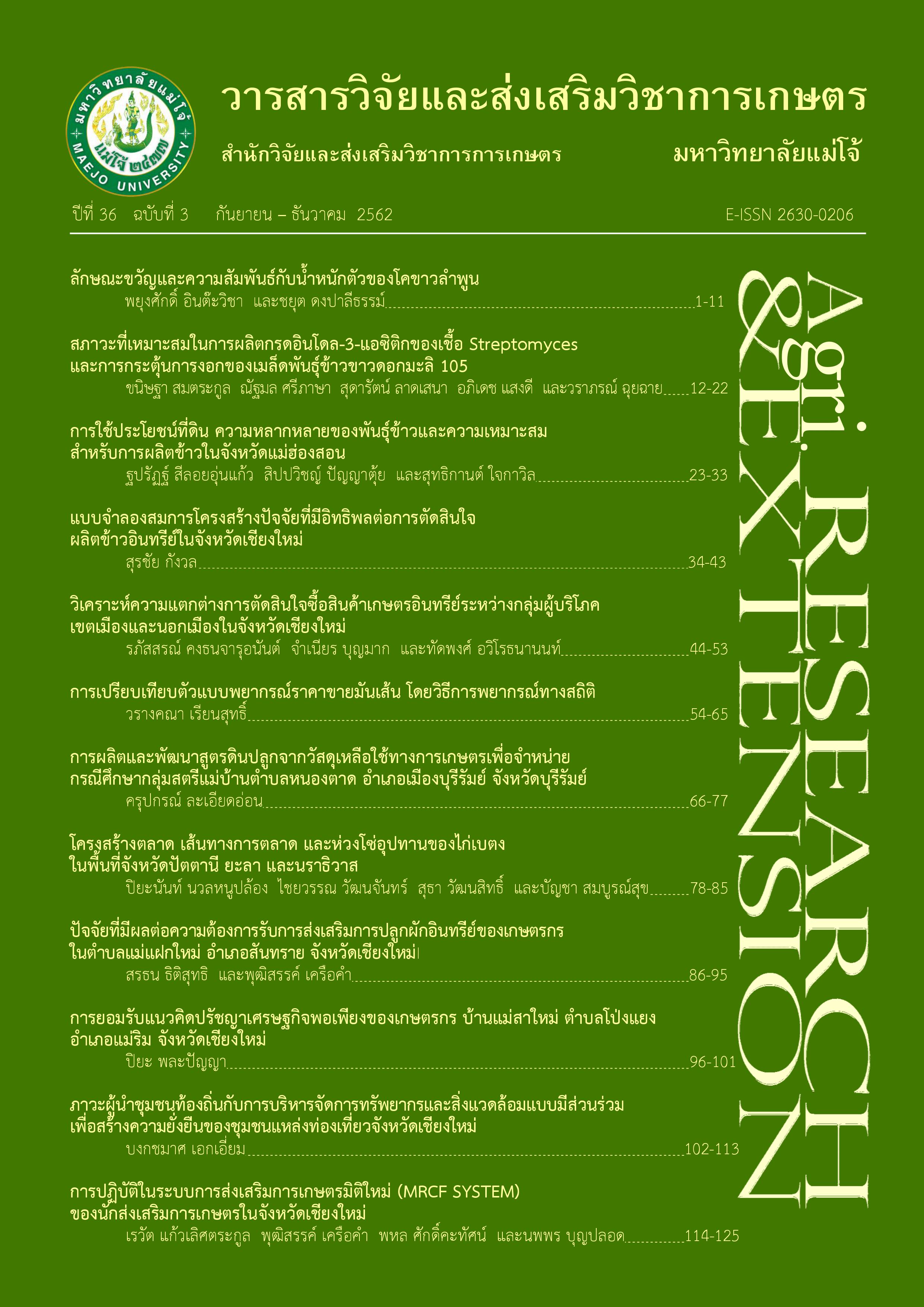
Market Structure Marketing Channel and Supply Chain of Betong Chicken in Pattani Yala and Narathiwat Provinces
Keywords:
market structure, marketing channel, supply chain, Betong chickenAbstract
The purposed of this study was to analyzed market structure, marketing channel, and supply chain of Betong chicken in Pattani, Yala, and Narathiwat provinces. Eleven Betong chicken farmers, two Betong traders, and four entrepreneurs were selected as purposive sources of data. Structured questionnaires and in-depth interviews were used to gather the data. To recheck the accuracy of information, triangulation technique was applied before qualitative and quantitative data analysis. The results revealed that the market structure of Betong chicken approached a pure oligopoly.
This Marketing channel was started from farmers (100%) who supplied Betong chicken to collecting agents (100%) before passing to wholesale merchants (100%) who slaughtered and sold carcasses to entrepreneurs for consumers. The entrepreneurs could be classified into chicken rice vendors, restaurants, and hotel. The supply chain of Betong chicken consisted of five groups: (1) commercial farmers who operated as group of network, (2) collecting agents, (3) wholesalers, (4) entrepreneurs, and (5) consumers however, the collecting agents and wholesalers who were the same person.
References
Boonman, C. and S. Weesaphen. 2009. The evaluation of feasibility of Native chicken production for commerce in the community level case study: Mai-Ma-Dan grilled chicken, Baan-Kean grilled chicken and Native chicken trading in the market of Srisaket, Yasothorn, and Ubon Ratchathani province. 69 p. In Research Report. Bangkok: The Thailand Research Fund. [in Thai].
Buakeeree, K., M. Thepparat and T. Thepparat. 2018. The development of Betong chicken production for commerce in Klong Hoi Klong district, Songkhla province. Prawarun Agr. J. 15(1): 130-137. [in Thai]
Chatreewong, D. and W. Waree. 2006. Optimum market age and weight of Betong chicken. Songklanakarin J. Sci. Technol. 28(2): 311-319. [in Thai]
Diversity Research Section Bureau of Animal Husbandry and Genetic Improvement Department of Livestock Development. 2014. Announcement of native animal breed, Betong chicken. [Online]. Available http://breeding.dld.go.th/biodiversity/chm/pvp_chm/pvp_culture%202.html (20 August 2015). [in Thai]
Kerdsuk, V. and W. Kerdsuk. 2009. Feasibility of the demand for native chicken or native hybrid chicken for commercial in community level. 87 p. In Research Report. Bangkok: The Thailand Research Fund. [in Thai]
Leotaragul, A., C. Prathum, S. Pangmao and A. Phianmongkhol. 2010. Satisfaction of consumers with native chicken (Pradu Hangdum Chiangmai) meat. Khon Kaen Agr. J. 38: 104-107. [in Thai]
Madyun, W. 2010. The Study on Broiler Marketing System in Satun Province. Minor Thesis. Prince of Songkla University. 119 p. [in Thai]
Thammarat, W. 2006. Marketing of Broilers in Songkhla Province. Minor Thesis. Prince of Songkla University. [in Thai]
Wongsuthavas, S. and K. Sombun. 2009. Feasibility study of the using of native chicken or native hybrid chicken for commercial in community level: Sakon Nakorn province. 77 p. In Research Report. Bangkok: The Thailand Research Fund. [in Thai]
Downloads
Published
How to Cite
Issue
Section
License

This work is licensed under a Creative Commons Attribution-NonCommercial-NoDerivatives 4.0 International License.
This article is published under a Creative Commons Attribution-NonCommercial-NoDerivatives 4.0 International License (CC BY-NC-ND 4.0), which allows others to share the article with proper attribution to the authors and prohibits commercial use or modification. For any other reuse or republication, permission from the journal and the authors is required.


