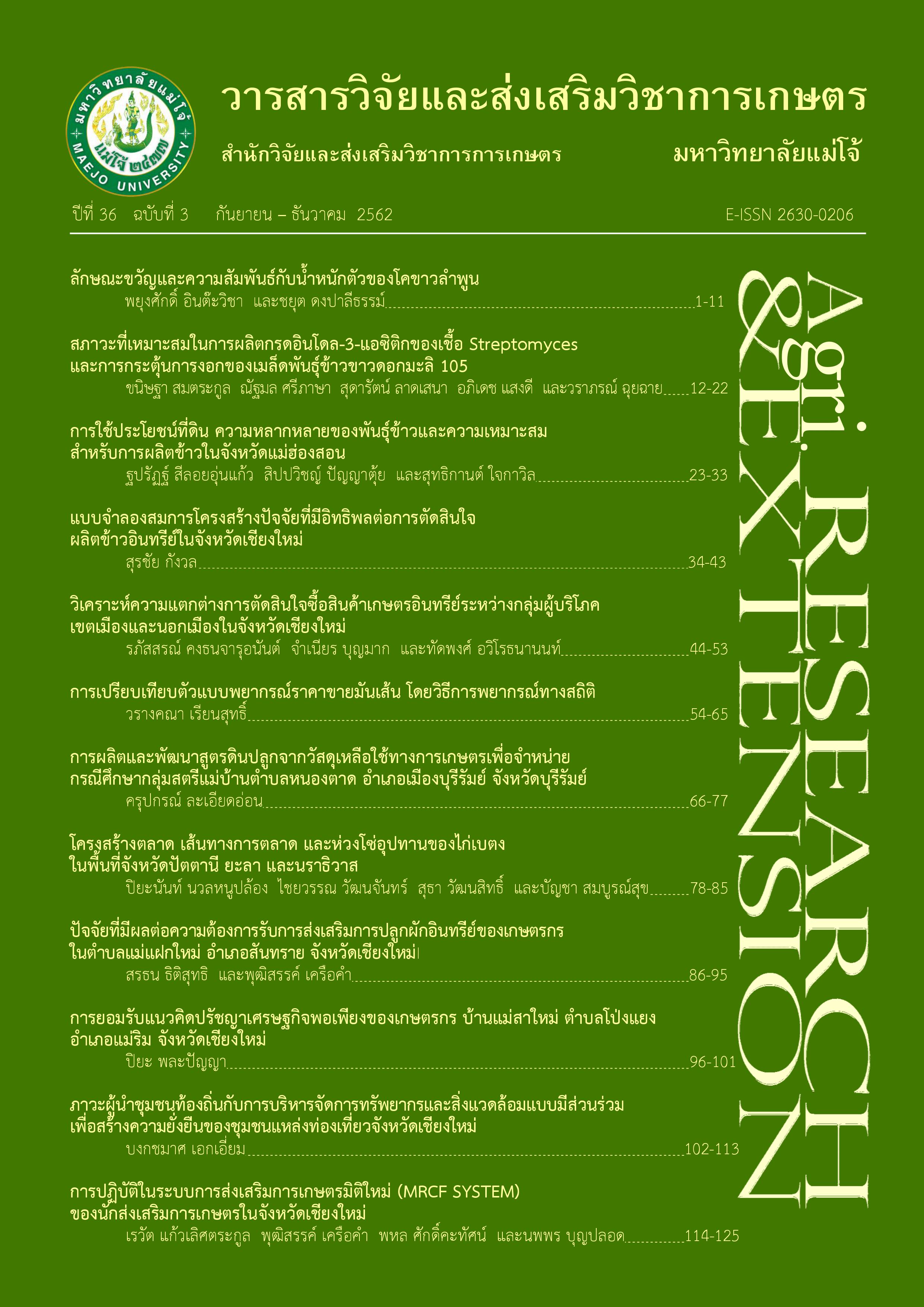
การยอมรับแนวคิดปรัชญาเศรษฐกิจพอเพียงของเกษตรกร บ้านแม่สาใหม่ ตำบลโป่งแยง อำเภอแม่ริม จังหวัดเชียงใหม่
คำสำคัญ:
เศรษฐกิจพอเพียง, การยอมรับ, จังหวัดเชียงใหม่บทคัดย่อ
การวิจัยครั้งนี้มีวัตถุประสงค์เพื่อศึกษาการยอมรับความรู้จากแนวคิดเศรษฐกิจพอเพียงไปปฏิบัติของเกษตรกรกลุ่มตัวอย่างที่ใช้ในการศึกษาคือ เกษตรกร บ้านแม่สาใหม่ ตำบลโป่งแยง อำเภอแม่ริม จังหวัดเชียงใหม่ จำนวน 350 คนเครื่องมือที่ใช้ คือ แบบสัมภาษณ์ วิเคราะห์ข้อมูลโดยโปรแกรมสำเร็จรูปเพื่อการวิจัยทางสังคมศาสตร์ โดยใช้สถิติพรรณนา (Descriptive Statistics) การแจกแจงความถี่ (Frequency) ค่าเฉลี่ย (Mean) และร้อยละ (Percentage)
ผลการศึกษาพบว่า เกษตรกรส่วนใหญ่ไม่มีประสบการณ์ที่สอดคล้องกับแนวคิดปรัชญาเศรษฐกิจพอเพียง มากกว่ากึ่งหนึ่งไม่มีประสบการณ์ในการฝึกอบรมเกี่ยวกับแนวคิดปรัชญาเศรษฐกิจพอเพียง และส่วนใหญ่ไม่มีประสบการณ์การศึกษาดูงานเกี่ยวกับแนวคิดปรัชญาเศรษฐกิจพอเพียง ระดับการยอมรับเรื่องแนวคิดปรัชญาเศรษฐกิจพอเพียงของการเกษตรกร พบว่า เกษตรกรมีระดับการยอมรับมาก 3 ประเด็น ได้แก่ ประเด็นการปฏิบัติตน หลักการพึ่งพาตนเอง และการนำไปปฏิบัติต้องมีความพอเพียงในด้านต่างๆ ในระดับปานกลาง 3 ประเด็น ได้แก่ ประเด็นการทำอาชีพที่สอดคล้องกับแนวคิดของเศรษฐกิจพอเพียง ปัจจัยพื้นฐานของการดำรงชีวิต และการดำเนินชีวิตทางภาคเกษตร ปัญหา อุปสรรค และข้อเสนอแนะในการยอมรับแนวคิดปรัชญาเศรษฐกิจพอเพียงของเกษตรกรบ้านแม่สาใหม่ ตำบลโป่งแยง อำเภอแม่ริม จังหวัดเชียงใหม่ พบว่าเกษตรกรประสบปัญหาในประเด็น 1) การเข้าถึงเกษตรกรทำได้ยาก เนื่องจากเกษตรกรเป็นชาวเขา การรับรู้เรื่องที่ผู้ส่งสารอาจไม่ชัดเจน สื่อสารไม่ตรงกัน 2) เนื้อหาสาระบางทีเข้าใจยาก ผู้ส่งสารไม่สามารถทำให้เกษตรกรสนใจเนื้อหาได้ 3) ช่องทางการสื่อสารการเข้าถึงหมู่บ้านไม่ยาก แต่ไม่มีหน่วยงานใดเข้าไปให้ความรู้เกี่ยวกับเศรษฐกิจพอเพียง 4) การเปิดรับความรู้ใหม่ ๆ ของเกษตรกรยังไม่มากพอ ส่วนข้อเสนอแนะในการเปิดรับข่าวสารของเกษตรกร ได้แก่ 1) ควรมีผู้ส่งสาร ที่มีความรู้ และความสามารถในการสื่อสารภาษาท้องถิ่นได้ 2) เนื้อหาควรใช้สื่อที่มีประสิทธิภาพในการสื่อสารกับเกษตรกร 3) ผู้รับสารควรมีความกระตือรือร้น ใฝ่รู้ ใฝ่เรียน พร้อมที่จะเปิดรับความรู้ใหม่ๆ
เอกสารอ้างอิง
Rungkawat, N. 2012. Communication process and adoption of sufficiency economy philosophy by farmers in Chiang Mai Province. Doctoral Dissertation. Chiang Mai University. 215 p. [in Thai]
Simarak, S. 2012. Learning model on sufficiency economy philosophy for farmers in Phitsanulok provience, Thailand. Doctoral Dissertation. Chiang Mai University. 191 p. [in Thai]
Taweerat , P. 1997. Research methodology in Behavioral Sciences and Social Sciences (7thed.). Bangkok: Srinakharinwirot University. 303 p. [in Thai]
Yamane, T. 1967. Statistics: An Introductory Analysis. New York: Harper and Row. 886 p.
ดาวน์โหลด
เผยแพร่แล้ว
รูปแบบการอ้างอิง
ฉบับ
ประเภทบทความ
สัญญาอนุญาต

อนุญาตภายใต้เงื่อนไข Creative Commons Attribution-NonCommercial-NoDerivatives 4.0 International License.
บทความนี้ได้รับการเผยแพร่ภายใต้สัญญาอนุญาต Creative Commons Attribution-NonCommercial-NoDerivatives 4.0 International (CC BY-NC-ND 4.0) ซึ่งอนุญาตให้ผู้อื่นสามารถแชร์บทความได้โดยให้เครดิตผู้เขียนและห้ามนำไปใช้เพื่อการค้าหรือดัดแปลง หากต้องการใช้งานซ้ำในลักษณะอื่น ๆ หรือการเผยแพร่ซ้ำ จำเป็นต้องได้รับอนุญาตจากวารสาร