
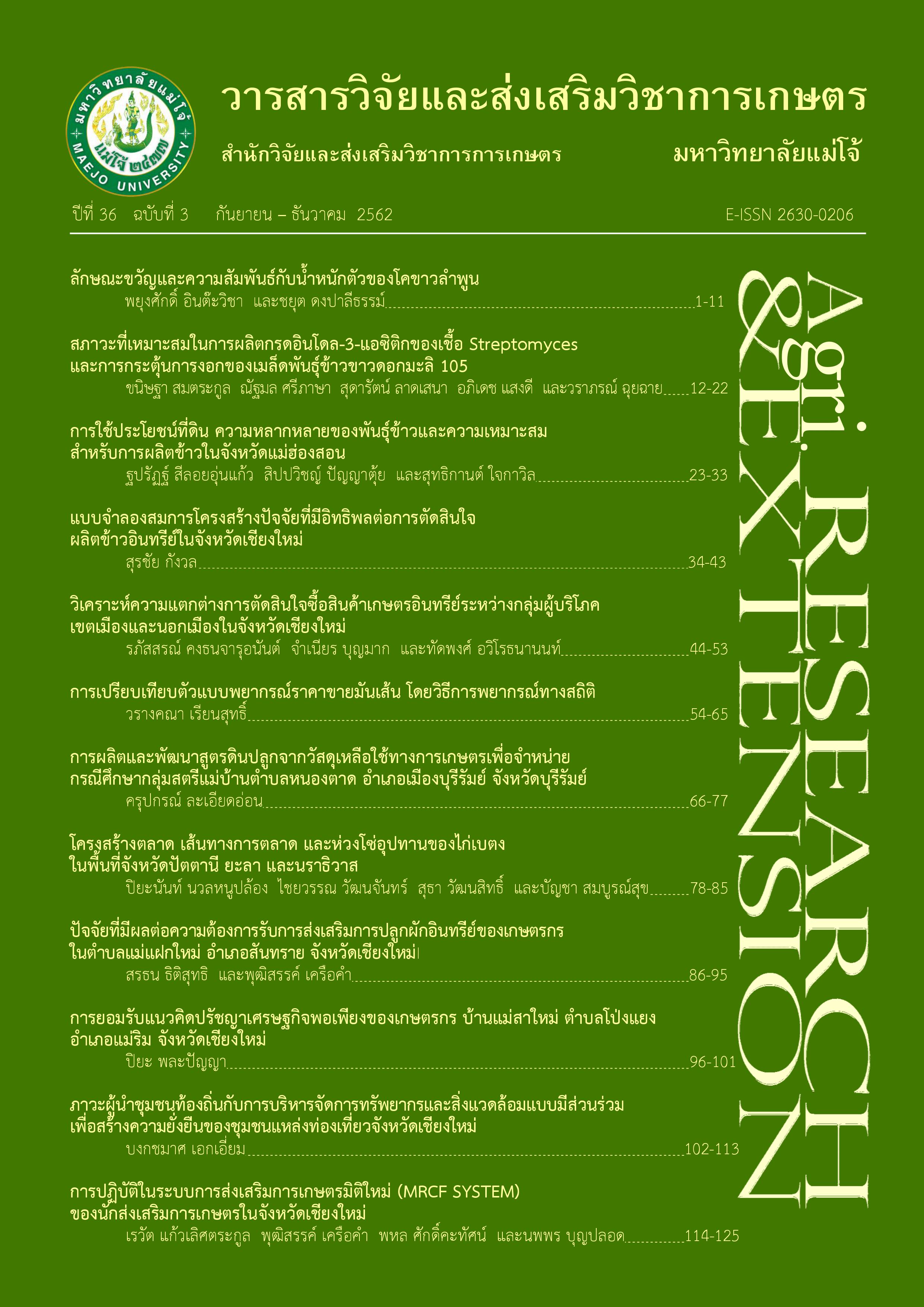
Practice of Agricultural Extension Worker in the New Dimension Agricultural Extension System (MRCF SYSTEM) in Chiang Mai Province
Keywords:
practice, the new dimension agricultural extension system, agricultural extension workerAbstract
The objectives of this study were to investigate: 1) socio–economic attributes of agricultural extension worker; 2) practice in accordance with the system of new dimension of agricultural extension of the agricultural extension worker; 3) factors effecting practice in accordance with the system of new dimension of agricultural extension; and 4) problems encountered and suggestion about practice in accordance with the system of new dimension of agricultural extension. The sample group in this study consisted of 172 agricultural extension works in Chiang Mai province. A set of questionnaire was used for data collection and analyzed by using descriptive statistics i.e. frequency, percentage, mean, and standard deviation. Multiple suggestion was also employed for an analysis.
Results of the study revealed that most of the respondents were male, 42 years old on average, married, and bachelor’s degree holders. Their monthly income was 28,513 baht and their household debt was 351,396 baht on average. Their years of service was 14 years and they attended training once a year on average. They perceived information about agricultural extension through printed media, the respondents had a high level of knowledge and understanding about the system of new dimension agricultural extension but a moderate level of its practice. Factors effecting practice in accordance with the new dimension of agricultural extension system included age, assigned task, household debt, training, and social position of the respondents.
The following were problems encountered and suggestions: 1) problem in program system (QGIS, gisagro, Faamis and inconstant speed of internet; 2) some areas were beyond title deed; 3) remote areas which could not access to social media; 4) expenses on communication between the agricultural extension worker and the farmer ; 5) farmers had a lot of task with must be done every day ; 6) concerned agencies lacked of participation; 7) an analysis of “area/people/product” was not in accordance with time span due to too many tasks ; and 8) unclear task. Therefore, the following were suggested: improvement of internet system; promotion of farmer to adoption communication technology; putting the importance on integrated operation among concerned agencies in the area; a continual holding a training for agricultural extension workers about the new dimension of agricultural extension
References
Dejnambanchachai, W. 2012. Factors in the adoption of e-custom by business companies in Thailand (Eastern area of Thailand as a case study). NIDA Development Journal 50(1): 59-79. [in Thai]
Department of Agricultural Extension. 2014. MRCF Extension System. Bangkok: Department of Agricultural Extension. 15 p. [in Thai]
Jitanan, B. 1997. Agricultural Extension. Bangkok: Kasetsart University. 225 p. . [in Thai]
Panpinit, S. 2001. Social Change and Agricultural Extension. Bangkok: Kasetsart University. 256 p. [in Thai]
Phengsawat, W. 2010. Applied Statistics for Social Science Research. Bangkok: Suveeriyasarn. 428 p. [in Thai]
Prasit-rathasint, S. 2002. Applications of Statistical Methods in Research. Bangkok: Fueang Fa Printing House. 352 p. [in Thai]
Sangkaphun, K., S. Jaiyen and P. Vichaidit. 2007. Performance effectiveness of Suratthani provincial police. Academic Journal Phranakhon Rajabhat University 8(2): 55-65. [in Thai]
Sangsiri, N. and V. Lawbaumrung. 2013. Motivation to work of Lad Yao subdistrict administrative organization’s staff in Nakhon Sawan province. The Golden Teak: Humanity and Social Science Journal 19(1): 129-140. [in Thai]
Siriwathananukul, Y., S. Yuthana, L. Mongkol and I. Aummorn. 2007. The adoption of farmers on longkong orchard technological management amphoe Bacho, Changwat Narathiwat. Thaksin University Journal 10(2): 32-49. [in Thai].
Siriniwatkul, J. 2015. Determinants Influencing the SAP System Adoption of State Enterprises: A Case Study of Thailand Institute of Scientific and Technological Research. Master Thesis. Rajamangala University of Technology Thanyaburi. 138 p. [in Thai]
Sujaritturakarn, W. and J. Tanapanyaratchawong. 2010. Factors influencing the adoption of production techniques and applications of organic fertilizer for farmers in Hatyai district, Songkhla province. Suranaree Journal of Social Science 4(1): 29-43. [in Thai].
Thongmullek, T. and P. Vichitthamaros. 2017. The study of factors affecting acceptance and use of social network of people in Thailand. The Journal of Social Communication Innovation 5(2): 114-124. [in Thai].
Wipak, R., N. Turnbull and S. Siwina. 2017. Factors related to data quality management for 43 public health data folders in primary care unit network at Chaturaphakphiman district, Roi-Et province. The Southern College Network Journal of Nursing and Public Health 4(Special Issue): 162-179. [in Thai].
Yamane, T. 1973. Statistics: An Introductory Analysis. New York: 3. S. l. Harper International. 886 p.
Downloads
Published
How to Cite
Issue
Section
License

This work is licensed under a Creative Commons Attribution-NonCommercial-NoDerivatives 4.0 International License.
This article is published under a Creative Commons Attribution-NonCommercial-NoDerivatives 4.0 International License (CC BY-NC-ND 4.0), which allows others to share the article with proper attribution to the authors and prohibits commercial use or modification. For any other reuse or republication, permission from the journal and the authors is required.


