
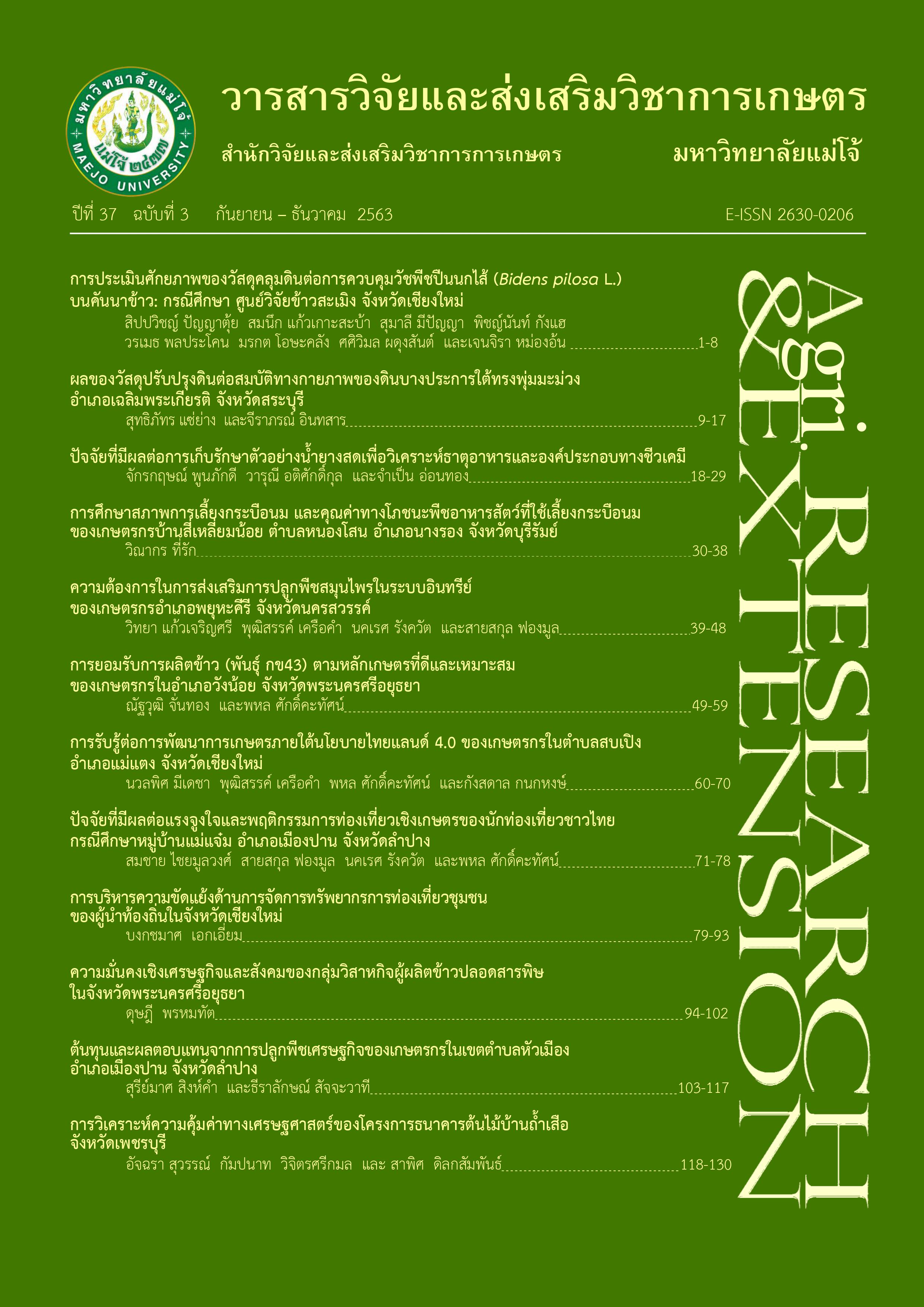
Conflict Management in Community Tourism Resource Management of Local Leaders in Chiang Mai
Keywords:
conflicts management, community tourism, tourism resources management, local leaderAbstract
Local community leaders play an important role in conflict management of tourism resources within the community. Each leader may choose different strategies or methods of managing conflicts, depending on the characteristics and roles of the leader, or the causes of conflict, factors, and the conflict situations. This study aimed to study the conflicts and the patterns of conflict management in tourism resources management of local community leaders in order to propose guidelines and an appropriate conflict management model to manage tourism resources within the community for sustainable use. This study used conflict management concepts in determining conceptual frameworks, and applied both quantitative and qualitative research methods for data collection and data analysis. The research results showed that the communities have conflicts in tourism resource management at a moderate level. While the leaders agree that there were conflicts of the structure of the community, government regulations, and inconsistent internal operations, the people indicated that conflicts arise from the goals and expectations of people in different communities, and the structure of the community. Both leaders and local peoples agreed that leaders had conflict management in 5 patterns: 1) competing, 2) avoiding conflict, 3) compromise, 4) accommodation and 5) corroborating. The appropriate conflict management depended on the conflict situations or problems. However, conflict management with emphasis on cooperation of all stakeholders was the best solution of conflicts in tourism resources. Factors supporting successful conflict management were leadership, community participation in resource management, good relationships among people in the community, and community culture.References
Charoensiri, W. 2011. Conflict Management in Public Lands in Mahasarakham Province. Master Thesis. Rajabhat Rajanagarindra University. 238 p. [in Thai]
Chevasiri, N. 2001. Strength of Community-Based Natural Resource Management: A Case Study of Ban Ta Pong, NongHarn Sub-district San Sai District Chiang Mai Province. Master Thesis. Chiang Mai University. 98 p. [in Thai]
Chiang Mai Provincial Office. 2017. Chiang Mai Briefing: General Information of Chiang Mai Province. Publication Documents. Chiang Mai: Strategy and Information Group for Provincial Development. 20 p. [in Thai]
Chompunth. C. 2017. Environmental conflict management: A case study of the thermal coal fired power plant project in Rayong province. Kasetsart Journal of Social Sciences 38(3): 692-703.[in Thai]
Cronbach, L.J. 1951. Coefficient alpha and the internal structure of tests. Psychometrika 16(3): 297-334.
Ek-Iem, B. 2019. Local community leadership and participative management for sustainable use of resources and environment in tourism attraction communities in Chiang Mai. Journal of Agricultural Research and Extension 36(3): 102-113. [in Thai]
Ganjanapan, A. 2000. Community Dynamics in Resource Management: Paradigms and Policies. Bangkok: The Thailand Research Fund. 559 p. [in Thai]
Graham, P. (eds). 2003. Mary Parker Follett Prophet of Management. Washington D.C: Beard Books. 309 p.
Jittasathien, P. 2010. Solving the political violence in Thailand found a dead end?King Prajadhipoks Institute Journal 8(1): 28-38. [in Thai]
Katz, D. 1964. Approaches to Managing Conflict. pp. 105-144. In Kahn R.L. and K.E. Boulding (eds.). Power and Conflict in Organizations. New York: Basic Books.
New Local Government Network. 2005. Making Community Leadership Real. London: NLGN Publication. 22 p.
Office of Tourism and Sports. 2016. Tourism Economic Review 6 (Oct.-Dec. 2016). Bangkok: Ministry of Tourism and Sports. 99 p. [in Thai]
Plathong, P., W. Krisanaputi and S. Langlaa. 2012. Conflict management in the Pahurat communiy of Bangkok. Humanities and Social Sciences 29(3): 41-80. [in Thai]
Sinthipong, U. 2015. Local communities and participation in sustainable management of natural resources. Executive journal 35(1): 104-113. [In Thai]
Sodpiban, P. 2010. Conflict management’s Bangluang market 122 rattanakosin era. Executive Journal 30(3): 191-196. [in Thai]
Thomas, K.W. 1976. Conflict and Conflict Management. pp. 889-935. In Dunnette, M.D. (eds.). Handbook of Industrial and Organizational Psychology. Chicago: Rand McNally.
Thomas, K.W. 1992. Conflict and conflict management: reflections and update. Journal of Organizational Behavior 13(3): 265-274.
Trakarnsirinont, W. 2019. The traffic in Ban Mae Kampong community-based tourism, Huay Kaew sub-district, Maeon district Chiang Mai province. Political Science and Public Administration Journal 10(2): 67-84. [in Thai]
Turner, J.C. 1982. Towards a Cognitive Redefinition of the Social Group. pp. 15-40. In Tajfel, H. (eds.). Social Identity and Intergroup Relations. Cambridge: Cambridge University Press.
Ubali, C. 2015. Conflict management among local community leaders: a case study in Ta Kien Thong sub-district Khitchakoot district Chanthaburi province. Journal of Politics and Governance 5(1): 181-195. [in Thai]
Interviews:
Ming. Village Headman. (2016, February 9).
Jun. Villager. (2016, February 10).
Som. Village Headman. (2016, March 11).
Keaw. Villager. (2016, March 13).
Lam. Sub-district Headman. (2016, March 13).
Pook. Sub-district Headman. (2016, March 13).
Jom. Villager. (2016, March 11).
Discussion Group:.
Community Leaders. (2016, April 15).
Downloads
Published
How to Cite
Issue
Section
License
Copyright (c) 2020 Journal of Agricultural Research and Extension

This work is licensed under a Creative Commons Attribution-NonCommercial-NoDerivatives 4.0 International License.
This article is published under a Creative Commons Attribution-NonCommercial-NoDerivatives 4.0 International License (CC BY-NC-ND 4.0), which allows others to share the article with proper attribution to the authors and prohibits commercial use or modification. For any other reuse or republication, permission from the journal and the authors is required.


