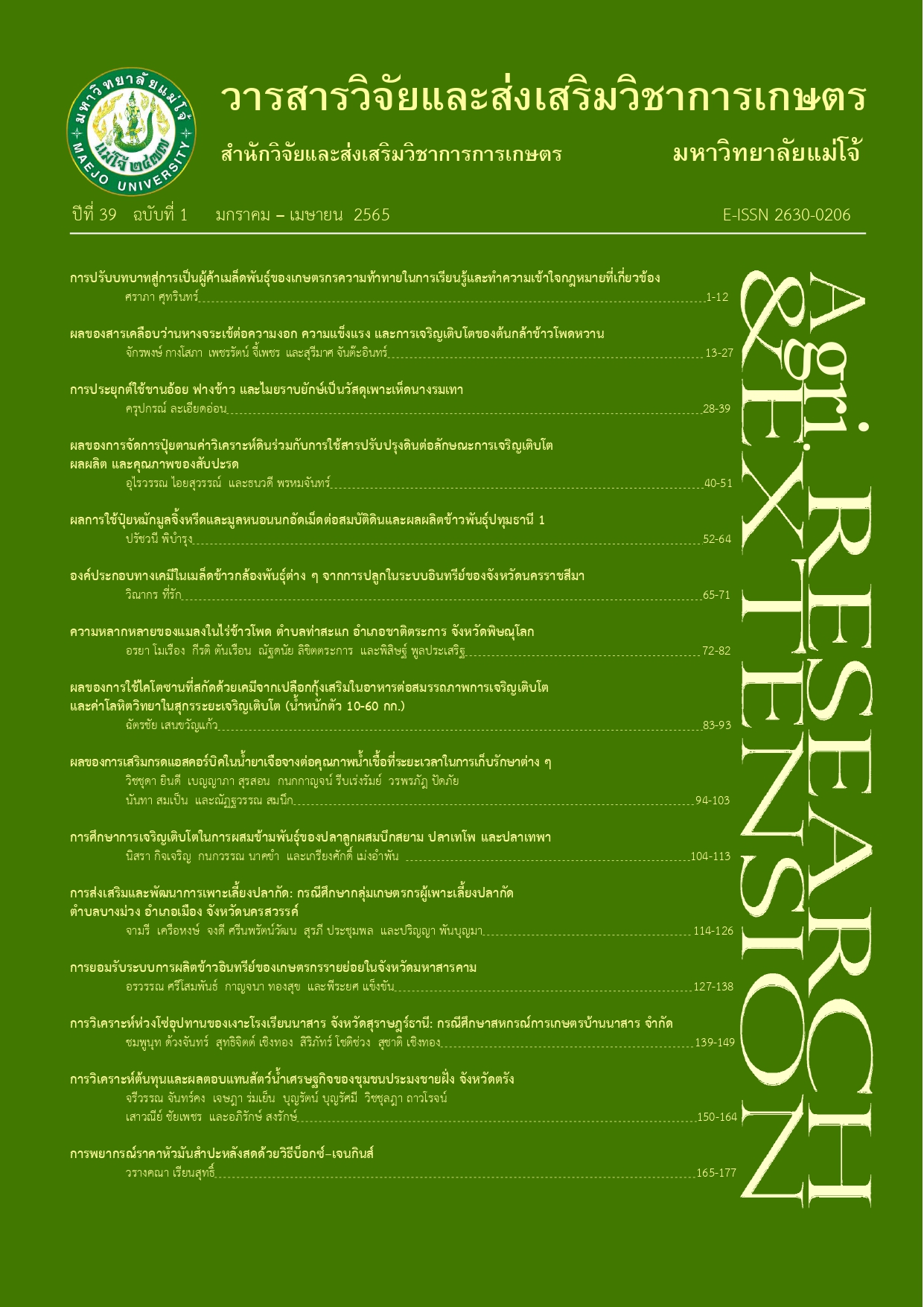
ผลของการใช้ไคโตซานที่สกัดด้วยเคมีจากเปลือกกุ้งเสริมในอาหารต่อสมรรถภาพการเจริญเติบโตและค่าโลหิตวิทยาในสุกรระยะเจริญเติบโต (น้ำหนักตัว 10-60 ก.ก.)
คำสำคัญ:
ไคโตซาน , สมรรถภาพการเติบโต , สุกร , ค่าโลหิตวิทยาบทคัดย่อ
การศึกษาผลของการสกัดไคโตซานด้วยวิธีเคมีจากเปลือกกุ้งต่อสมรรถภาพการเติบโตในสุกรเล็ก-สุกรรุ่น ใช้สุกรลูกผสม 3 สายเลือด (ดูร็อค x ลาร์จไวท์ x แลนด์เรซ) จำนวน 32 ตัว น้ำหนักเริ่มต้นเฉลี่ย 10.37 กิโลกรัม ทำการวางแผนการทดลองแบบสุ่มสมบูรณ์ (CRD) แบ่งกลุ่มการทดลองออกเป็น 4 กลุ่ม กลุ่มละ 4 ซ้ำ ๆ ละ 8 ตัว โดยกลุ่มที่ 1 คือ กลุ่มควบคุม (ไม่เสริมไคโตซาน) กลุ่มที่ 2, 3 และ 4 คือ กลุ่มเสริมไคโตซานที่สกัดด้วยเคมีระดับ 100, 200 และ 300 ppm ในสูตรอาหาร ตามลำดับ ผลการศึกษาพบว่า การดูดซึมโภชนะของสุกรทั้งหมดไม่มีความแตกต่างกันอย่างมีนัยสำคัญทางสถิติ ยกเว้นการย่อยได้ไขมันกลุ่มที่เสริมไคโตซาน 200 และ 300 ppm มีค่าสูงกว่ากลุ่มควบคุมและแตกต่างกันอย่างมีนัยสำคัญทางสถิติ (P<0.05) สมรรถภาพการผลิตของสุกรทุกกลุ่มการทดลองไม่แตกต่างกันอย่างมีนัยสำคัญทางสถิติ (P>0.05) ส่วนผลต่อองค์ประกอบของเลือด พบว่ากลุ่มเสริมไคโตซาน 100 และ 200 ppm มีค่าฮีมาโตคริต สูงกว่ากลุ่มควบคุมอย่างมีนัยสำคัญยิ่งทางสถิติ (P<0.01) ส่วนปริมาณเม็ดเลือดขาวทั้งหมด พบว่ากลุ่มที่เสริม ไคโตซาน 200 และ 300 ppm มีปริมาณเม็ดเลือดขาว สูงกว่ากลุ่มควบคุมอย่างมีนัยสำคัญยิ่งทางสถิติ (P<0.01) และแตกต่างอย่างมีนัยสำคัญทางสถิติกับกลุ่มที่เสริม ไคโตซาน 100 ppm ดังนั้นการเสริมไคโตซานควรจะใช้ในระดับ 300 ppm ในสูตรอาหารเพื่อใช้เป็นสารเสริมต่อการเจริญเติบโต และทำให้เม็ดเลือดขาวเพิ่มสูงขึ้นนั้นอาจหมายถึงภูมิคุ้มกันของสุกรเพิ่มขึ้น ซึ่งจะส่งผลดี ต่อสุขภาพของสุกร
เอกสารอ้างอิง
Aluko, K., V.E. Deepak, K. Ehsan, L. Aike, and Y. Yulong. 2017. Combined effects of chitosan and microencapsulated Enterococcus faecalis CG1.0007 probiotic supplementation on performance and diarrhea incidences in enterotoxigenic Escherichia coli K88+ challenged piglets. Animal Nutrition 3(2): 366-371.
Aranaz, I., M. Mengibar, R. Harris, I. Panos, B. Miralles and N. Acosta. 2009. Functional characterization of chitin and chitosan. Current Chemical Biology 3(2): 203-230.
Association of Official Chemists (AOAC). 1998. Official Method of Analysis of Association of Official Analytical Chemists. 18th ed. Washington: Association of Official Analytical Chemists Internation. 1298 p.
Bucolo, G. and H. David. 1973. Quantitative determination of serum triglycerides by the use of enzymes. Clinical Chemistry 19(5): 476-482.
Chiraphan, T. 2008. The Effect of Chitosan Usage on Fattening Pig Performance. Nakhon Sawan: Faculty of Agricultural Technology and Industrial Technology, Nakhon Sawan Rajabhat University.
p. [in Thai]
Chongritthiporn, S., A. Kangsuwan and R.K. Sudip. 2003. Inhibition of the Growth of Bacteria that Causing Disease by Chitosan. 122 p. In Proceedings of Fisheries Seminar Department
of Fisheries, 7–9 July 2003. Bangkok: Department of Fisheries. [in Thai]
Galyean, M.L. 2010. Laboratory Procedures in Animal Nutrition Research. Lubbock: Department of Animal and Food Sciences, Texas Tech University. 193 p.
Khanafari, A., R. Marandi and Sh. Sanatei. 2008. Recovery of chitin and chitosan from shrimp waste by chemical and microbial methods. Iran Journal Environment Health Science English 5(1): 19-24.
Kumar, M.Y., J.V. Ramana, A. Ravi, J. Suresh and A.V.N. Sivakumar. 2017. Effect of supplementation of shrimp waste on the immune response, hematological characters and lipid profile in crossbred weans piglets. International Journal of Science Environment and Technology 6(4): 2329-2334.
Lahsaenmuang, C., N. Thongsana, Y. Khamchan and S. Kongkaew. 2006. Effects of chitosan supplementation in food on pig-fattening pig performance. 28 p. In Special Issue. Bangkok: Department of Animal Production Technology, Faculty of Agricultural Technology, King Mongkut's Institute of Technology Ladkrabang. [in Thai]
Li, J., B. Shi, S. Yan, L. Jin, Y. Guo, Y. Xu, T. Li and X. Guo. 2013. Effects of dietary supplementation of chitosan on humoral and cellular immune function in weaned piglets. Animal Feed Science & Technology 186(2013): 204-208.
Li, X.J., X.S. Piao, S.W. Kim, P. Liu, L. Wang, Y.B. Shen, S.C. Jung and H.S. Lee. 2007. Effects of chitooligosaccharide supplementation on performance, nutrient digestibility, and serum composition in broiler chickens. Poultry Science 86(6): 1107-1114.
Park, M., E.C. Penick., J.G. Edwards., J.A. Kauer and M.D. Ehlers. 2004. Recycling endosomes supply AMPA receptors for LTP. Science 305: 1972-1975.
Satchatchaphong, C. 2009. Effects of Shrimp Meal on Production Performance, Microbial Population Change and Immune Response of Broilers. Master Thesis. Suranaree University of Technology. 111 p. [in Thai]
Senkwankaew, C., A. Makpangwon, B. Maneewon and M. Thirabunyanon. 2015. Study on Supplemented Chitosan Various Forms in Diet on Nutrients Absorption and Growth Performance of Growing –Finishing Pig (15-90 kg). Master Thesis. Maejo University. 91 p. [in Thai]
Wang, M.Q., C. Wang, Y.J. Du, H. Li, W.J. Tao, S.S. Ye, Y.D. He, and S.Y. Chen. 2014. Effects of chromium-loaded chitosan nanoparticles on growth, carcass characteristics, pork quality, and lipid metabolism in finishing pigs. Livestock Science 161(2014): 123-129.
Xiao, D., Z. Tang, Y. Yin, B. Zhang, X. Hu, Z. Feng and J. Wang. 2013. Effects of dietary administering chitosan on growth performance, jejunal morphology, jejunal mucosal sIgA, occluding, claudin-1 and TLR4 expression in weaned piglets challenged by enterotoxigenic Escherichia coli. Science Direct 17(3): 670-676.
Xu, Y., B. Shi, S. Yan, J. Li, T. Li, Y. Guo and X. Guo. 2014. Effects of chitosan supplementation on the growth performance, nutrient digestibility, and digestive enzyme activity in weaned pigs. Czech Journal Animal Science 59(4): 156-163.
Xu, Y.Q., Z.Q. Wang, Z. Qin, S.M. Yan and B.L. Shi. 2018. Effects of chitosan addition on growth performance, diarrhea, anti-oxidative function and serum immune parameters of weaned piglets. South Africa Journal Animal Science 48(1): 142-150.
ดาวน์โหลด
เผยแพร่แล้ว
รูปแบบการอ้างอิง
ฉบับ
ประเภทบทความ
สัญญาอนุญาต
ลิขสิทธิ์ (c) 2022 วารสารวิจัยและส่งเสริมวิชาการเกษตร

อนุญาตภายใต้เงื่อนไข Creative Commons Attribution-NonCommercial-NoDerivatives 4.0 International License.
บทความนี้ได้รับการเผยแพร่ภายใต้สัญญาอนุญาต Creative Commons Attribution-NonCommercial-NoDerivatives 4.0 International (CC BY-NC-ND 4.0) ซึ่งอนุญาตให้ผู้อื่นสามารถแชร์บทความได้โดยให้เครดิตผู้เขียนและห้ามนำไปใช้เพื่อการค้าหรือดัดแปลง หากต้องการใช้งานซ้ำในลักษณะอื่น ๆ หรือการเผยแพร่ซ้ำ จำเป็นต้องได้รับอนุญาตจากวารสาร