
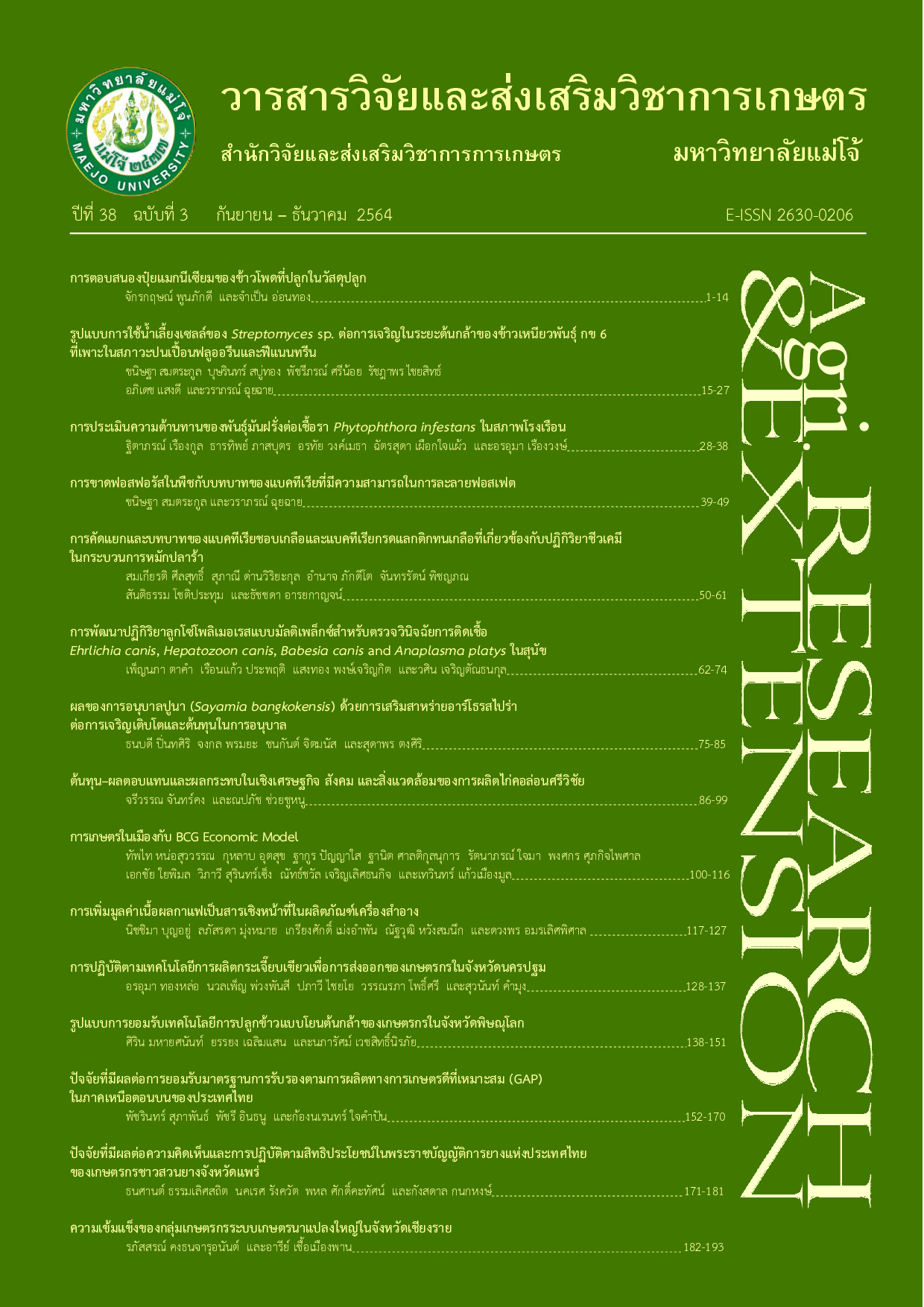
Urban Agriculture and BCG Economic Model
Keywords:
urban agriculture, BCG Economic ModelAbstract
This review aimed to call attention to the urban agricultural development in congruence with the BCG Economic Model, which was related to the reduction of resource usage, resource renewability, and waste reduction from the lives of urban people, including adding values on land use and the supporting urban ecosystems. The characteristics and advantages of urban agricultures differed depending on the purposes and local socio-economic contexts. Under land size limitation, intensive production and technologies were needed to enhance efficiency and productivity. Urban agriculture can also reduce the ecological footprint caused by consumer behaviors by recycling urban waste into growing mediums and soil amendments. By sharing residential and agricultural spaces, designing urban agriculture must respond to the diverse needs and integrate itself with the urban landscape ecology and geosocial conditions. Urban agriculture had the potential to supply urban vegetable consumption. Economic returns depended on to adaptability and multifunctionality to serve urban needs. Therefore, the development of urban agriculture requires collaborations of the associated sectors to support national economic development based on the BCG Economic Model. This article included important information regarding urban agricultural development under BCG Economic Model Framework. Researchers, agriculturalists, and decision makers can use this information for better support this type of agriculture. Furthermore, researchers can develop the knowledge further to respond to challenges mentioned in this article to further benefit urban agriculture.
References
Anastasiou, A., A. de Valenca, E. Amare, G.M. de Oca, I. Widyaningrum, K. Bokhorst and S. Liu. 2014. The Role of Urban Agriculture in Urban Organic Waste Management in The Hague, The Netherlands. Wageningen: Wageningen University. 66 p.
Armanda, D.T., J.B. Guinée and A. Tukker. 2019. The second green revolution: innovative urban agriculture's contribution to food security and sustainability – a review. Journal of Global Food Security 22: 13-24.
Artmann, M. and K. Sartison. 2018. The role of urban agriculture as a nature-based solution: a review for developing a systemic assessment framework. Journal of Sustinability 10(6): 1-32.
Aubry, C., J. Ramamonjisoa, M.-H. Dabat, J. Rakotoarisoa, J. Rakotondraibe and L. Rabeharisoa. 2012. Urban agriculture and land use in the cities: an approach with the multi-functionality and sustainability conceep in the case of Antananarivo (Madagascar). Journal of Land Use Policy 29(2): 429-439.
Azunre, G.A., O. Amponsah, C. Peprah, S.A. Takyi and I. Braimah. 2019. A review of the role of urban agriculture in the sustainable city discourse. Journal of Cities 93: 104-119.
Bakker, N., M. Dubbeling, S. Gündel, U. Sabel-Koschella and H. de Zeeuw. 2000. Growing Cities, Growing Food: Urban Agriculture on the Policy Agenda, A Reader on Urban Agriculture. Feldafing: Deutsche Sitftung für International Entwicklung. 531 p.
Benis, K. and P. Ferrão. 2018. Commercial farming within the urban built environment–Taking stock of an evolving field in northern countries. Journal of Global Food Security 17: 30-37.
Breunig, H.M., J. Amirebrahimi, S. Smith and C.D. Scown. 2019. Role of digestate and biochar in carbon–negative bioenergy. Journal of Environmental Science and Technology 53(22): 12989-12998.
Carabassa, V., X. Domene and J.M. Alcaniza. 2020. Soil restoration using compost–like–outputs and digestates from non–source–separated urban waste as organic amendments: limitations and opportunities. Journal of Environmental Management 255: 1-10.
Charoenlertthanakit, N., C. Wanitchayapaisit, E. Yaipimol, V. Surinseng and P. Suppakittpaisarn. 2020. Landscape planning for an agricultural research center: a research–by–design case study in Chiang Mai, Thailand. Journal of Land 9(5): 149.
Codyre, M., E.D.G. Fraser and K. Landman. 2015. How does your garden grow? An empirical evaluation of the cost and potential of urban gardening. Journal of Urban Forestry and Urban Greening 14(1): 72-79.
Community of Bio–economic Research Revolving Economy and Green Economy. 2018. BCG in action: science development technology and innovation in Thailand for the biological economy circular economy and green economy. [Online]. Available http://stiic.sti.or.th/work/bcg-model/ (20 July 2020).
Diehl, J.A., E. Sweeney, B. Wong, C.S. Sia, H. Yao and M. Prabhudesai. 2020. Feedingcities: Singapore's approach to land use planning for urban agriculture. Journal of Global Food Security 26: 1-11.
Döhren, P.V. and D. Haase. 2015. Ecosystem disservices research: a review of the state of the art with a focus on cities. Journal of Ecological Indicators52: 490-497.
Elkhalifa, S., T. Al–Ansari, H.R. Mackey and G. McKay. 2019. Food waste to biochars through pyrolysis: a review. Journal of Resources, Conservation and Recycling 144: 310-320.
Energy Research and Development Institute–Nakornping, Chiang Mai University. 2020. Biomass management center Chiang Mai University. Chiang Mai: Nakornping Energy Research and Development Institute (Chiang Mai University). [Online]. Available https://erdi. cmu.ac.th/?p=1445 (20 October 2020).
FAO. 2003. The informal food sector–municipal support policies for operators. [Online]. Available http://www.fao.org/3/a-y4312e.pdf (20 October 2020).
.18. FAO. 2007. Profitability and sustainability of urban and peri–urban agriculture. [Online]. Available http://www.fao.org/ 3/a-a1471e.pdf (20 October 2020).
FAO. 2010. Growing greener cities. [Online]. Available http://www.fao.org/ag/agp/greenercities/pdf-/ggc-en.pdf (20 October 2020).
FAO. 2014. Growing greener cities in Latin America and the Caribbean. [Online]. Available http://www.fao.org/3/a-i3696e.pdf (20 October 2020).
Golden, S. 2013. Urban agriculture impacts: social, health, and economic: a literature review. [Online]. Available https://ucanr.edu/sites/CEprogramevaluation/files/215003.pdf (20 October 2020).
Grewal, S.S. and P.S. Grewal. 2012. Can cities become self-reliant in food?. Journal of Cities 29(1): 1-11.
Hallett, S., L. Hoagland and E. Toner. 2016. Urban Agriculture: Environmental, Economic, and Social Perspectives. pp. 65-120. In Janick, J. (ed.). Horticultural Reviews. New Jersey: Wiley–Blackwell, Inc.
Hansen, P.G. and A.M., Jespersen. 2013. Nudge and the manipulation of choice: a framework for the responsible use of the nudge approach to behaviour change in public policy. European Journal of Risk Regulation 4(1): 3-28.
Hashim, N. 2015. Reversing food desertification: examining urban farming in Louisville, Chicago and Detroit. Journal of Local Environment 20(6): 611-636.
Hawkins, J.L., J. Mercer, K.J. Thirlaway and D.A. Clayton. 2013. Doing gardening and being at the allotment site: exploring the benefits of allotment gardening for stress reduction and healthy aging. Journal of Ecopsychology 5(2): 110-125.
Huang, D. and M. Drescher. 2015. Urban crops and livestock: the experiences, challenges, and opportunities of planning for urban agriculture in two Canadian provinces. Journal of Land Use Policy 43: 1-14.
Hunold, C., Y. Sorunmu, R. Lindy, S. Spatari and P.L. Gurian. 2016. Is urban agriculture financially sustainable? An exploratory study of small–scale market farming in Philadelphia, Pennsylvania. Journal of Agriculture, Food Systems, and Community Development 7(2): 51-67.
Jamal, M. and S.S. Mortez. 2014. The effect of urban agriculture in urban sustainable development and its tecniques: a case study in Iran. International Journal of Agriculture and Forestry 4(4): 275-285.
Jia, J., B. Li, Z. Chen, Z. Xie and Z. Xiong. 2012. Effects of biochar application on vegetable production and emissions of N2O and CH4. Journal of Soil Science and Plant Nutrition 58(4): 503-509.
Kanokwalee, S. 2012. The impact of food distances on the ecological pattern of food sources in Bangkok. NAJUA: Architecture. Journal of Design and Built Environment 26: 71-71. [in Thai]
Körner, I., I. Saborit–Sánchez and Y. Aguilera–Corrales. 2008. Proposal for the integration of decentralised composting of the organic fraction of municipal solid waste into the waste management system of Cuba. Journal of Waste Management 28(1): 64-72.
Lawson, L.J. 2005. City Bountiful: A Century of Community Gardening in America. Berkeley: University of California. 363 p.
Lee, J.W., B. Hawkins, D.M. Day and D.C. Reicosky. 2010. Sustainability: the capacity of smokeless biomass pyrolysis for energy production, global carbon capture and sequestration. Journal of Energy and Environmental Science 3(11): 1695-1705.
Lehmann, J. 2007. A handful of carbon. Journal of Nature 447(7141): 143-144.
Lin, B.B., S.M. Philpott and S. Jha. 2015. The future of urban agriculture and biodiversity–ecosystem services: challenges and next steps. Journal of Basic and Applied Ecology 16(3): 189-201.
López, G.I.M., G. Kim, Y. Lei, G. Newman and P. Suppakittpaisarn. 2021. An assessment method and typology for the regeneration of vacant land in Quito, Ecuador. Journal of Urban Forestry and Urban Greening 62. 127-130.
Madmaiy. B. 2009. The use of bioenergy technology for efficient energy management. Technology Promotion 35(205): 60-67. [in Thai]
Manorom, K. and S. Promthong. 2018. Peri-urban agriculture in Ubon Ratchathani city: pressure and persistence. Journal of Mekong Societies 14(1): 41-62.
McLain, R., M. Poe, P.T. Hurley, J. Lecompte–Mastenbrook and M.R. Emery. 2012. Producing edible landscapes in Seattle's urban forest. Journal of Urban Forestry and Urban Greening 11(2): 187-194.
Ministry of Higher Education, Science, Research and Innovation. 2019. Proposal for BCG in action: the new sustainable growth engine. [Online]. Available https://www.nstda.or.th/th/images/- file-pdf/20200306-bcg-in-action.pdf (21 October 2020). [in Thai]
Mougeot, L.J.A. 2000. Urban Agriculture: Definition, Presence, Potentials and Risks and Policy Challenges. 58 p. In Cities Feeding People Series Report 31. Ottawa: International Development Research Centre.
Office of National Higher Education Science Research and Innovation Policy Council. 2020. BCG in action. [Online]. Available https://www.nxpo.or.th/th/en/bcg-in-action/ (5 May 2021).
Orsini, F., N. Michelon, F. Scocozza and G. Gianquinto. 2008. Farmers–to–consumers: an example of sustainable soilless horticulture in urban and peri–urban areas. Journal of Acta Horticulturae 809: 209-220.
Orsini, F., R. Kahane, R. Nono–Womdim and G. Gianquinto. 2013. Urban agriculture in the developing world: a review. Journal of Agronomy for Sustainable Development 33(4): 695-720.
Poonpolsub, S., N. Jakrawatana, M. Pattarapremcharoen and W. Setthapun. 2017. Carbon footprint reduction from Bangkok urban home vegetable garden. International Journal of Renewable Energy 12(2): 75-86.
Pottharst, K. 1995. Urban dwellers and vacant lots: partners in pride. Journal of Parks and Recreation (Arlington) 30(9): 94-101.
Selman, P. 2012. Sustainable Landscape Planning: The Reconnection Agenda. New York: Routledge. 176 p.
Semida, W.M., H.R. Beheiry, M. Setamou, C.R. Simpson, T.A.A. El-Mageed, M.M. Rady and S.D. Nelson. 2019. Biochar implications for sustainable agriculture and environment: a review. South African Journal of Botany 127: 333-347.
Siddiqua, A. 2018. Paradigm of eco–urban–agriculture for the sustainable city: integrating the concept for urban Dhaka. Journal of Environmental Design and Planning 14: 1-14.
Sinad, T. 2016. Behavioral economics and urban policy. [Online]. Available https://www.researchgate.net/publication/340478650_sersthsastrphvtikrrmlaeanyobaykhxngmeuxng_Behavioral_Economics_and_Urban_Policy (5 May 2021). [in Thai]
Singer, C. and R.G. Brumfield. 2017. An economic analysis of urban agriculture. International Journal of Agricultural Science 2: 42-45.
Skar, S.L.G., R. Pineda-Martos, A. Timpe, B. Polling, K. Bohn, M. Kulvik and C. Delgado. 2020. Urban agriculture as a keystone contribution towards securing sustainable and healthy development for cities in the future. Journal of Blue–Green Systems 2(1): 1-27.
Spataru, A., R. Faggian and A. Docking. 2020. Principles of multifunctional agriculture for supporting agriculture in metropolitan peri-urban areas: the case of Greater Melbourne, Australia. Journal of Rural Studies 77: 34-44.
Supannika, S., J. Chalermphot, R. Sirisunyaluck, B. Limnirankul and S. Kanjina. 2019. Smallholder farmers’ adaptation to the impact of expanded urban areas in Chiang Mai province. Journal of Agricultural Research and Extension 37(1): 94-105 [in Thai]
Suppakittpaisarn, P., X. Jiang and W.C. Sullivan. 2017. Green infrastructure, green stormwater infrastructure, and human health: a review. Journal of Current Landscape Ecology Reports 2(4): 96-110.
Suppakittpaisarn, P., C.Y. Chang, B. Deal, L. Larsen and W.C. Sullivan. 2020. Does vegetation density and perceptions predict green stormwater infrastructure preference? Journal of Urban Forestry and Urban Greening 55: 126842.
Supparwoko, W. and B. Taufani. 2017. Urban farming construction model on the vertical building envelope to support the green buildings development in Sleman, Indonesia. Journal of Procedia Engineering 171: 258-264.
Sustainable Agriculture Foundation (Thailand). 2017. Urban agriculture. [Online]. Available http://www.thaicityfarm.com/category/ Research Knowledge Article (20 July 2020).
Tampio, E., T. Salo and J. Rintala. 2016. Agronomic characteristics of five different urban waste digestates. Journal of Environmental Management 169: 293-302.
Todd, L.F., K. Landman and S. Kelly. 2016. Phytoremediation: an interim landscape architecture strategy to improve accessibility of contaminated vacant lands in Canadian municipalities. Journal of Urban Forestry and Urban Greening 18: 242-256.
Tzoulas, K., H. Korpela, S. Venn, V. Yli-Pelkonen, A. Kaźmierczak, J. Niemela and P. James. 2007. Promoting ecosystem and human health in urban areas using green infrastructure: a literature review. Journal of Landscape and Urban Planning 81(3): 167-178.
Valley, W. and H. Wittman. 2019. Beyond feeding the city: the multifunctionality of urban farming in Vancouver, BC. Journal of City, Culture and Society 16: 36-44.
Waffle, A.D., R.C. Corry, T.J. Gillespie and R.D. Brown. 2017. Urban heat island as agriculture opportunities: an innovative approach. Journal of Landscape and Urban Planning 161: 103-114.
Wijitkosum, S. and P. Jiwnok. 2019. Elemental composition of biochar obtained from agricultural waste for soil amendment and carbon sequestration. Journal of Applied Sciences 9(19): 1-15.
Wynen, E. and D. Vanzetti. 2008. No through road: the limitations of food miles. [Online]. Available http://www.adbi.org/ workingpaper/2008/10/30/2735.limitations.food.miles/ (20 October 2020).
Yue, Y., L. Cui, Q. Lin, G. Li and X. Zhao. 2017. Efficiency of sewage sludge biochar in improving urban soil properties and promoting grass growth. Journal of Chemosphere 173: 551-556.
Zabaniotou, A. and K. Stamou. 2020. Balancing waste and nutrient flows between urban agglomerations and rural ecosystems: biochar for improving crop growth and urban air quality in The Mediterranean Region. Journal of Atmosphere 11(5): 1-32.
Zaid, S.M., E. Perisamy, H. Hussein, N.E. Myeda and N. Zainon. 2018. Vertical greenery system in urban tropical climate and its carbon sequestration potential: a review. Journal of Ecological Indicators 19: 57-70.
Zasada, I. 2011. Multifunctional peri-urban agriculture – A review of societal demands and the provision of goods and services by farming. Journal of Land use policy 28(4): 639-648.
Downloads
Published
How to Cite
Issue
Section
License
This article is published under a Creative Commons Attribution-NonCommercial-NoDerivatives 4.0 International License (CC BY-NC-ND 4.0), which allows others to share the article with proper attribution to the authors and prohibits commercial use or modification. For any other reuse or republication, permission from the journal and the authors is required.


