
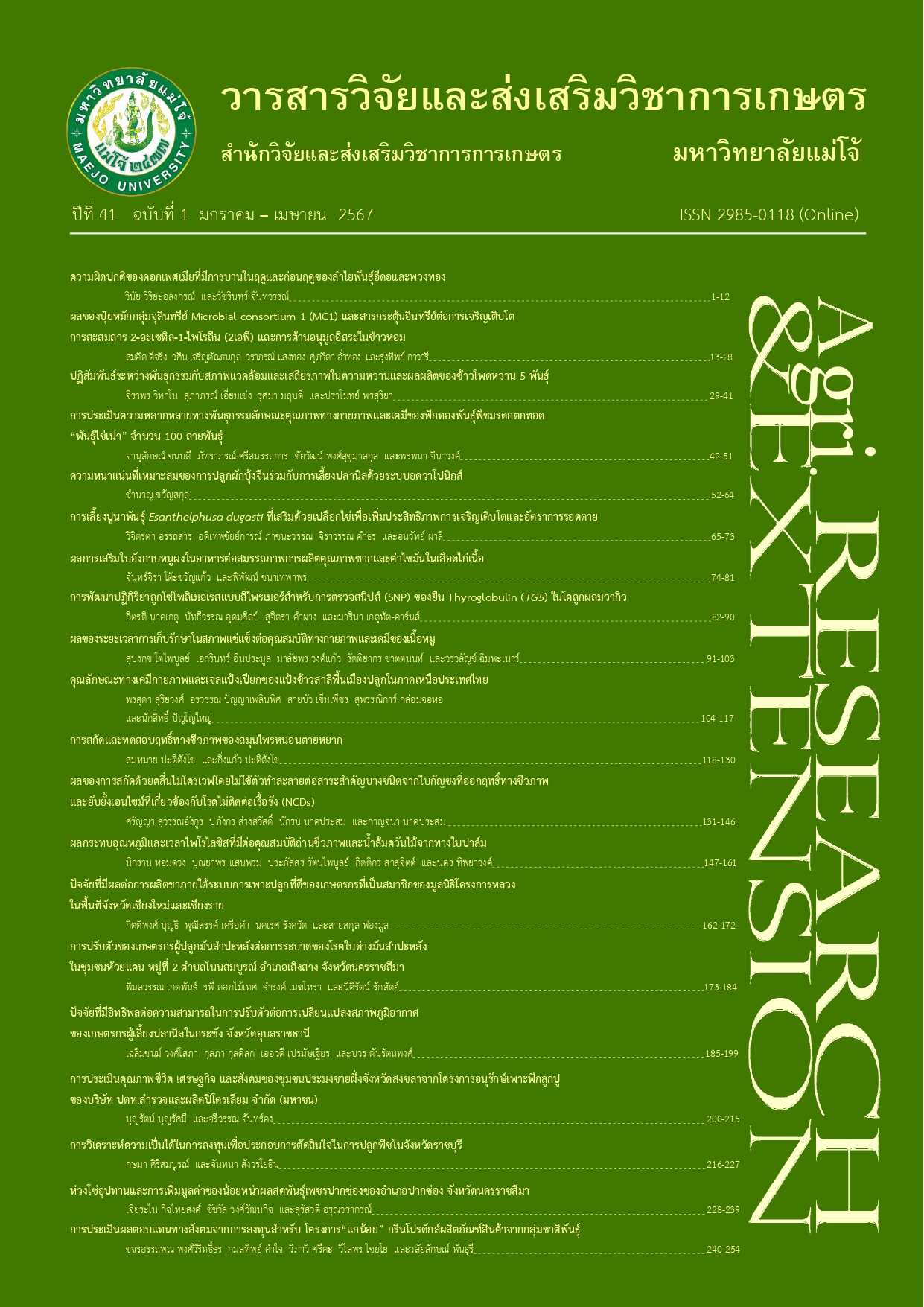
The Adaptation of Cassava Farmers to the Outbreak of Cassava Mosaic Disease in Huai Khaen Community, Moo 2, Non Somboon Subdistrict Soeng Sang District, Nakhon Ratchasima Province
DOI:
https://doi.org/10.14456/jare-mju.2024.15Keywords:
adaptation, Huai Khaen community, cassava, cassava mosaic diseaseAbstract
The cassava mosaic disease has continuously caused trouble to farmers in terms of damage to their yields and farmers' incomes. The purposes of this study were to study; 1) general information and production condition of cassava farmers in Non Somboon subdistrict, 2) cassava mosaic disease impacts on cassava production, 3) cassava farmers’ adaptation to the cassava mosaic disease. Mixed methods, including both qualitative and quantitative were analyzed, using questionnaire as the tool to gather the data from 103 cassava farmers in the area of Huai Khaen community, Moo 2, Non Somboon subdistrict, Soeng Sang district, Nakhon Ratchasima province. The result showed that; 1) most farmers (52.43%) were females with an average age of 51.00 years old, finished primary school. A number of family members engaged in cassava production were four people per household, the majority of farmers (63.11%) planted cassava variety Kasetsart 50, the average income was 50,340.15 Baht per household per production cycle, 2) the effect of cassava mosaic disease consisted of two aspects, they were economic effects in terms of crop damaged and product decline and social effects in terms of community conflicts and the change of occupation, 3) cassava farmers’ adaptation to cassava mosaic disease consisted of 3 aspects, they were production adaptation, i.e. changes in crop maintenance and changes in planting time; occupation adaptation, i.e. planting mixed crops and changing crops; and problem-solving adaptation, i.e. changes in cassava stem management and the source of the stem, and monitoring of cassava mosaic disease situation and forecasting the effects in advance. The multiple regression analysis revealed that farmer income would be explained by the adaptation variables 61.40%
References
Chanrangsi S. 2022. Korat speeds up control of spotted leaf disease after an outbreak was found in 28 districts. Korat Daily 48(2744): 14-27 September 2022. [in Thai]
Department of International Trade Promotion. 2021. Cassava Products. Bangkok: Mimeographed. 2 p. [in Thai]
Havighurst, R.J. 1953. Human Development and Education. Oxford: Longmans, Green. 135 p.
Non Somboon Subdistrict Municipality. 2019. Local Development Plan (2018-2022) Non Somboon Subdistrict Municipality, Soeng Sang District, Nakhon Ratchasima Province. Nakhon Ratchasima Province: Mimeographed. 65 p. [in Thai]
Office of Agricultural Economics. 2018. The Economic Potentials of Agricultural Commodities to the ASEAN Economic Community: A Case Study of Cassava. Bangkok: Mimeographed. 293 p. [in Thai].
Office of Agricultural Economics. 2020. Analysis of the situation of cassava mosaic disease. [Online]. Available https://www.nabc.go.th/disaster/baidang. (May 10, 2022). [in Thai]
Prasithrathsint, S. 1997. Multivariate Analysis Techniques for Social and Behavioral Science Research. Bangkok: Lieng Chiang Printing House. 579 p. [in Thai].
Rogers, C.R. 1942. Counseling and Psychotherapy; Newer Concepts in Practice. New York: Houghton Mifflin 450 p.
Tannin, S. and P. Prachonpachanuk. 2014. The adaptation to the problems of farmers cultivating coconut in Thap Sakae district, Prachuap Khiri Khan province. Journal of Social Science and Humanities 40(1): 114-127. [in Thai]
Tapioca Development Institute. 2017. Characteristics, Limitations and Brief History of Cassava Varieties. Bangkok: Mimeographed. 3 p. [in Thai]
Thamma-apipon, S. and N. Sitthiphakdee. 2017. The adaptability of the mangostee farmers to climate change, case study: Bok-Krai Community, Tambon Nam-Jeut, Amphoe Kra-Buri, Ranong Province. Veridian E-Journal, Silpakorn University 10(3): 1350-1359. [in Thai]
Yamane, T.I. 1967. Statistics: An Introductory Analysis. 2nd Ed. New York: Harper and Row. 919 p.
Downloads
Published
How to Cite
Issue
Section
License
Copyright (c) 2024 Journal of Agricultural Research and Extension

This work is licensed under a Creative Commons Attribution-NonCommercial-NoDerivatives 4.0 International License.
This article is published under a Creative Commons Attribution-NonCommercial-NoDerivatives 4.0 International License (CC BY-NC-ND 4.0), which allows others to share the article with proper attribution to the authors and prohibits commercial use or modification. For any other reuse or republication, permission from the journal and the authors is required.


