
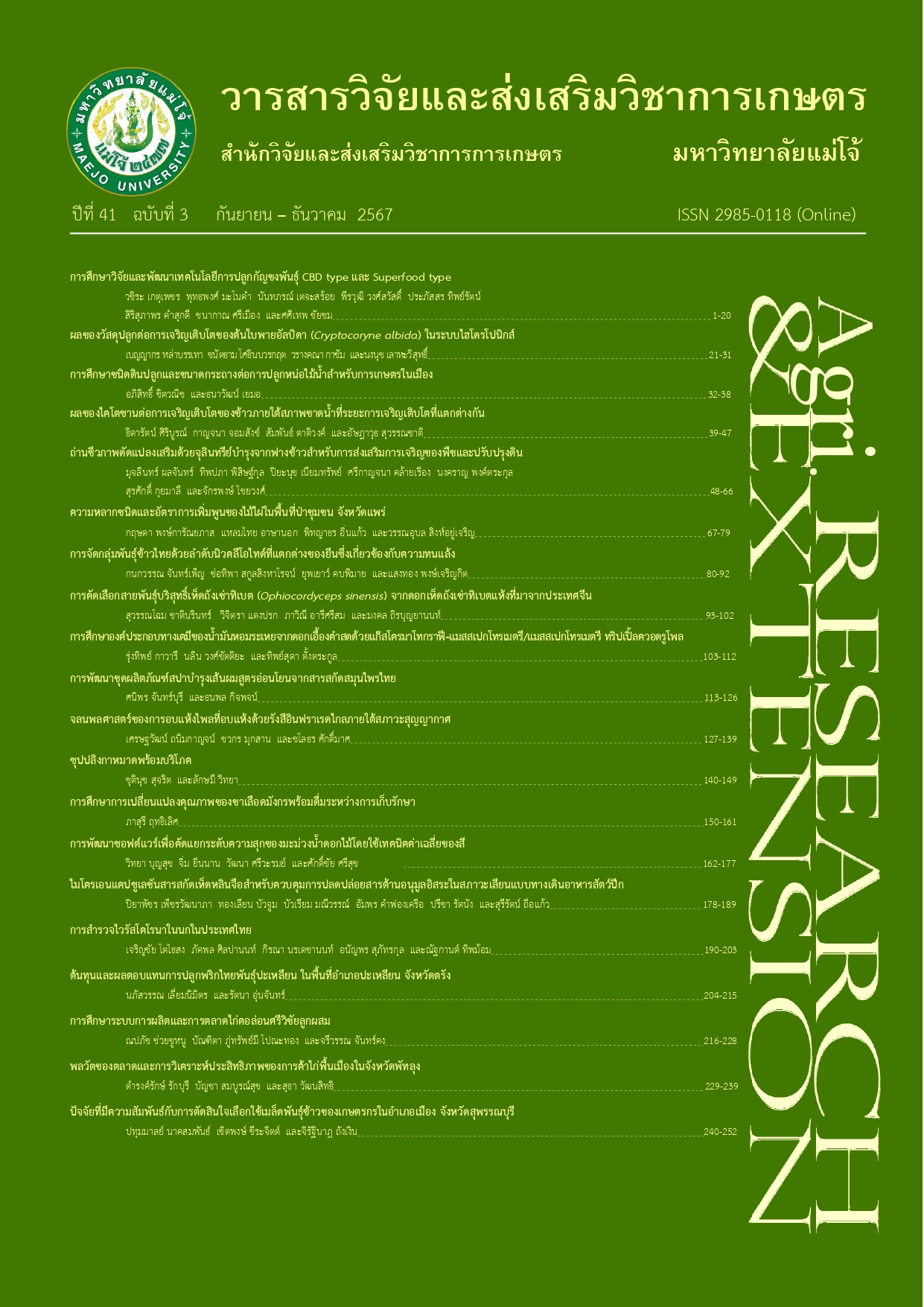
A Survey of Coronaviruses in Birds in Thailand
DOI:
https://doi.org/10.14456/jare-mju.2024.56Keywords:
Birds, Coronaviruses, Deltacoronaviruses, Gammacoronaviruses, ThailandAbstract
Coronaviruses (CoVs) are a global threat to public health, animal health, and wildlife health. They cause emerging infectious diseases and infect multiple hosts. While there have been numerous studies on mammalian coronaviruses, research on CoVs in birds is limited. To bridge this gap, the Department of National Parks, Wildlife, and Plant Conservation conducted a survey in Thailand to investigate CoVs in various bird species. Between October 2020 and September 2022, oral and cloacal swabs were collected from these birds and analyzed in the laboratory using RT-PCR and sequencing to detect and identify CoVs. A total of 530 samples were collected from 24 bird species, including shorebirds, waterfowl, wading birds, passerines and doves. Among these, 265 birds were identified, with 41.51% (110/265) being shorebirds, 21.13% (56/265) waterfowl, 20.38% (54/265) passerines, 10.19% (27/265) doves, and 6.79% (18/265) wading birds. The positive rate of CoVs was found to be 6.03% (16/265). These positive samples were classified as gammacoronaviruses, with 6.52% (3/46) detected in Lesser Whistling-Duck (Dendrocygna javanica) and 2.63% (1/38) in Whiskered Tern (Chlidonias hybrida). Deltacoronaviruses were identified in 100% (6/6) of Eastern Cattle Egret (Bubulcus coromandus), 33.33% (2/6) of Indian Cormorant (Phalacrocorax fuscicollis), 28.57% (2/7) of Little Egret (Egretta garzetta), 9.09% (1/11) Rock Pigeon (Columba livia), and 6.66% (2/30) of Barn Swallow (Hirundo rustica). It is worth noting that all positive birds appeared to be healthy. The genetic characteristics of these CoVs were similar to those found in similar bird species in other regions. Although there were no reports of abnormal sickness or mortality events among birds in the study areas, the results suggest the circulation of these viruses in local birds and their potential role in maintaining the viral transmission cycle in the region. To gain a better understanding of the epidemiology of CoVs in birds and to monitor the viral transmission cycle in the region, continuous surveillance of CoVs in migratory birds should be conducted.
References
BungBoraphet Wildlife Research Station. 2019. Ringing and Banding Studies of Migratory Shorebirds of Thailand. pp. 30-53. In Annual Report. Bangkok: Wildlife Research Division, Wildlife Conservation Office, Department of National Parks, Wildlife and Plant Conservation. [in Thai]
Cavanagh, D. 2007. Coronavirus avian infectious bronchitis virus. Veterinary Research 38: 281-297.
Chamings, A., T.M. Nelson, J. Vibin, M. Wille, M. Klaassen and S. Alexandersen. 2018. Detection and characterisation of coronaviruses in migratory and non-migratory Australian wild birds. Scientific Reports 8(5980): 1-10.
Chu, D.K.W., C.Y.H. Leung, M. Gilbert, P.H. Joyner., E.M. Ng, T.M. Tse, Y. Guan, J.S.M. Peiris and L.L.M. Poon. 2011. Avian coronavirus in wild aquatic birds. Journal of Virology 85(23): 12815-12820.
Kim, H.R. and J.K. Oem. 2014. Surveillance of avian coronaviruses in wild bird populations of Korea. Journal of Wildlife Diseases 50(4): 964-968.
Marchenko, V., A. Danilenko, N. Kolosova, M. Bragina, M. Molchanova, Y. Bulanovich, V. Gorodov, S. Leonov, A. Gudymo, G. Onkhonova, S. Svyatchenko and A. Ryzhikov. 2022. Diversity of gammacoronaviruses and deltacoronaviruses in wild birds and poultry in Russia. Scientific Reports 12(19412): 1-12.
Miłek, J. and K. Blicharz-Domanska. 2018. Coronaviruses in avian species – review with focus on epidemiology and diagnosis in wild birds. Journal of Veterinary Research 62: 249-255.
Miyabayashi, Y. and T. Mundkur. 1999. Atlas of key sites for Anatidae in the East Asian flyway. [Online]. Available https://www.wetlands.org/wp-content/uploads/2015/11/Key-sites-of-the-Anatidae-in-the-East-Asian-Flyway.pdf (August 20, 2024).
The Monitoring and Surveillance Center for Zoonotic Diseases in Wildlife and Exotic Animals. 2018. Animal Samples Collection and Processing for Laboratory Diagnosis. Bangkok: Faculty of Veterinary Science, Mahidol University. 40 p. [in Thai]
Vlasova, A.N., S.P. Kenney, K. Jung, Q. Wang and L. J.Saif. 2021. Deltacoronavirus evolution and transmission: current scenario and evolutionary perspectives. Sec. Veterinary Infectious Disease 7(2020): 1-8.
Wille, M. and E.C. Holmes. 2020. Wild birds as reservoirs for diverse and abundant gamma- and deltacoronaviruses. FEMS Microbiology Reviews 40(5): 631-644.
Xiu, L., R.A. Binder, N.A. Alarja, K. Kochek, K.K. Coleman, S.T. Than, E.S. Bailey, V.N. Bui, T.H. Toh, D.D. Erdman and G.C. Gray. 2020. A RT-PCR assay for the detection of coronaviruses from four genera. Journal of Clinical Virology 128(104391): 1-7.
Zhigailov, A.V., E.R. Maltseva, Y.V. Perfilyeva, Y.O. Ostapchuk, D.A. Naizabayeva, Z.A. Berdygulova, S.A. Kuatbekova, A.S. Nizkorodova, A. Mashzhan, A.E. Gavrilov, A.Z. Abayev, I.A. Akhmetollayev, S.M. Mamadaliyev and Y.A. Skiba. 2022. Prevalence and genetic diversity of coronaviruses, astroviruses and paramyxoviruses in wild birds in southeastern Kazakhstan. Heliyon 8(11): e11324. DOI: 10.1016/j.heliyon.2022.e11324.
Downloads
Published
How to Cite
Issue
Section
License
Copyright (c) 2024 Journal of Agricultural Research and Extension

This work is licensed under a Creative Commons Attribution-NonCommercial-NoDerivatives 4.0 International License.
This article is published under a Creative Commons Attribution-NonCommercial-NoDerivatives 4.0 International License (CC BY-NC-ND 4.0), which allows others to share the article with proper attribution to the authors and prohibits commercial use or modification. For any other reuse or republication, permission from the journal and the authors is required.