
Effect of Sodium, Calcium, and Potassium Salts on Mozzarella Cheese Properties
DOI:
https://doi.org/10.14456/jare-mju.2025.53Keywords:
yield, mozzarella cheese, NaCl, CaCl2,, KClAbstract
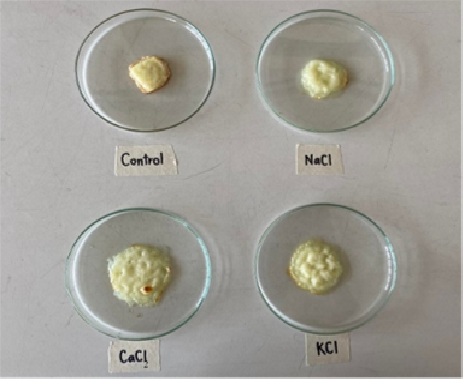
Mozzarella is a soft textured cheese with mild flavor and natural white to light cream color. It is classified as a pasta-filata. In cheese making, acetic acid in vinegar was used for protein precipitation and salt addition is relevant to several factors that affected the product qualities. The objective of this research was to increase the yield and sensory quality of Mozzarella cheese by adding 1% (w/v) of different salts: NaCl, CaCl2, and KCl. It was found that cheese with CaCl2 had the lowest moisture content at 41.09% but gave the highest yield, hardness, and resilience at 8.28%, 9.28 N, and 0.83, respectively. Cheese with KCl showed the best melting, flow, and stretching qualities at 74.10%, 13.50 cm, and 5.40 inch, respectively. Different types of salts had no significant effect on sensory quality (P>0.05). After baking, the cheese with CaCl2 showed good melting and had the best oiling-out.
References
Ayyash, M.M., F. Sherkat and N.P. Shah. 2013. Effect of partial NaCl substitution with KCl on the texture profile, microstructure, and sensory properties of low-moisture Mozzarella cheese. Journal of Dairy Research 80(1): 7–13. https://doi.org/10.1017/S002202991200043X
Belitz, H.D. and W. Grosch. 1999. Aroma Substances. pp. 319-377. In Belitz, H.D. and W. Grosch (Eds.). Food Chemistry. Heidelberg: Springer.
Buriti, F.C., J.S. Da Rocha and S.M. Saad. 2005. Incorporation of Lactobacillus acidophilus in Minas fresh cheese and its implications for textural and sensorial properties during storage. International Dairy Journal 15(12): 1279–1288.
Cavalier-Salou, C. and J.C. Cheftel. 1991. Emulsifying salts influence on characteristics of cheese analogs from calcium caseinate. Journal of Food Science 56(6): 1542–1547.
Costa, R.G.B., R.C. Alves, da Cruz, A.G. Sobral, V.A.M.D. Teodoro, L.C.G.C. Junior and E.M. Miguel. 2018. Manufacture of reduced-sodium Coalho cheese by partial replacement of NaCl with KCl. International Dairy Journal 87: 37–43.
Costa, R.G.B., A.C. Junior, A.G. da Cruz, D. Sobral, L.C.G.C. Júnior, J.C.J. de Paula and V.A.M. Teodoro. 2019. Effect of partial replacement of sodium chloride with potassium chloride on the characteristics of Minas Padrão cheese. International Dairy Journal 91: 48–54.
Cruz, A.G., J.A Faria, M.A. Pollonio, H.M. Bolini, R.M. Celeghini, D. Granato and N.P. Shah. 2011. Cheeses with reduced sodium content: effects on functionality, public health benefits and sensory properties. Trends in Food Science and Technology 22(6): 276–291.
Dalgleish, D.G. 1983. Coagulation of renneted bovine casein micelles: dependence on temperature, calcium ion concentration and ionic strength. Journal of Dairy Research 50(3): 331–340.
Fife, R.L., D.J. McMahon and C.J. Oberg. 2002. Test for measuring the stretchability of melted cheese. Journal of Dairy Science 85(12): 3539–3545.
Fitzgerald, E. and J. Buckley. 1985. Effect of total and partial substitution of sodium chloride on the quality of Cheddar cheese. Journal of Dairy Science 68(12): 3127–3134.
Fox, P.F., P.L. McSweeney, T.M. Cogan and T.P. Guinee. 2004. Cheese: Chemistry Physics and Microbiology Volume 1: General Aspects. Burlington: Academic Press Burlington. 640 p.
Fox, P.F., T.P. Guinee, T.M. Cogan and P.L. McSweeney. 2017. Starter Cultures. pp. 121–183. In Fox, P.F., T.P. Guinee, T.M. Cogan and P.L. McSweeney (Eds.). Fundamentals of Cheese Science. New York: Springer Science+Business Media LLC.
Guinee, T.P. and P.F. Fox. 2017. Salt in cheese: Physical, Chemical and Biological Aspects pp. 317-375. In Guinee, T.P. and P.F. Fox (Eds.). Cheese. London: Academic Press.
Hokes, J.C., M.E. Mangino and P.M.T. Hansen. 1982. A model system for curd formation and melting properties of calcium caseinates. Journal of Food Science 47(4): 1235–1249.
Johnson, B., J. Muller, B. Gregersen and J. Orozco. 2009. Pitfalls and opportunities in knowledge sharing: experiences from a research capacity building project in Central America. International Journal of Technological Learning, Innovation and Development 2(4): 250–273.
Kindstedt, P., M. Carić and S. Milanović. 2004. Pasta-filata Cheeses. Vol. 2. pp. 251–277. In Kindstedt, P., M. Carić and S. Milanović (Eds.). Cheese: Chemistry, Physics and Microbiology. London: Academic Press.
Kosikowski, F.V. and V.V. Mistry. 1997. Cheese and Fermented Milk Foods. Volume 1: Origins and Principles (Ed. 3). Westport, CT: F.V. Kosikowski. 739 pp.
Lucey, J.A. and P.F Fox. 1993. Importance of calcium and phosphate in cheese manufacture: a review. Journal of Dairy Science 76(6): 1714–1724.
Luo, J., T. Pan, H.Y. Guo and F.Z. Ren. 2013. Effect of calcium in brine on salt diffusion and water distribution of Mozzarella cheese during brining. Journal of Dairy Science 96(2): 824–831.
Ministry of Public Health. 2000. Announcement of the Ministry of Public Health (No. 209), B.E. 2000 Subject. Bangkok: Ministry of Public Health. 854 p. [in Thai]
Mizuno, R. and J.A. Lucey. 2005. Effects of two types of emulsifying salts on the functionality of nonfat pasta filata cheese. Journal of Dairy Science 88(10): 3411–3425.
Oberg, C.J., R.K. Merrill, R.J. Brown and G.H. Richardson. 1992. Effects of milk-clotting enzymes on physical properties of Mozzarella cheese. Journal of Dairy Science 75(3): 669–675.
Ong, L., R.R. Dagastine, S.E. Kentish and S.L. Gras. 2013. The effect of calcium chloride addition on the microstructure and composition of Cheddar cheese. International Dairy Journal 33(2): 135–141.
Pastorino, A.J., C.L. Hansen and D.J. McMahon. 2003. Effect of salt on structure-function relationships of cheese. Journal of Dairy Science 86(1): 60–69.
Rizvi, S.S., A. Shukla and J. Srikiatden. 1999. U.S. Patent No. 5,925,398. Washington, DC: U.S. Patent and Trademark Office. 571 p.
Thibaudeau, E., D. Roy and D. St-Gelais. 2015. Production of brine-salted Mozzarella cheese with different ratios of NaCl/KCl. International Dairy Journal 40: 54–61. https://doi.org/10.1016/j.idairyj.2014.07.013
USDA (United States Department of Agriculture). 1980. USDA specifications for Mozzarella cheese. [Online]. Available http://www.ams.usda.gov/dairy/ mozz.pdf. (September 22, 2022).
USDA (United States Department of Agriculture). 2001. USDA specifications for loaf and shredded lite Mozzarella cheese. [Online]. Available http://www.ams.usda.gov/dairy/shreddedlitemozz_03-01-2001.pdf (September 22, 2022).
Ustunol, Z. and C.L. Hicks. 1990. Effect of calcium addition on yield of cheese manufactured with Endothia parasitica protease. Journal of Dairy Science 73(1): 17–25.
Wang, W., P.S. Kindstedt, J.A. Gilmore and M.R. Guo. 1998. Changes in the composition and meltability of Mozzarella cheese during contact with pizza sauce. Journal of Dairy Science 81(3): 609–614.
Whitney, R.M. 1988. Proteins of Milk. pp. 81-169. In Whitney, R.M. (Ed.). Fundamentals of Dairy Chemistry. Boston: Springer.
Wolfschoon-Pombo, A.F. 1997. Influence of calcium chloride addition to milk on the cheese yield. International Dairy Journal 7(4): 249–254.
Downloads
Published
How to Cite
Issue
Section
License
Copyright (c) 2025 Journal of Agricultural Research and Extension

This work is licensed under a Creative Commons Attribution-NonCommercial-NoDerivatives 4.0 International License.
This article is published under a Creative Commons Attribution-NonCommercial-NoDerivatives 4.0 International License (CC BY-NC-ND 4.0), which allows others to share the article with proper attribution to the authors and prohibits commercial use or modification. For any other reuse or republication, permission from the journal and the authors is required.