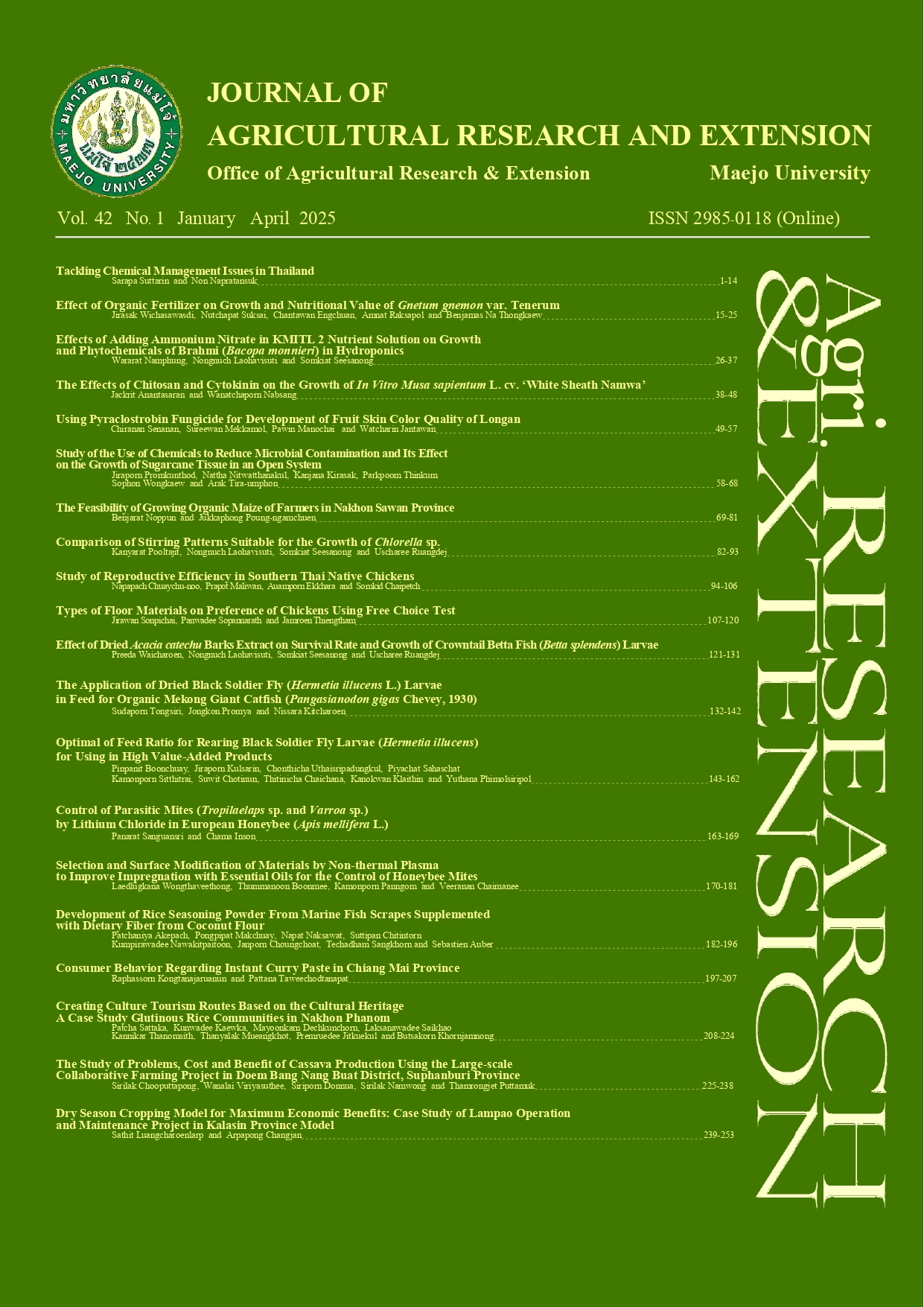
Selection and Surface Modification of Materials by Non-thermal Plasma to Improve Impregnation with Essential Oils for the Control of Honeybee Mites
DOI:
https://doi.org/10.14456/jare-mju.2025.15Keywords:
Tropilaelaps, non-thermal plasma technology, clove essential oil, absorption, evaporationAbstract
Tropilaelaps mites are a serious ectoparasite of honeybees, Apis mellifera, in Thailand and Asia. In this research, the absorption and release properties of essential oils (EOs) of porous media were analyzed. The brown ceramic bar showed the highest clove oil absorption capacity, 0.0050±0.0002 µl/mg, followed by carbon at 0.0036±0.0002 µl/mg of oil absorption capacity. The highest cinnamon oil absorption was observed in carbon and brown ceramic bar materials (0.0067±0.0002 and 0.0065±0.0002 µl/mg, respectively). A slight decrease in clove oil absorption was observed in carbon after plasma treatment generated by argon and helium gases, but there were no significant differences (0.0036± 0.0002 and 0.0035±0.0001 µl/mg, respectively). Although, argon- and helium-water vapour mixtures were applied for carbon surface modification, the absorption of clove oil did not significantly change. The clove oil slowly evaporated from the carbon material during the first 8 hours of incubation. Then, the quantification of evaporation increased on day 3 (40-50%) and reached 50-60% by day 14 of incubation. Lastly, the evaporation of clove oil from carbon was not significantly affected by plasma treatments. Therefore, the conditions of non-thermal plasma should be further investigated to improve the surface of materials for the application of essential oils or other materials to control honeybee mites.
References
Boonmee, T., L. Wongthaveethong, C. Sinpoo, T. Disayathanoowat, J.S. Pettis and V. Chaimanee, 2022. Surface modification of materials by atmospheric-pressure plasma to improve impregnation with essential oils for the control of Tropilaelaps mites in honeybees (Apis mellifera). Appl. Sci. 12: 5800.
Bruggeman, P. and D.C. Schram. 2010. On OH production in water containing atmospheric pressure plasmas. Plasma Sources Sci. Technol. 19: 045025.
Camphor, E.S.W., A.A. Hashmi, W. Ritter and I.D. Bowen. 2005. Seasonal changes in mite (Tropilaelaps clarae) and honeybee (Apis mellifera) populations in apistan treated and untreated colonies. Apiacta 40: 34-44.
Castro Vidaurre, E.F., C.A. Achete, F. Gallo, D. Garcia, R. Simão and A.C. Habert. 2002. Surface modification of polymeric materials by plasma treatment. Mater. Res. 5: 37-41.
Chaimanee, V., P. Chantawannakul, K. Khongphinitbunjong, T. Kamyo and J.S. Pettis. 2019. Comparative pesticide exposure to Apis mellifera via honey bee-collected pollen in agricultural and non-agricultural areas of Northern Thailand. Journal of Apicultural Research 58: 720-729.
Chaimanee, V., N. Warrit, T. Boonmee and J.S. Pettis. 2021. Acaricidal activity of essential oils for the control of honeybee (Apis mellifera) mites Tropilaelaps mercedesae under laboratory and colony conditions. Apidologie 52: 561-575.
Colin, T., M. Lim, S.R. Quarrell, G.R. Allen and A.B. Barron. 2019. Effects of thymol on European honey bee hygienic behaviour. Apidologie 50: 141-152.
Czylkowski, D., B. Hrycak, A. Sikora, M. Moczala-Dusanowska, M. Dors and M. Jasinski. 2019. Surface modification of polycarbonate by an atmospheric pressure argon microwave plasma sheet. Materials 12: 2418.
Emsen, B., E. Guzman-Novoa and P.G. Kelly. 2007. The effect of three methods of application on the efficacy of thymol and oxalic acid for the fall control of the honey bee parasitic mite Varroa destructor in a Northern climate. American Bee Journal 147: 535-539.
Gaire, S., M.E. Scharf and A.D. Gondhalekar. 2019. Toxicity and neurophysiological impacts of plant essential oil components on bed bugs (Cimicidae: Hemiptera). Scientific Reports 9: 3961.
Hýbl, M., A. Bohatá, I. Rádsetoulalova, M. Kopecký, I. Hosticková, A. Vaníckova and P. Mráz. 2021. Evaluating the efficacy of 30 different essential oils against Varroa destructor and honey bee workers (Apis mellifera). Insects 12: 1045.
Junka, A., A. Zywicka, G. Chodaczek, M. Dziadas, J. Czajkowska, A. Duda-Madej, M. Barttoszewicz, K. Mikolajewicz, G. Krasowski, P. Szymczyk and K. Fijalkowski. 2019. Potential of biocellulose carrier impregnated with essential oils to fight against biofilms formed on hydroxyapatite. Scientific Reports 9: 1256.
Kaushik, N.K., N. Kaushik, N.N. Linh, B. Ghimire, A. Pengkit, J. Sornsakdanuphap, S.-J. Lee and E.H. Choi. 2019. Plasma and nanomaterials: fabrication and biomedical applications. Nanomaterials 9: 98.
Kongpitak, P., G. Polgar and J. Heine. 2008. The efficacy of Bayvarol and Checkmite+ in the control of Tropilaelaps mercedesae in the European honey bee (Apis mellifera) in Thailand. Apiacta 43: 12-16.
Li, X., J. Lin and Y. Qiu. 2012. Influence of He/O2 atmospheric-pressure plasma jet treatment on subsequent wet desizing of polyacrylate on PET fabrics. Applied Surface Science 258: 2332-2338.
Liu, F., B. Zhang, Z. Fang, M. Wan, H. Wan and K.K. Ostrikov. 2018. Jet-to-jet interactions on atmospheric-pressure plasma jet arrays for surface processing. Plasma Process Polym 15: 1700114.
Luan, P., V.S.S.K. Kondeti, A.J. Knoll, P.J. Bruggeman and G.S. Oehrlein. 2019. Effect of water vapor on plasma processing at atmospheric pressure: polymer etching and surface modification by an Ar/H2O plasma jet. Journal of Vacuum Science & Technology A37: 031305.
Macgregor, M. and K. Vasilev. 2019. Perspective on plasma polymers for applied biomaterials nanoengineering and the recent rise of oxazolines. Materials 12: 191.
Mullin, C.A., M. Frazier, J.L. Frazier, S. Ashcraft, R. Simonds, D. vanEngelsdorp and J.S. Pettis. 2010. High levels of miticides and agrochemicals in North American apiaries: implications for honey bee health. PLoS ONE 5: e9754.
Nuanjohn, T. and V. Chaimanee. 2019. Effectiveness of some essential oils for control of Tropilaelaps mercedesae mites in honey bees (Apis mellifera L.) King Mongkut’s Agricultural Journal 37(1): 43-50. [in Thai]
Puliyalil, H. and U. Cvelbar. 2016. Selective plasma etching of polymeric substrates for advanced applications. Nanomaterials 6: 108.
Yanling, C., W. Yingkuan, P. Chen, S. Deng and R. Ruan. 2014. Non-thermal plasma assisted polymer surface modification and synthesis: a review. International Journal of Agricultural and Biological Engineering 7: 1-9.
Zhang, C., M. Zhao, L. Wang, L. Qu and Y. Men. 2017. Surface modification of polyester fabrics by atmospheric-pressure air/He plasma for color strength and adhesion enhancement. Applied Surface Science 400: 304-311.
Downloads
Published
How to Cite
Issue
Section
License
Copyright (c) 2025 Journal of Agricultural Research and Extension

This work is licensed under a Creative Commons Attribution-NonCommercial-NoDerivatives 4.0 International License.
This article is published under a Creative Commons Attribution-NonCommercial-NoDerivatives 4.0 International License (CC BY-NC-ND 4.0), which allows others to share the article with proper attribution to the authors and prohibits commercial use or modification. For any other reuse or republication, permission from the journal and the authors is required.