Bio-innovative Production of Soil Amendment from Spent Oyster Mushroom Substrates Co-fermented with Agricultural Organic Waste Using Endophytic Bacteria as Inoculant
DOI:
https://doi.org/10.14456/jare-mju.2025.48Keywords:
bio-innovative, soil amendments, spent oyster mushroom, endophytic bacteria , fodder corn dustAbstract
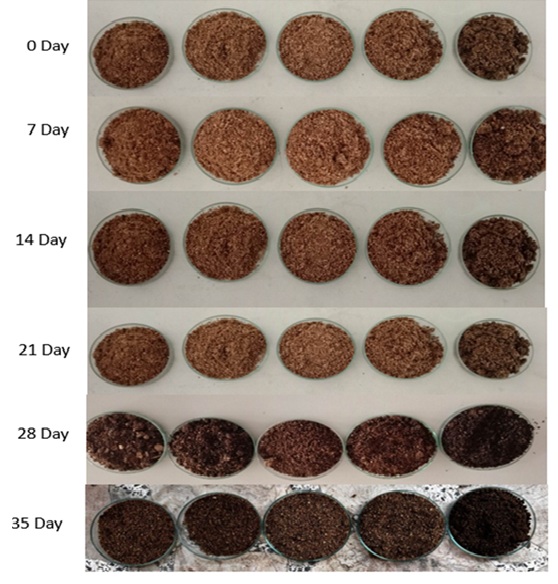
Bio-innovative production of soil amendment from spent oyster mushroom substrates co-fermented with agricultural organic waste using endophytic bacteria as inoculants helped to shorten the time it takes for soil amendments to occur and to produce an effective soil amendment formula. Bio-innovative production of soil amendment materials from spent oyster mushroom substrates co-fermented with agricultural organic waste, using two endophytic nitrogen-fixing bacterial strains: Pseudoxanthomonas spadix MJUP08 and Novosphingobium sp. MJUP_r9. Five levels of spent oyster mushroom substrates (50, 60, 70, 80, and 90%) were tested over a fermentation period of 35 days. The optimal formulation contained 80% spent mushroom substrate, 6% coffee husks, 6% corn fodder dust, 7% cow manure and 7% molasses diluted with water at a 1:20 ratio, totaling 10 liters with 60% moisture content. A 10% inoculum of both bacterial strains was applied. This formula resulted in the chemical of the soil amendment, with nitrogen (N2), phosphorus (P2O5), and potassium (K2O) contents of 0.34, 0.15, and 0.84%, respectively.
References
Daramola, D.S., A.S. Adeyeye and D. Lawal. 2006. Effect of Application of Organic and Inorganic Nitrogen Fertilizer on the Growth and Dry Matter Yield of Amaranthus. pp.56–65. In Proceedings of the 2nd National Conference on Organic Agriculture 27th November-1st December 2006. Ibadan: University of Ibadan.
Meena, M.D., P.K. Joshi, H.S. Jat, A.R. Chinchmalatpure, B. Narjary, P. Sheoran and D.K. Sharma. 2016. Changes in Biological and Chemical Properties of Saline Soil Amended with Municipal Solid Waste Compost and Chemical Fertilizers in a Mustard-Pearl Millet Cropping System. Karnal: CATENA Press. 140 p.
Nottidge, D.O., S. Ojeniyi and D. Asawalam. 2005. Comparative effect of plant residues and NPK fertilizer on nutrient status and yield of maize (Zea mays L.) in humid Ultisol. Nigerian Journal of Soil Science 15: 1–8.
Oluchukwu, A.C., A.G. Nebechukwu and S.O. Egbuna. 2018. Enrichment of nutritional contents of sawdust by composting with other nitrogen rich agro-wastes for bio-fertilizer synthesis. Journal of Chemical Technology and Metallurgy 53(3): 430–436.
Onnby, L., K. Harald and I.A. ges. 2015. Cryogel-supported titanate nanotubes for waste treatment: impact on methane production and bio-fertilizer quality. Journal of Biotechnology 207: 58–66.
Rajoka, M.I. and K.A. Malik. 1997. Cellulase production by Cellulomonas biazotea cultured in media containing different cellulosic substrates. Bioresource Technology 59(1): 21–27.
Shaviv, A. 2005. Controlled Release Fertilizers. pp. 28–39. In IFA International Workshop on Enhanced-Efficiency Fertilizers. Frankfurt: International Fertilizer Association (IFA).
Silva, V.N., L.E.S.F. Silva, A.J.N. Silva, N.P. Stamford and G.R. Macedo. 2017. Solubility curve of rock powder inoculated with microorganisms in the production of biofertilizers. Agriculture and Natural Resources 51: 142–147.
Subba, R.N.S. 1993. Biofertilizer in Agriculture and Forestry. 3rded. New York: International Science Publisher. 242 p.
Taiwan Fertilizer Company. 1994. Field Tests of Application of Organic Compound Fertilizer. 10 p. In Research Report. China: Taiwan Fertilizer Company.
Tejada, M., B. Rodríguez-Morgado, I. Gómez L. Franco-Andreu, C. Benítez and J. Parrado. 2016. Use of biofertilizers obtained from sewage sludges on maize yield. European Journal of Agronomy 78: 13–19.
Thongpradistha, S., T. Muadsri and A. Sukkaew. 2023. The effect of organic fertilizer formula from Sajor-caju mushroom (Pleurotus sajor-caju) waste on macronutrients. Rajamangala University of Technology Srivijaya Research Journal 12(1): 61–71.
Yang, S.S., H.L. Chan, C.B. Wei and H.C Lin. 1991. Reduce wastes production with modified Kjeldahl method for nitrogen measurement. Biomass and Bioenergy Journal 10: 147–155.
Downloads
Published
How to Cite
Issue
Section
License
Copyright (c) 2025 Journal of Agricultural Research and Extension

This work is licensed under a Creative Commons Attribution-NonCommercial-NoDerivatives 4.0 International License.
This article is published under a Creative Commons Attribution-NonCommercial-NoDerivatives 4.0 International License (CC BY-NC-ND 4.0), which allows others to share the article with proper attribution to the authors and prohibits commercial use or modification. For any other reuse or republication, permission from the journal and the authors is required.