การศึกษาความสัมพันธ์ระหว่างความมีชีวิต ความงอกของละอองเกสร และสภาพอากาศ ต่อการติดผลของฝรั่งพันธุ์ ‘ไร้เมล็ด’ ‘เด่นขุนวัง’ และ ‘บางกอกแอปเปิล’
DOI:
https://doi.org/10.14456/jare-mju.2025.24คำสำคัญ:
ความมีชีวิตของละอองเกสร , การติดผล , สภาพอากาศ , ฝรั่งไม่มีเมล็ดบทคัดย่อ
การศึกษาความสัมพันธ์ระหว่างความมีชีวิต ความงอกของละอองเกสร และสภาพอากาศ ต่อการติดผลของฝรั่งพันธุ์ ‘ไร้เมล็ด’ ‘เด่นขุนวัง’ และ ‘บางกอกแอปเปิล’ มีวัตถุประสงค์เพื่อศึกษาสาเหตุของการติดผลน้อยของฝรั่งกลุ่มไร้เมล็ด โดยสภาพอากาศที่เก็บบันทึกข้อมูล ได้แก่ อุณหภูมิ ความชื้นสัมพัทธ์ ปริมาณน้ำฝน และปริมาณหยาดน้ำฟ้า ทำการทดลองกับฝรั่ง 3 สายพันธุ์ ที่ปลูกในสภาพแปลงในพื้นที่ของ พล. ร. 7 อำเภอแม่ริม จังหวัดเชียงใหม่ ผลการทดลองพบว่า ความมีชีวิตของละอองเกสรกับการติดผลมีความสัมพันธ์ไปในทิศทางเดียวกันในฝรั่งทั้งสามพันธุ์ (พันธุ์ไร้เมล็ด r = 0.755; พันธุ์เด่นขุนวัง r = 0.690; พันธุ์บางกอกแอปเปิล r = 0.706) ฝรั่งแต่ละสายพันธุ์ติดผลได้ดีในช่วงเวลาที่แตกต่างกัน โดยพันธุ์ไร้เมล็ดมีการติดผลได้ดีที่สุดในเดือนสิงหาคม ร้อยละ 56.54 พันธุ์เด่นขุนวังติดผลได้ดีที่สุดในเดือนตุลาคม ร้อยละ 71.43 ส่วนพันธุ์บางกอกแอปเปิลติดผล ได้ดีที่สุดในเดือนเมษายนและมิถุนายน ร้อยละ 42.77 และ 40.00 ตามลำดับ นอกจากนี้ยังพบว่าสภาพอากาศ มีลักษณะความสัมพันธ์กับการติดผลของฝรั่งทั้งสาม สายพันธุ์ ในทิศทางเดียวกัน ได้แก่ ความชื้นสัมพัทธ์ (พันธุ์ไร้เมล็ด r = 0.246; พันธุ์เด่นขุนวัง r = 0.296; พันธุ์บางกอกแอปเปิล r = 0.343) ปริมาณน้ำฝน (พันธุ์ไร้เมล็ด r = 0.383; พันธุ์เด่นขุนวัง r = 0.322; พันธุ์บางกอกแอปเปิล r = 0.457) และปริมาณหยาดน้ำฟ้า (พันธุ์ไร้เมล็ด r = 0.356; พันธุ์เด่นขุนวัง r = 0.232; พันธุ์บางกอกแอปเปิล r = 0.363) ผลการศึกษานี้บ่งชี้ว่าปัจจัยทางสภาพอากาศมีผลอย่างมากต่อการติดผลของฝรั่งแต่ละสายพันธุ์ ซึ่งแสดงให้เห็นถึงอิทธิพลของสภาพภูมิอากาศต่อการติดผลของฝรั่งอย่างชัดเจน หากวางแผนการผลิตให้เหมาะสมจะสามารถช่วยเพิ่มผลผลิตของกลุ่มฝรั่งที่ศึกษาได้
เอกสารอ้างอิง
Adhikari, S. and T.P. Kandel. 2015. Effect of time and level of pruning on vegetative growth, flowering, yield, and quality of guava. International Journal of Fruit Science 15(3): 290–301.
Brewbaker, J.L. and B.H. Kwack. 1963. The essential role of calcium ion in pollen germination and pollen tube growth. American Journal of Botany 50(9): 859–865.
Chatbanyong, R. and U. Boonprakob. 2021. Techniques for producing Taiwanese guava to get high value. Kehakaset Magazine 45(2): 55–71. [in Thai]
Department of Agricultural Extension. 2023. Geographic information system for agriculture. [Online]. Available https://geoplots.doae.go.th/ssmap (July 5, 2023). [in Thai]
Gustafson, F.G. 1942. Parthenocarpy: natural and artificial. The Botanical Review 8: 599–654.
Kaewkhumpai, A., S. Onsanit, Y. Sontikun, T. Srisawat, and S. Thitithanakul. 2018. Appropriate methods for pollen viability pollen and germination testing of Nepenthes sp. Agricultural Science Journal 49(1)(Suppl.): 225–229. [in Thai]
Nartvaranant, P. and S. Kongsri. 2020. Relationship between temperature, relative humidity and seasonal variation on pollen germination and pollen viability in ‘Nam Hom’ coconut. Wichcha Journal Nakhon Si Thammarat Rajabhat University 39(2): 101–115. [in Thai]
Nongyai, N., D. Thawornchareon and K. Thaipong. 2015. Morphology, viability and germinability of dwarf guava pollen. Agricultural Science Journal 46(3)(Suppl.): 117–120. [in Thai]
Sangphet, P., U. Boonprakob and K. Thaipong. 2007. Evaluation on viability and germination of seedless and less seed guava pollen. Agricultural Science Journal 38(5): 389–395. [in Thai]
Singh, G., H. Sahare and M. Deep. 2019. Recent trends in guava propagation–a review. Biosciences Biotechnology Research Asia 16(1): 143–154.
Srimat, S., K. Iamjud, S. Wasee and K. Thaipong. 2014. Seasonal effect on viability and germination of papaya pollen. Khon Kaen Agriculture Journal 42(3)(Suppl.): 174–179. [in Thai]
Techawongstien, S. 2013. Teaching Materials Physiology of Horticulture. Chapter 3 Physiology of Fruit. Khon Kaen: Department of Horticulture, Faculty of Agriculture, Khon Kaen University. 256 p. [in Thai]
Vinod, M. and H.N. Sattagi. 2018. Foraging activity of pollinators in guava under organic and conventional farming systems. Journal of Entomology and Zoology Studies 6(5): 865–872.
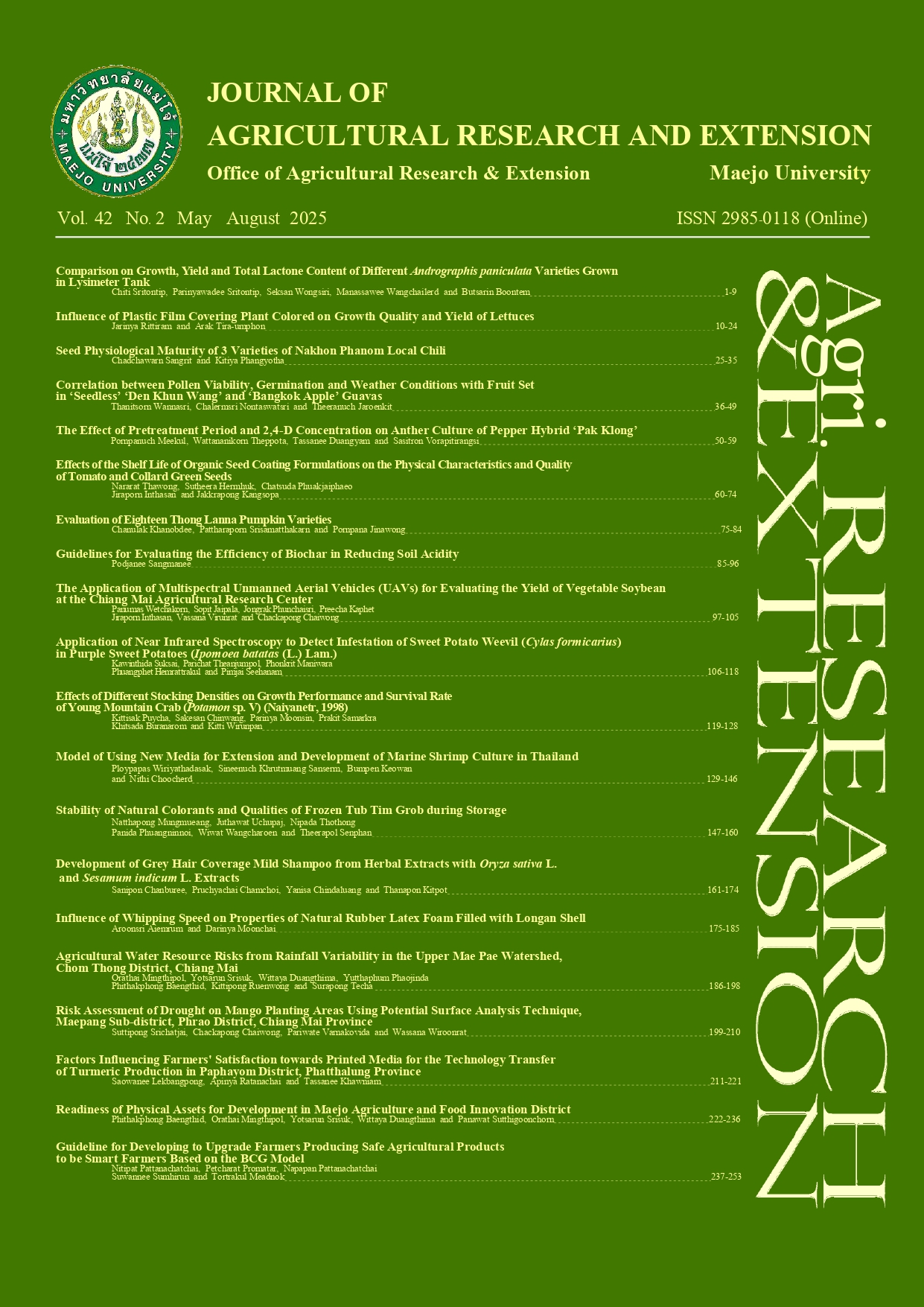
ดาวน์โหลด
เผยแพร่แล้ว
รูปแบบการอ้างอิง
ฉบับ
ประเภทบทความ
สัญญาอนุญาต
ลิขสิทธิ์ (c) 2025 วารสารวิจัยและส่งเสริมวิชาการเกษตร

อนุญาตภายใต้เงื่อนไข Creative Commons Attribution-NonCommercial-NoDerivatives 4.0 International License.
บทความนี้ได้รับการเผยแพร่ภายใต้สัญญาอนุญาต Creative Commons Attribution-NonCommercial-NoDerivatives 4.0 International (CC BY-NC-ND 4.0) ซึ่งอนุญาตให้ผู้อื่นสามารถแชร์บทความได้โดยให้เครดิตผู้เขียนและห้ามนำไปใช้เพื่อการค้าหรือดัดแปลง หากต้องการใช้งานซ้ำในลักษณะอื่น ๆ หรือการเผยแพร่ซ้ำ จำเป็นต้องได้รับอนุญาตจากวารสาร