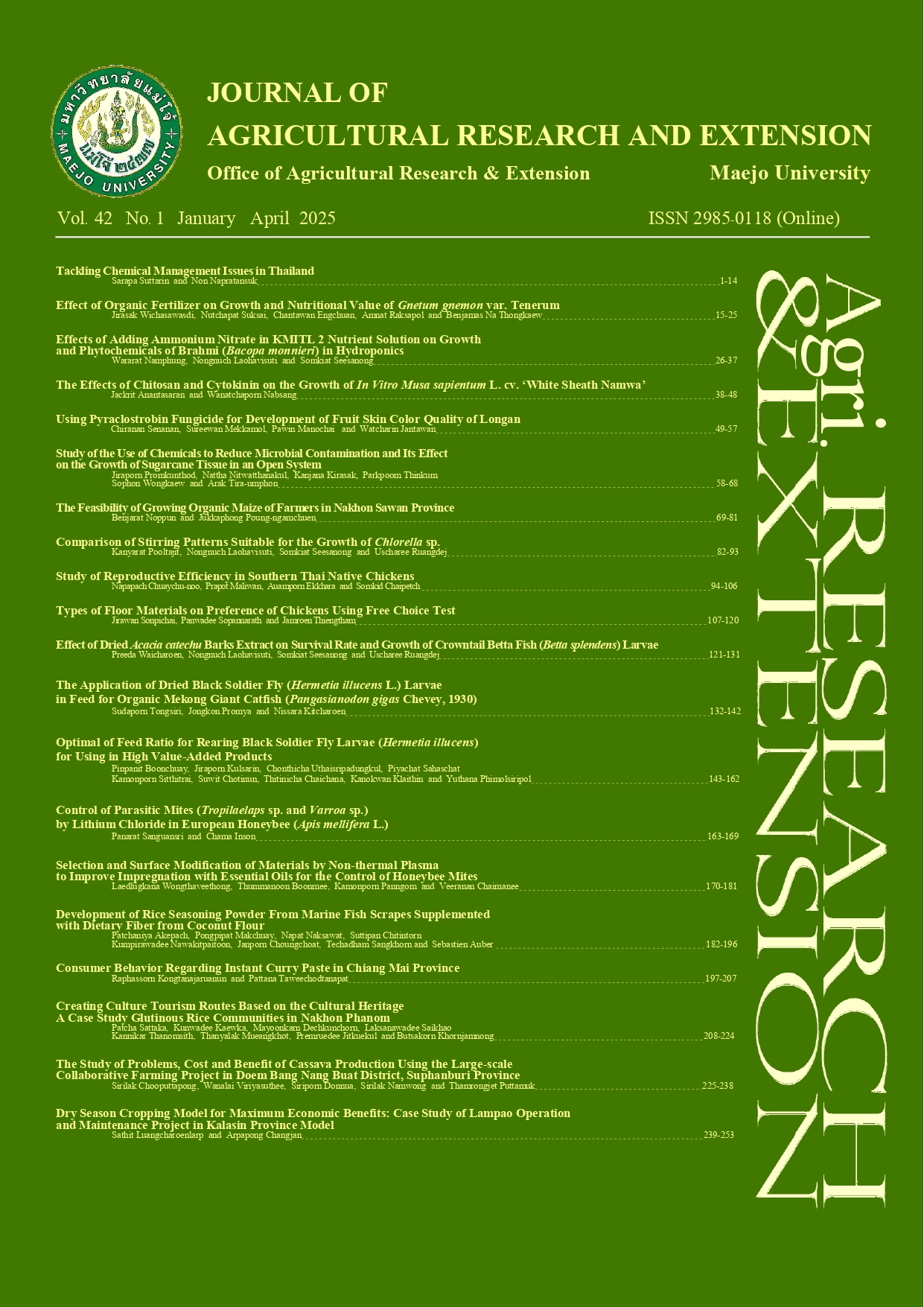
Optimal of Feed Ratio for Rearing Black Soldier Fly Larvae (Hermetia illucens) for Using in High Value-Added Products
DOI:
https://doi.org/10.14456/jare-mju.2025.13Keywords:
black soldier fly, Hermetia illucens, feed formulation, oil, cosmetics, high value-added productAbstract
The black soldier fly larvae (Hermetia illucen, BSFL) are noteworthy in various industries. They produce lipids that possess desirable physicochemical properties and show promising bioactive potential. Furthermore, the residual biomass left after oil extraction is a high-quality alternative protein source. This makes them an excellent choice for applications in livestock feeding and aquaculture. Therefore, the objective of this study was to optimize the ratio and formulation of feed for BSF to assess how it affects the growth rate, oil yield, and oil characteristics for use in high value-added products. The results demonstrated that the optimal feed components were corn, rice bran, and soybean meal. Soybean meals displayed the highest protein and fat levels, at 26.50 and 10.63 g/100 g, respectively. Additionally, soybean meal had the greatest diversity of amino acids. Based on the evaluation of the optimal ratio, the optimal formulation consisted of corn meal, rice bran, and fresh soybean meal at a ratio of 1:1:3 by weight, producing 82.61 g/100 g of BSFL oil and containing 34.88 g/100 g of lauric acid. Furthermore, BSFL oil contained 1,100, 17,197, and 17,480 mg of omega 3, 6, and 9 fatty acids per 100 g of BSFL oil. The peroxide value and saponification number of BSFL were measured at 3.65 m Eq/kg and 233.44 mg KOH/g, respectively. Consequently, the BSFL feed formulation from this study could be applied as a method for BSFL rearing for high value-added products.
References
Ahmad, A. and H. Ahsan. 2020. Lipid-based formulations in cosmeceuticals and biopharmaceuticals. Biomedical Dermatology 4: 1-10.
Almeida, C., D. Murta. R. Nunes, A.R. Baby, Â. Fernandes, L. Barros, P. Rijo and C. Rosado. 2022. Characterization of lipid extracts from the Hermetia illucens larvae and their bioactivities for potential use as pharmaceutical and cosmetic ingredients. Heliyon 8(5): e09455.
Amrul, N.F., I. Kabir Ahmad, N.E. Ahmad Basri, F. Suja, N.A. Abdul Jalil and N.A. Azman. 2022. A review of organic waste treatment using black soldier fly (Hermetia illucens). Sustainability 14(8): 4565.
AOAC. 2019. Official Methods of Analysis of the Association of Official Analytical Chemists: Official Methods of Analysis of AOAC International. 21st Edition. Washington DC: AOAC. 3750 p.
AOCS. 1993. Official Methods and Recommended Practices of the American Oil Chemists Society. 4th Edition. Illinois: The American Oil Chemists Society 1749 p.
Barker, L.A., B.W. Bakkum and C. Chapman. 2019. The clinical use of monolaurin as a dietary supplement: a review of the literature. Journal of Chiropractic Medicine 18(4): 305-310.
CODEX. 1995. Codex general standard for contaminants and toxins in food and feed: CODEX STAN 193-1995. 1-77. [Online]. Available https://www.fao.org/fileadmin/user_upload/livestockgov/documents/1_CXS_193e.pdf (July 30, 2024).
da Silva, P., N. Ribeiro, M.N.C. Pinheiro and R. Costa. 2019. Modelling Drying Kinetics of Black Soldier Fly (Hermetia illucens, l.) Larvae. pp. 1-6 In Proceedings of XII International Conference on Computational Heat, Mass and Momentum Transfer (ICCHMT 2019) 3-6 September 2019. Rome: EDP Sciences.
Dandadzi, M., R. Musundire, A. Muriithi and R.T. Ngadze. 2023. Effects of drying on the nutritional, sensory and microbiological quality of edible stinkbug (Encosternum delgorguei). Heliyon 9(8): e18642.
Franco, A., R. Salvia, C. Scieuzo, E. Schmitt, A. Russo and P. Falabella. 2021. Lipids from insects in cosmetics and for personal care products. Insects 13(1): 41.
Hernández-Álvarez, A.J., M. Mondor, I.A. Piña-Domínguez, O.A. Sánchez-Velázquez and G. Melgar Lalanne. 2021. Drying technologies for edible insects and their derived ingredients. Drying Technology 39(13): 1991-2009.
Hurtado-Ribeira, R., D.M. Hernández, D. Villanueva-Bermejo, M.R. García-Risco, M.D. Hernández, L. Vázquez, T. Fornari, and D. Martin. 2023. The interaction of slaughtering, drying, and defatting methods differently affects oxidative quality of the fat from black soldier fly (Hermetia illucens) larvae. Insects 14(4): 368.
Huseynli, L., T. Parviainen, T. Kyllönen, H. Aisala, and K. Vene. 2023. Exploring the protein content and odor-active compounds of black soldier fly larvae for future food applications. Future Foods 7: 100224.
Leong, S.Y., S.R.M. Kutty, C.K. Tan and L.H. Tey. 2015. Comparative study on the effect of organic waste on lauric acid produced by Hermetia illucens larvae via bioconversion. Journal of Engineering Science and Technology 8(2015): 52-63.
Lestari, A., T.H. Wahyuni, E. Mirwandhono and N. Ginting. 2020. Maggot black soldier fly (Hermetia illucens) nutritional content using various culture media. Jurnal Peternakan Integratif 8(3): 161-169.
Maya, I., D.O. Winardi, E. Amalia, S.R. Mita, C.K. Kusumawulan, N.A. Putriana, and S. Sriwidodo. 2023. Physicochemical characteristics, fatty acid profile, and In Vitro antioxidant activity evaluation of Sacha Inchi seed oil from Indonesia. Cosmetics 10(6): 171.
Nayak, A., M. Rühl and P. Klüber. 2023. Hermetia illucens (diptera: stratiomyidae): need, potentiality, and performance measures. Agriculture 14(1): 8.
Nde, D.B. and A.C. Foncha. 2020. Optimization methods for the extraction of vegetable oils: a review. Processes 8(2): 209.
Patterson, H.B.W. 2011. Chapter 12-Quality and control. pp. 329-350. In Gary, R.L. and W.K. Jerry (eds.). Hydrogenation of Fats and Oils. Champaign, IL: AOCS Press.
Phongpradist, R., W. Semmarath, K. Kiattisin, J. Jiaranaikulwanitch, W. Chaiyana, S. Chaichit, Y. Phimolsiripol, P. Dejkriengkraikul and C. Ampasavate. 2023. The In Vitro effects of black soldier fly larvae (Hermitia illucens) oil as a high-functional active ingredient for inhibiting hyaluronidase, anti-oxidation benefits, whitening, and UVB protection. Frontiers in Pharmacology 14: 1243961.
Seyedalmoosavi, M.M., M. Mielenz, T. Veldkamp, G. Daş, and C.C. Metges. 2022. Growth efficiency, intestinal biology, and nutrient utilization and requirements of black soldier fly (Hermetia illucens) larvae compared to monogastric livestock species: a review. Journal of Animal Science and Biotechnology 13(1): 31.
Smetana, S., E. Schmitt, and A. Mathys. 2019. Sustainable use of Hermetia illucens insect biomass for feed and food: attributional and consequential life cycle assessment. Resources, Conservation and Recycling 144: 285-296.
Suryati, T., E. Julaeha, K. Farabi, H. Ambarsari, and A.T. Hidayat. 2023. Lauric acid from the black soldier fly (Hermetia illucens) and its potential applications. Sustainability 15(13): 10383.
Thrastardottir, R., H.T. Olafsdottir and R.I. Thorarinsdottir. 2021. Yellow mealworm and black soldier fly larvae for feed and food production in Europe, with emphasis on Iceland. Foods 10(11): 2744.
Wabner, D. 2002. The peroxide value-a new tool for the quality control of essential oils. The International Journal of Aromatherapy 3(12): 142-144.
Xu, W., L. Xu, X. Liu, S. He, Y. Ji, W. Wang and F. Wang. 2021. An effective strategy for the production of lauric acid–enriched monoacylglycerol via enzymatic glycerolysis from black soldier fly (Hermetia illucens) larvae (BSFL) oil. Applied Biochemistry and Biotechnology 193: 2781-2792.
Yang, M., M. Zhou and L. Song. 2020. A review of fatty acids influencing skin condition. Journal of Cosmetic Dermatology 19(12): 3199-3204.
Downloads
Published
How to Cite
Issue
Section
License
Copyright (c) 2025 Journal of Agricultural Research and Extension

This work is licensed under a Creative Commons Attribution-NonCommercial-NoDerivatives 4.0 International License.
This article is published under a Creative Commons Attribution-NonCommercial-NoDerivatives 4.0 International License (CC BY-NC-ND 4.0), which allows others to share the article with proper attribution to the authors and prohibits commercial use or modification. For any other reuse or republication, permission from the journal and the authors is required.