อิทธิพลของปุ๋ยอินทรีย์เคมีต่อการเจริญเติบโต สรีรวิทยา ผลผลิต และปริมาณแลคโตนรวมในฟ้าทะลายโจรภายใต้สภาพกระถาง
DOI:
https://doi.org/10.14456/jare-mju.2025.43คำสำคัญ:
ปุ๋ยอินทรีย์เคมี , ฟ้าทะลายโจร , แลคโตนรวมบทคัดย่อ
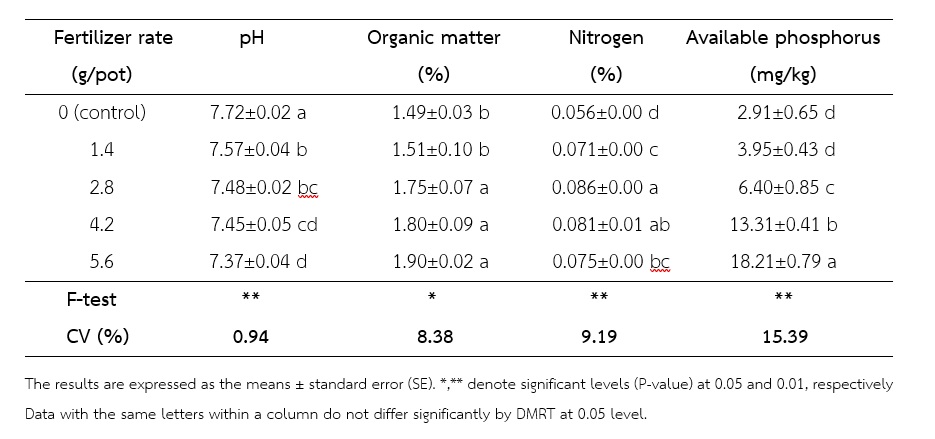
การวิจัยนี้มีวัตถุประสงค์เพื่อศึกษาอัตราปุ๋ยอินทรีย์เคมีที่เหมาะสมต่อการเจริญเติบโต สรีรวิทยา ผลผลิต และปริมาณแลคโตนรวมในการปลูกฟ้าทะลายโจรภายใต้สภาพกระถาง ดำเนินการทดลอง ณ สถาบันวิจัยเทคโนโลยีเกษตร มหาวิทยาลัยเทคโนโลยีราชมงคลล้านนา จังหวัดลำปาง วางแผนการทดลองแบบสุ่มในบล็อกสมบูรณ์ (Randomized Complete Block Design) จำนวน 5 กรรมวิธี กรรมวิธีละ 8 ซ้ำ ได้แก่ การใส่ปุ๋ยอินทรีย์เคมีอัตรา 0 (กรรมวิธีควบคุม), 1.4, 2.8, 4.2 และ 5.6 กรัมต่อกระถาง ปุ๋ยที่ใช้ในการทดลอง คือ ปุ๋ยอินทรีย์เคมี สูตร 6-3-3 OM10% แบบคอมปาวน์ ทำการทดลองระหว่างเดือนสิงหาคม-ตุลาคม 2566 จากการทดลองพบว่า การใส่ปุ๋ยอินทรีย์เคมีอัตรา 2.8–4.2 กรัมต่อกระถาง ฟ้าทะลายโจรมีการเจริญเติบโตทางลำต้นในด้านความสูงของลำต้น ขนาดเส้นผ่านศูนย์กลางของลำต้น จำนวนใบ ความกว้างใบ และความยาวใบ ส่งผลให้มีน้ำหนักแห้งสูงกว่าการใส่ปุ๋ยในอัตราอื่น ส่วนการใส่ปุ๋ยอินทรีย์เคมีในอัตรา 2.8–5.6 กรัมต่อกระถาง ช่วยเพิ่มประสิทธิภาพการทำงานของระบบแสงที่สองของใบ การคายน้ำ การยอมให้ก๊าซผ่านทางปากใบ อัตราการแลกเปลี่ยนก๊าซคาร์บอนไดออกไซด์ และน้ำหนักสด สูงกว่าการใส่ปุ๋ยในอัตราอื่น การใส่ปุ๋ยทุกอัตราช่วยเพิ่มความเขียวของใบ และปริมาณแลคโตนรวมมากกว่าการไม่ใส่ปุ๋ย อัตราปุ๋ยอินทรีย์เคมีที่แนะนำสำหรับการทดลองนี้ที่เหมาะสม คือ 4.2 กรัมต่อกระถาง หรืออัตรา 75 กิโลกรัมต่อไร่
เอกสารอ้างอิง
Attanandana, T. And J. Chancharoensuk. 1999. Soil and Plant Analysis Exercises and Practical Manual. Bangkok: Faculty of Agriculture Kasetsart University. 170 p. [in Thai]
Bray, R.H. and L.T. Kurtz. 1945. Determination of total, organic, and available forms of phosphorus in soils. Soil Science. 59(1): 39–46.
Chaemcheun, K., S. Anuttato, P. Kheawpoompuang C. Ditchaiwong and C. Kongnakhon. 2020. Andrographis paniculata: High-Quality Varieties for Combating the COVID-19 Crisis. Phitsanulok: Office of Agricultural Research and Development Region 2. 8 p. [in Thai]
Chainok, K. 2021. Using Fah Talai Jone for COVID-19 Treatment: National Drug System Development Committee Announcement. [Online]. Available https://pharmacy.mahidol.ac.th/th/knowledge/article/569/ฟ้าทะลายโจร-โควิด-19/ (December 10, 2023). [in Thai ]
Department of Medical Sciences. 2020. Thai Herbal Pharmacopoeia 2020. Bangkok: The Agricultural Co-operative Federation of Thailand., Ltd. 475 p. [in Thai]
Dimande, P., M. Arrobas and M.Â. Rodrigues. 2023. Effect of bat guano and biochar on okra yield and some soil properties. Horticulturae 9(7): 1–17.
Kaewhao, S. 2014. Soil quality improvement using green manure: case study in Nongbor reservoir area, Borabue district, Maha Sarakham province. Journal of Science and Technology Mahasarakham University 33(6): 592–602. [in Thai]
Kaewsuralikhit, S., P. Namwong, P. Thongra-ar, N. Thaweenut and K. Chatchaisiri. 2020. Mineralization and chemical properties changes in soil amended with azolla. Thai Agricultural Research Journal 38(2): 139–149. [in Thai]
Khowilaisaeng, N. and C. Aninbon. 2022. Influence of organic fertilizer types on yield components and total phenolic compounds in peanut. Thai Science and Technology Journal 28(2): 265–273. [in Thai]
Li, J., Z. Zhu and J. Gerendás. 2008. Effects of nitrogen and sulfur on total phenolics and antioxidant activity in two genotypes of leaf mustard. Journal of Plant Nutrition 31(9): 1642–1655.
Nilawonk, W. 2020. Influence of organic fertilizers and bio-extracts on the change of some soil properties and vegetable yields. Khon Kaen Agriculture Journal 48(3): 639–650. [in Thai]
Office of the Permanent Secretary for Ministry of Agricultural and Cooperatives. 2023. Assessment of Herbal Product Production by the Ministry of Agriculture and Cooperatives. Bangkok: Office of the Permanent Secretary for Ministry of Agricultural and Cooperatives. 69 p. [in Thai]
Onsa, N.E., S.K. Prasad, T. Chaiyaso, C. Lumsangkul and S.R. Sommano. 2022. Phenotypic and chemotypic relations among local Andrographis paniculata (Burm. f.) wall landrace collection. Horticulturae 8(10): 978.
Pukpumin, E., P. Khaengkhana and E. Sareepua. 2022. Comparison of nutrient quality from manure to organic melon (Cucumis melo L.) production in greenhouse. Journal of Science Engineering and Technology Rajabhat Maha Sarakham University 1(2): 1–16. [in Thai]
Rattaneetu, B. 2009. Organic fertilizer improves deteriorated soil. Princess of Naradhivas University Journal 1(2): 1–16. [in Thai]
Sae Lim, S. 2016. Organic Fertilizer and Utilization in Thailand. Khon Kaen: Research and Development Group for Organic Matter Management, Land Development Department. 202 p. [in Thai]
Sharma, S. and Y.P. Sharma. 2018. Comparison of different extraction methods and HPLC method development for the quantification of andrographolide from Andrographis paniculata (Burm. f.) Wall. Ex Nees. Annals of Phytomedicine 7(1): 119–130.
Sukyankij, S., S. Khienman and C. Khongsud. 2024. Influence of organic fertilizer on growth and quality of kalmegh. Thai Science and Technology Journal 32(2): 13–26. [in Thai]
Sukyankij, S., S. Sukyankij, and T. Panich-Pat. 2023. Effect of co-fertilizer application and dolomite amendments on yield and grain quality of rice grown on post-active acid sulfate soil. AGRIVITA Journal of Agricultural Science 45(2): 311–321.
Supakamnerd, N. 1999. Colorimetric Analysis of Ammonium Nitrogen. Chiang Rai: Chiangrai Horticulture Research Center. 17 p. [in Thai]
Thai PBS. 2021. Booming market for Fah Talai Jone: sales surge 5x amid raw material. [Online]. Available https://www.thaipbs.or.th/news/content/306846 (December 20, 2023). [in Thai]
Tripathi, P. and A. Singh. 2021. Biofertilizers: “An Ace in the Hole” in Medicinal and Aromatic Plants Cultivation. pp. 253–263. In Rakshit, A., V.S. Meena, M. Parihar, H.B. Singh and A.K. Singh (Eds.). Biofertilizers. United Kingdom: Woodhead Publishing.
Walkley, A. and I.A. Black. 1934. An examination of the Degtjareff method for determining soil organic matter, and a proposed modification of the chromic acid titration method. Soil science 37(1): 29–38.
Yusuk, P., N. Nokham and N. Kamol. 2022. Nutrients from manure fertilizer. [Online]. Available https://www.hrdi.or.th/articles/Detail/1526 (May 23, 2024). [in Thai]
ดาวน์โหลด
เผยแพร่แล้ว
รูปแบบการอ้างอิง
ฉบับ
ประเภทบทความ
สัญญาอนุญาต
ลิขสิทธิ์ (c) 2025 วารสารวิจัยและส่งเสริมวิชาการเกษตร

อนุญาตภายใต้เงื่อนไข Creative Commons Attribution-NonCommercial-NoDerivatives 4.0 International License.
บทความนี้ได้รับการเผยแพร่ภายใต้สัญญาอนุญาต Creative Commons Attribution-NonCommercial-NoDerivatives 4.0 International (CC BY-NC-ND 4.0) ซึ่งอนุญาตให้ผู้อื่นสามารถแชร์บทความได้โดยให้เครดิตผู้เขียนและห้ามนำไปใช้เพื่อการค้าหรือดัดแปลง หากต้องการใช้งานซ้ำในลักษณะอื่น ๆ หรือการเผยแพร่ซ้ำ จำเป็นต้องได้รับอนุญาตจากวารสาร