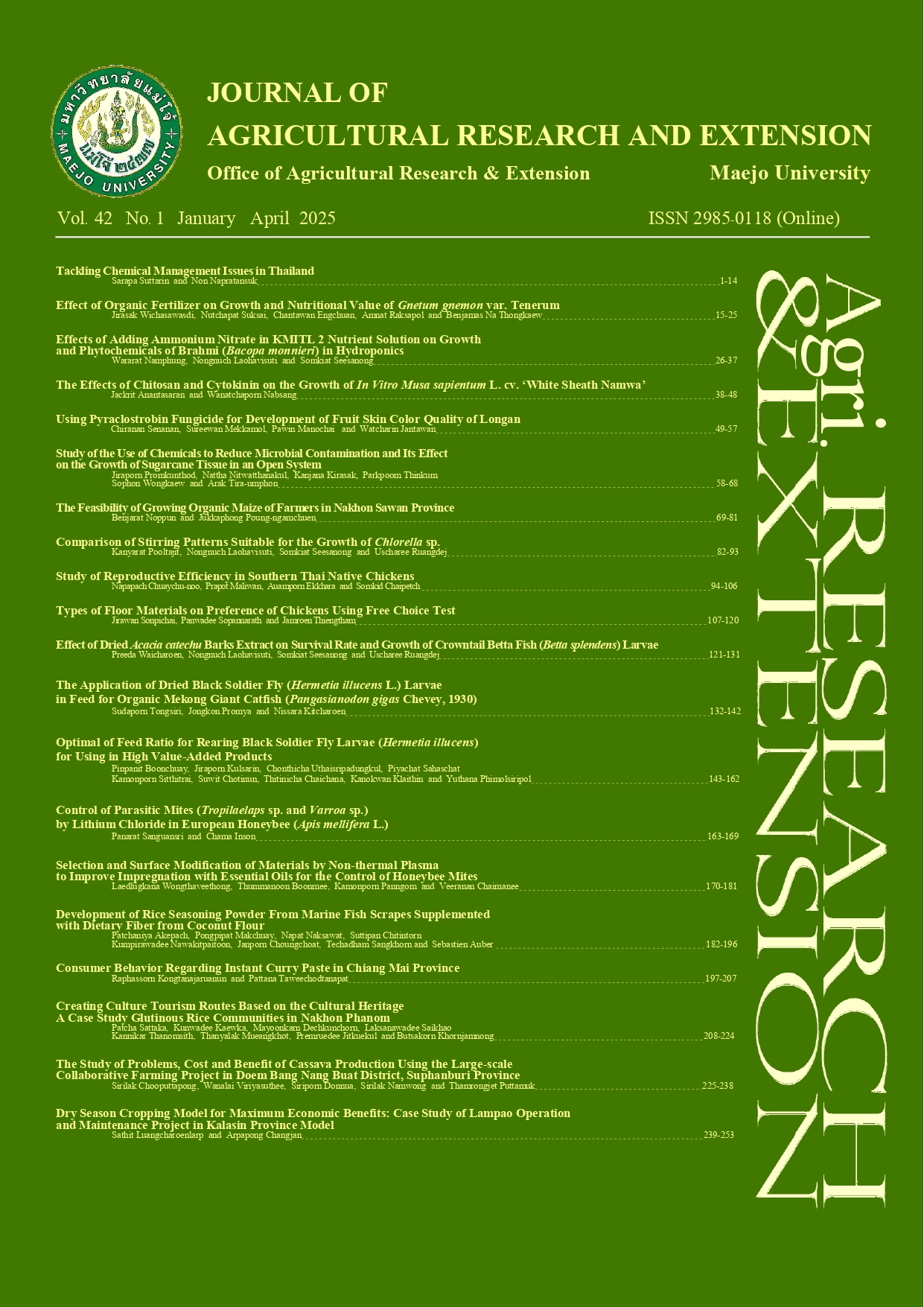
Tackling Chemical Management Issues in Thailand
DOI:
https://doi.org/10.14456/jare-mju.2025.1Keywords:
chemical management, chemical management system, risk assessment, chemical policy, chemical safetyAbstract
This article presents an analytical study of the current situation and gaps in Thailand's chemical management system, along with proposed improvements and developments. The objectives are to 1) assess the current state of chemical management in Thailand, 2) identify existing problems and gaps in the chemical management system, and 3) propose guidelines for improving and developing the chemical management system to enhance efficiency and align it with international standards.
The findings reveal that despite Thailand's continuous efforts to develop its chemical management system, several significant gaps remain. These include a lack of integrated chemical data, inefficient risk assessment systems, inadequate law enforcement, a widespread lack of knowledge and understanding, and insufficient support for research and the development of alternative technologies or chemical substitutes.
The article proposes reforming the chemical management system through improved administrative structure and supervision by establishing three levels of committees: the National Chemical Policy Committee, the Chemical Assessment Committee, and the Specific Chemical Management Committee. Additionally, it recommends developing an integrated chemical information system, improving laws and risk assessment mechanisms, and enhancing knowledge and understanding across all sectors. These reforms will help elevate chemical safety standards, protect public health and the environment, and supporting sustainable economic development.
References
Arunpoolthap, K. 2024. Legal measures for the control of hazardous substances. [Online]. Available https://shorturl.asia/mWMCb (January 11, 2024). [in Thai]
Babel, S. 2020. Current Situation and Challenges of Waste Management in Thailand: Sustainable Waste Management Challenges in Developing Countries. pp. 409-440. In Pariatamby, A., F. Shahul Hamid and M. Bhatti (Eds.). Sustainable Waste Management Challenges in Developing Countries. Pennsylvania: IGI Global Scientific Publishing.
Center for Occupational Safety Health and Environment Management: COSHEM. 2024. Chemical and chemical waste management. [Online]. Available https://www.tm.mahidol.ac.th/research/ORIC/Chemical%20Safety/WasteManagements.pdf (January 11, 2024). [in Thai]
Chananphudsa, O., C. Pararach and C. Phadermrod. 2024. Risk assessment of chemical management system: a case study of chemical laboratories of Faculty of Science and Technology in A University, Pathum Thani province. Thai Journal of Safety and Health, Year 17(1): 60-71.
Charoen Pokphand Group. 2024. Chemical and hazardous substance management policy, Charoen Pokphand Group. [Online]. Available https://www.cpgroupglobal.com/storage/document/code-of-conduct-policies-and-guidelines/hazardous-chemicalsand-substances-management-policy-th.pdf (August 13, 2024).
Dan-utra, W., W. Muksuwan and W. Pruetthithawon. .2006. Integrated chemical management information system. [Online]. Available https://www.chemtrack.org/News-Detail.asp?TID=3&ID=2 (August 18, 2024) [in Thai]
Department of Industrial Works. 2024. Hazardous substance act. [Online]. Available https://www.diw.go.th/webdiw/law-haz/ (August 13, 2024). [in Thai]
In-na, Y. 2017. Feasibility Study on the Establishment of the National Chemical Agency (Thailand). pp. 303-318. In Proceedings of the 1st National Conference on Chemicals Management: Moing e Forwards Sound Chemicals Management for Sustainable Development. Bangkok: Department of Agriculture.
In-na, Y. 2017. Preparation of Thailand Existing Chemicals Inventory. pp. 287-302. In Proceedings of the 1st National Conference on Chemicals Management: Moving Forwards Sound Chemicals Management for Sustainable Development. Bangkok: Department of Agriculture.
Luangpaiboon, W.A. 2022. Hazardous waste management system for Thailand’s local administrative organization via route and location selection. Journal of the Air and Waste Management Association 10(22): 1121-1136.
National Committee on the Development of Strategic Management of Chemical Substances. 2018. Chemical Management Master Plan 2019-2037. Bangkok: Aksorn Graphic and Design Publishing. 54 p. [in Thai]
Phumwiangsri, S., N. Sinsupan and A. Chanawongse. 2021. The development of a sustainable management model for pesticides contamination in fruits, vegetables and agricultural products with the participation of communities and network partners in Nong Na Kham district, KhonKaen. Research and Development Health System Journal 14(2): 36-56.
Praekunatham, H. and K. Boonmephong. 2023. An evaluation of national capacity regarding chemical event management under the International Health Regulations: a case of Thailand, 2022. Outbreak, Surveillance, Investigation and Response (OSIR) Journal 3(16): 119-129.
Pratumwan, W. 2021. Development of chemical management system of Material Technology Laboratory, Faculty of Agro-Industry, Prince of Songkhla University. Academic Journal of the Public Sector Development Commission 12(1): 185-195.
Soontornchai, S. 2019. Problems and obstacles causing gap of GHS-based chemical safety management among household hazardous substance product enterprises. Electronic Journal of Open and Distance Innovative Learning (e-JODIL) 10(1): 143-152. [in Thai]
Thailand Institute of Occupational Safety and Health (Public Organization). 2021. How to store chemicals in the laboratory to ensure safety. [Online]. Available https://www.tosh.or.th/index.php/blog/item/878-2021-03-12-04-23-24. (August 13, 2024). [in Thai]
Downloads
Published
How to Cite
Issue
Section
License
Copyright (c) 2025 Journal of Agricultural Research and Extension

This work is licensed under a Creative Commons Attribution-NonCommercial-NoDerivatives 4.0 International License.
This article is published under a Creative Commons Attribution-NonCommercial-NoDerivatives 4.0 International License (CC BY-NC-ND 4.0), which allows others to share the article with proper attribution to the authors and prohibits commercial use or modification. For any other reuse or republication, permission from the journal and the authors is required.