Comparative Study of the Amount of Bioactive Compounds and Optimum Conditions for Their Extraction Using the Microwave Technique in Dendrobium lindleyi Steud
DOI:
https://doi.org/10.14456/jare-mju.2026.10Keywords:
Dendrobium lindleyi Steud, bioactive compounds, flavonoidAbstract
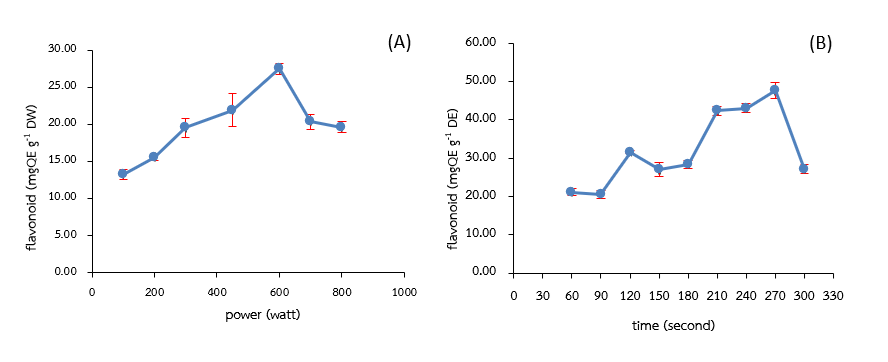
This study aims to compare the amount of bioactive compounds and determine the optimal extraction conditions using microwave-assisted extraction in the flower of Dendrobium Lindleyi Steud. Comparative tests were conducted on the amounts of substances extracted from the stem, leaf, flower, and root parts using the microwave technique. The obtained extracts were analyzed for total phenolic content using the Folin–Ciocalteu method, total flavonoid content using the aluminum chloride colorimetric method, antioxidant activity via the DPPH radical scavenging assay, and tyrosinase inhibition activity using the modified dopachrome method. Results indicated that the flower contained the highest amount of flavonoids at 32.53±0.76 mg QE g-1 DW. Therefore, further experiments were conducted to optimize the microwave extraction conditions by varying several factors, including microwave power, extraction time, ethanol-to-water ratio, and number of extraction cycles. The optimal conditions were found to be 600 watts of microwave power, 270 seconds of extraction time, an ethanol-to-water ratio of 100:0, and one extraction cycle. This study demonstrates that the flower of D. lindleyi Steud. contains bioactive compounds with potential for use in medicinal or skincare products. Moreover, understanding the appropriate microwave extraction conditions provided a guideline for researchers, students, and interested individuals.
References
Chang, C.H., H.Y. Lin, C.Y. Chang and Y.C. Liua. 2006. Comparisons on the antioxidant properties of fresh, freeze-dried and hot-air-dried tomatoes. Journal of Food Engineering 77: 478–485.
Mapoung, S., W. Semmarath, P. Arjsri, S. Umsumarng, K. Srisawad, P. Thippraphan, S. Yodkeeree and P. Limtrakul (Dejkriengkraikul). 2021. Determination of phenolic content, antioxidant activity, and tyrosinase inhibitory effects of functional cosmetic creams available on the Thailand market. Plants 10(1383): 1–18.
Nguyen, H.A., K.H. Lin, M.Y. Huang, C.M. Yang, T.H. Shin, T.C. Hsiung, Y.C. Lin and F.C. Tsao. 2018. Antioxidant activities of the methanol extracts of various parts of Phalaenopsis orchids with white, yellow, and purple flowers. Notulae Botanicae Horti Agrobotanici Cluj-Napoca 46(2): 457–465.
Obsuwan. K., B.R. Jeong and S. Maksup. 2019. Analysis of bioactive compounds, polysaccharides and antioxidant activity in different parts of Dendrobium Sonia Jo Daeng. Science, Engineering and Health Studies 13(2): 73–82.
Phunsawan, B. 2013. Free radicals, antioxidants, and antioxidant activity analysis. Journal of Science and Technology 21(3): 275–286.
Singh, R.P., K.N. Chidambara and G.K. Jayaprakasha 2002. Studies on the activity of pomegranate (Punica granatum) peel and seed extracts using in vitro models. Journal of Agricultural and Food Chemistry 50(1): 81–86.
Siriwattanamethanon, N. 2020. Multi-coloured food there are many benefits (Part 1): what are multicolored foods. Retrieved from https://pharmacy.mahidol.ac.th/knowledge/files/0148.pdf [in Thai]
Sopittummakhun, K. and P. Rattanasinganchan. 2017. Extraction and determination of antioxidant activity in herbal plant. Huachiew Chalermprakiet Science and Technology Journa 3(1): 86–94. [in Thai]
Suedee, A. 2017. Microwave-assisted extraction of active compounds from medicinal plants. EAU HEritAgE JoUrnAlScience and Technology 11(1): 1–14. [in Thai]
Taokaenchan, N., K. Areesrisom, P. Areesrisom, Y. Maifaey, J. Philadee and S. Sateinperakul. 2021. Contents of phenolic, flavonoid and antioxidant activity of Dendrobium spp. in Maejo University, Chiang Mai province. Journal of Science and Technology Yala Rajabhat University 7(1): 21–28. [in Thai]
Taokaenchan, N., K. Areesrisom, P. Areesrisom, V. Maifaey, R. Kongtanajaruanun and S. Sateinperakul. 2022. Comparison of different extraction methods and solvent ratios on yield, content of total phenolic and flavonoid in Kaempferia parviflora Wallich. ex Baker. Maejo Journal of Agricultural Production 4(1): 77–90. [in Thai]
Thanaphat, S. 2016. Extraction of active chemical constituent of herbal medicinal plant using microwave-assisted extraction technique. Retrieved from https://ccpe.pharmacycouncil.org/showfile.php?file=79
Ueda, Y., N. Apiphuwasukcharoen, S. Tsutsumi, Y. Matsuda, V. Areekul and S. Yasuda. 2019. Optimization of hot-water extraction of dried yacon herbal tea leaves: enhanced antioxidant activities and total phenolic content by response surface methodology. Food Science and Technology Research 25(1): 131–139.
Watcharakupt, O., P. Bunjong, C. Boonyarat and A. Sinthong. 2007. Radical Scavenging Agent. Bangkok: New Thaimit Printing. 262 p. [in Thai]
Yan, M-M, W., Liu, Y-J. Fu, Y-G. Zu, C-Y. Chen and M. Luo. 2010. Optimisation of the microwave-assisted extraction process for four main astragalosides in Radix astragali. Food Chemistry 119(4): 1663–1670.
Downloads
Published
How to Cite
Issue
Section
License
Copyright (c) 2026 Journal of Agricultural Research and Extension

This work is licensed under a Creative Commons Attribution-NonCommercial-NoDerivatives 4.0 International License.
This article is published under a Creative Commons Attribution-NonCommercial-NoDerivatives 4.0 International License (CC BY-NC-ND 4.0), which allows others to share the article with proper attribution to the authors and prohibits commercial use or modification. For any other reuse or republication, permission from the journal and the authors is required.


