
Investigation of Mango Flesh Disorder Using Near-Infrared Spectroscopy (NIRS)
DOI:
https://doi.org/10.14456/jare-mju.2025.51Keywords:
nondestructive evaluation, chemometrics, internal breakdown, spongy tissueAbstract
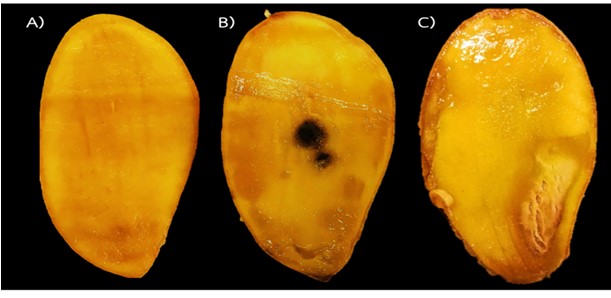
Export quality of ‘Nam Dok Mai Sithong’ mango has been reduced due to internal disorders that are undetectable by visual inspection. These flaws lead to loss of export value and importer’s trust. Therefore, this research aimed to investigate the feasibility of using NIRS and advanced chemometrics to detect internal disorders of the mangoes. A total of 38 fruits of ‘Nam Dok Mai Sithong’ mango, aged 115–120 days after flowering were harvested. Different areas of fruit peel were designated into different categories for near-infrared (NIRS) spectra measurement, consisting of 100 normal flesh spots, 100 internal breakdown spots, and 97 spongy tissue spots. Interactance measurement was used in wavenumbers of 4,000–12,500 cm-1. Classification models were developed using Self-Organizing Map (SOM) and classification accuracies were evaluated. Results from Principal Component Analysis (PCA) were unable to distinguish among the 3 different characteristics of mango flesh. On the other hand, classification models of SOM with 25,000 iterations were able to classify mango flesh into 2 classes (normal and disorder) and 3 classes (normal, internal breakdown, and spongy tissue), providing correct classification rates (%CC) of 83.1 and 82.4%, respectively. Therefore, application of near-infrared spectroscopy using SOM model provided more than 80% classification accuracy for classifying mango flesh into normal, internal breakdown, and spongy tissue symptoms.
References
Bantadjan, Y., R. Rittion, W. Manawijitwanit, S. Narongwongwattana and S. Pochanagorn. 2014. Classification of maize disorder using near infrared (NIR) spectroscopy. Agricultural Science Journal 45(3/1)(Suppl.): 293–296. [in Thai]
Boonyakiat, D. 2020. Produce quality evaluation by non-destructive with spectroscopy. pp. 1–12. In: Boonyakiat, D. and P. Theanjumpol (Eds.). Using NIR Spectroscopy in Evaluation of Quality of Agricultural Produce. Chiang Mai: Postharvest Technology Innovation Center. [in Thai]
Chaipanwiriyaporn, N. 2013. Detection of Pineapple Fruit Internal Browning by Near Infrared Spectroscopy. Master Thesis. Chiangmai University. 118 p. [in Thai]
Jaitrong, N., S. Noypitak and A. Terdwongworakul. 2016. The Evaluation of Internal Quality of Guava Using Near Infrared Spectroscopy. pp. 276–283. In Proceedings of the 13th KU-KPS Conference. Nakhon Pathom: Kasetsart University Kamphaeng Saen Campus. [in Thai]
Kaewpangchan, P., N. Phuangsaijai, P. Seehanam, P. Theanjumpol, P. Maniwara and S. Kittiwachana. 2021. Screening of coffee impurity using a homemade NIR sensor system. Chiang Mai Journal of Science 48(2): 292–300.
Ketnark, K. 2013. Moisture Content Determination of Arabica Green Coffee by Near Infrared Spectroscopy. Master Thesis. Chiangmai University. 99 p. [in Thai]
Kohonen, T. 2013. Essentials of the self-organizing map. Neural Networks 37: 52–65.
Lloyd, G.R., R.G. Brereton and J.C. Duncan. 2008. Self organising maps for distinguishing polymer groups using thermal response curves obtained by dynamic mechanical analysis. Analyst 133: 1046–1059.
Office of Agricultural Economics. 2024. Export market for important products of fresh mango. [Online]. Available: https://impexpth.oae.go.th/export (September 20, 2024). [in Thai]
Poovarodom, S. 2013. Calcium and Boron Fertilizer. pp. 239–246. In Rudcharate, T. W. Kumpoun and T. Jaroenkit (Eds.). Mango Production and Postharvest Technology. Bangkok: O.S. Printing House. [in Thai]
Postharvest Technology Innovation Center. 2024. Results (impact) of the research study “mango for sustainability” (mango) comprehensive education center. [Online]. Available: https://www.phtnet.org/phtic-research/ (July 15, 2024). [in Thai]
Raymond, L., B. Schaffer, J.K. Brecht and E.A. Hanlon. 1998. Internal breakdown, mineral element concentration and weight of mango fruit. Journal of Plant Nutrition 21(5): 871–889.
Sharma, R.R. and S.K. Saxena. 2004. Rootstocks influence granulation in Kinnow mandarin (Citrus nobilis × C. deliciosa). Scientia Horticulturae 101(3): 235–242.
Shenderey, C., I. Shmulevich, V. Alchanatis, H. Egozi, A. Hoffman, V. Ostrovsky, S. Lurie, R.B. Arie and Z. Schmilovitch. 2010. NIRS detection of moldy core in apples. Food and Bioprocess Technology 3: 79–86.
Shivashankar, S. 2014. Physiological Disorders of Mango Fruit. pp. 313–347. In Janick, J. (Ed.). Horticultural Reviews. Hoboken: John Wiley & Sons, Inc.
Smith, L.I. 2002. A Tutorial on Principal Components Analysis. 26 p. In Technical Report. Otago: Department of Computer Science, University of Otago.
Suphamitmongkol, W., G. Nie, R. Liu, S. Kasemsumran and Y. Shi. 2013. An alternative approach for the classification of orange varieties based on near infrared spectroscopy. Computers and Electronics in Agriculture 91: 87–93.
Takizawa, K., K. Nakano, S. Ohashi, H. Yoshizawa. J. Wang and Y. Sasaki. 2014. Development of nondestructive technique for detecting internal defects in Japanese radishes. Journal of Food Engineering 126: 43–47.
Teye, E., L.Y.C. Amuah, T. McGrath and C. Elliott. 2019. Innovative and rapid analysis for rice authenticity using hand-held NIR spectrometry and chemometrics. Spectrochimica Acta Part A: Molecular and Biomolecular Spectroscopy 217: 147–154.
Theanjumpol, P., K. Wongzeewasakunb, N. Muenmaneea, S. Wongsaipund, C. Krongchaid, V. Changrueb, D. Boonyakiatb and S. Kittiwachana. 2019. Non-destructive identification and estimation of granulation in ‘Sai Num Pung’ tangerine fruit using near infrared spectroscopy and chemometrics. Postharvest Biology and Technology 153: 13–20.
Wongzeewasakun, K., V. Changrue, N. Muenmanee and P. Theanjumpol. 2017. Possibility of using near infrared spectroscopy technique to detect dry juice sac of mandarin cv. Sai Nam Pueng. Agricultural Science Journal 48(3)(Suppl.): 295–298. [in Thai]
Yahia, E.M. 2011. Mango (Mangifera indica L.). pp. 492–567. In Yahia, E.M. (Ed.). Postharvest Biology and Technology of Tropical and Subtropical Fruits. Cambridge: Woodhead Publishing.
Zhou, Z., S. Zeng, X. Li and J. Zheng. 2015. Nondestructive detection of blackheart in potato by visible/near infrared transmittance spectroscopy. Journal of Spectroscopy 2015: 1–9. https://doi.org/10.1155/2015/786709
Downloads
Published
How to Cite
Issue
Section
License
Copyright (c) 2025 Journal of Agricultural Research and Extension

This work is licensed under a Creative Commons Attribution-NonCommercial-NoDerivatives 4.0 International License.
This article is published under a Creative Commons Attribution-NonCommercial-NoDerivatives 4.0 International License (CC BY-NC-ND 4.0), which allows others to share the article with proper attribution to the authors and prohibits commercial use or modification. For any other reuse or republication, permission from the journal and the authors is required.