
The Effects of Fertigation on Growth, Yield, and Seed Quality of Maize Grown in Suphan Buri and Nakhon Ratchasima Provinces
DOI:
https://doi.org/10.14456/jare-mju.2026.3Keywords:
fertigation, yield and quality of maize, fertilizer management for maizeAbstract
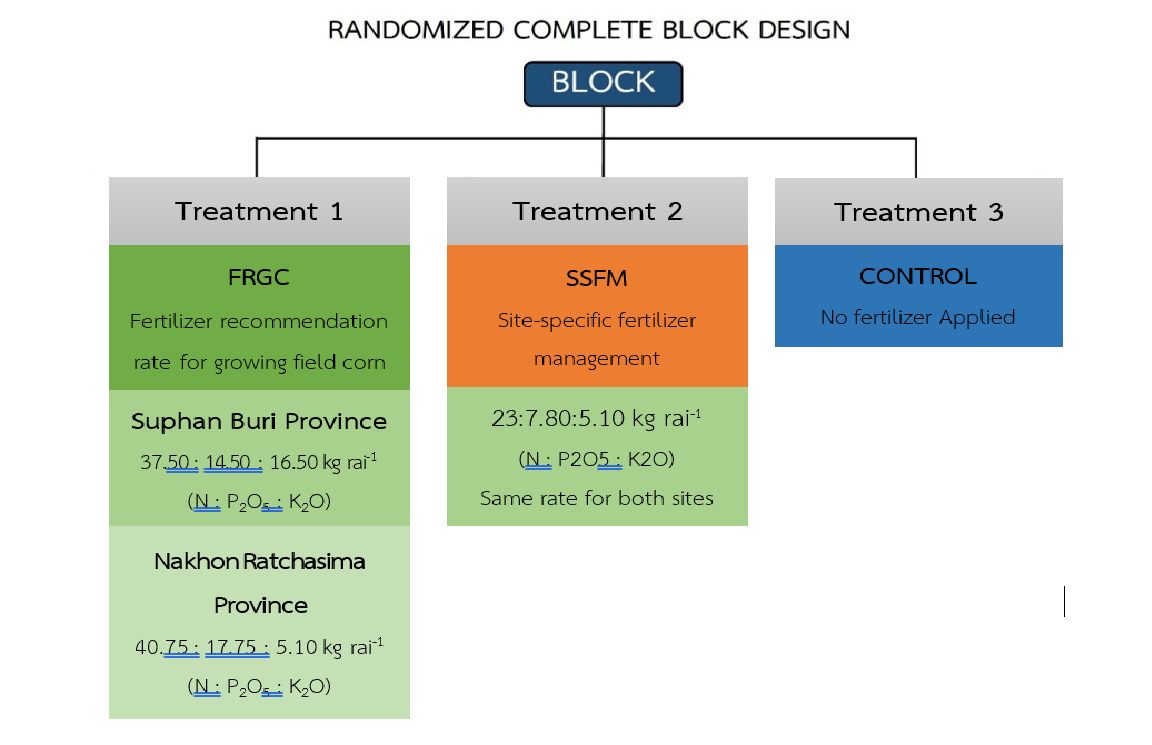
A study on the effects of fertigation on growth, yield, and seed quality of maize was conducted in maize cultivation areas located in the Central region at U Thong district, Suphan Buri province, as well as in the Northeastern region at Soeng Sang district, Nakhon Ratchasima province. The objective was to compare the effects of different fertigation management practices on the growth, yield, and seed quality of forage maize. The experiment was arranged in a randomized complete block design (RCBD) with four replications, consisting of three fertilizer management treatments: (1) chemical fertilizer application at rates commonly practiced by farmers for forage maize seed production (FRGM)—Suphan Buri: 37.50 kg N rai-1, 14.50 kg P2O5 rai-1, and 16.50 kg K2O rai-1; Nakhon Ratchasima: 40.75 kg N rai-1, 17.75 kg P2O5 rai-1, and 21.75 kg K2O rai-1; (2) chemical fertilizer application at recommended rates for forage maize seed production (SSFM)—23.00 kg N rai-1, 7.80 kg P2O5 rai-1, and 5.10 kg K2O rai-1; and (3) a control treatment without chemical fertilizer application. The results showed that fertilizer management according to treatment 2, which applied 23.00 kg N rai-1, 7.80 kg P2O5 rai-1, and 5.10 kg K2O rai-1, was sufficient to achieve good maize yield. Moreover, treatments 1 and 2 did not result in significant differences in plant height, dry matter accumulation, leaf greenness (SPAD value), macronutrient concentrations in leaves, yield quantity, or seed quality of forage maize at either location. The maize cultivated in Suphan Buri had an average yield ranging from 1.84 to 1.85 tons rai-1, while maize grown in Nakhon Ratchasima had an average yield ranging from 1.02 to 1.12 tons rai-1 (grain moisture content < 30%). Therefore, fertilizer management according to treatment 2, which used lower fertilizer input, could maintain yield levels comparable to those under farmers’ conventional practice without affecting the quality of forage maize seed.
References
Adhikari, K., B.R. Baral and J. Shrestha. 2016. Maize response to time of nitrogen application and planting seasons. Journal of Maize Research and Development 2(1): 83–93.
Alderman, S.C., W. Pfender and C.M. Ocamb. 2009. Diseases in seed production. Tall Fescue for the Twenty-first Century 53: 427–434.
Beegle, D.B., W. Piekielek and R. Fox. 2008. Early Season Chlorophyll Meter Test for Corn. Agronomy Facts 53. University Park: The Pennsylvania State University. 8 p.
Bibe, S.M., K.T. Jadhav and A.S. Chavan. 2017. Response of irrigation and fertigation management on growth and yield of maize. International Journal of Current Microbiology and Applied Sciences 6(11): 4054–4060.
Bray, R.H. and L.T. Kurtz. 1945. Determination of total, organic, and available forms of phosphorus in soils. Soil Science. 59(1): 39–45.
Canprasert, W. 1999. Field crop seed technology. Retrieved from https://kukr.lib.ku.ac.th/kukr_es/index.php?/KPS/search_detail/result/183336.
Delbaz, R., H. Ebrahimian and D. Ranazadeh. 2023. A global meta-analysis on surface and drip fertigation for annual crops under different fertilization levels. Agricultural Water Management 289: 108504.
Department of Agriculture. 2021. Soil Test-Based Fertilizer Recommendations for Major Economic Field Crops. 100 p. In Research Report. Bangkok: Department of Agriculture Ministry of Agriculture and Cooperatives, Thailand. [in Thai]
Food and Agriculture Organization of the United Nations. 2019. Standard Operating Procedure for Soil Organic Carbon Walkley-Black Method Titration and Colorimetric Method. Rome: FAO. 27 p.
Helmke, P.A. and L. Sparks. 1996. Lithium, Sodium, Potassium, Rubidium, and cesium. pp. 551–574. In Sparks, D.L., A.L. Page, P.A. Helmke and R.H. Loeppert (Eds.). Methods of Soil Analysis, Part 3: Chemical Methods. Madison, WI.: SSSA Book Series No.5. SSASA and American Society of Agronomy.
Kalra, Y.P. 1998. Handbook of Reference Methods for Plant Analysis. Boca Raton: CRC Press. 320 p.
Land Development Station. 2013. District soil map of Suphanburi province. Retrieved from http://r01.ldd.go.th/spb/SoilMap.html [in Thai]
Li, W., X. Gu and T. Chang. 2023. Optimizing nitrogen, phosphorus, and potassium fertilization regimes to improve maize productivity under double ridge-furrow planting with full film mulching. Agricultural Water Management 287: 108439
Lui, K., B.L. Ma and C. Li. 2011. Nitrogen phosphorus and potassium nutrient effects on grain filling and yield of high yielding summer corn. Journal of Plant Nutrition 34: 1516–1531.
Mallarino, A.P. and J.R. Webb. 1995. Long-term evaluation of phosphorus and zinc interactions in corn. Journal of Production Agriculture 8(1): 52–55.
Masood, T., R. Gul and H. Khan. 2011. Effect of different phosphorus levels on the yield and yield component of maize. Sarhad Journal of Agriculture 27(2): 167–170.
Matejovic, I. 2008. Total nitrogen in plant material determinated by means
of dry combustion: a possible alternative to determination by Kjeldahl digestion. Retrieved from https://www.tandfonline.com/doi/permissions
Morad, H., A. Mohammad and B. Simon. 2009. The effect of irrigation methods with effluent and irrigation scheduling on water use efficiency and corn yields in an arid region. Agricultural Water Management 96(1): 93–99.
Noppan, K. and C. Santasup. 2016. Appropriate fertilizer management for field corn seed production in Tak province. Journal of Agricultural Research and Extension 33(1): 10–19.
Office of Agricultural Economics. 2022. The situation of maize in Thailand. Retrieved from https://www.oae.go.th [in Thai]
Phanomtronitkul, M. 2000. Soil Water Management for Sustainable Systems. 1st Ed. Chiang Mai: Faculty of Agriculture, Chiangmai University. 487 p. [in Thai]
Rahmawati, R. 2017. Effect of nitrogen fertilizer on growth and yield of maize composite variety Lamuru. AgroTech Journal 2(2): 36–41.
Suwanwong, S. 2001. Plant Nutrient Analysis. Bangkok: Kasetsart University Press. 141 p. [in Thai]
UI-Allah, S., M. Ijaz and K. Mahmood. 2020. Potassium application improves grain yield and alleviates drought susceptibility in diverse maize hybrids. Plants 9(75): 1–11. https://doi.org/10.3390/plants9010075
Wichmann, W. 1992. IFA World Fertilizer Use Manual. Germany and France: BASF AG and IFA. 632 p.
Zarski, J. and R.T. Kusmierek. 2023. Effects of drip irrigation and topdressing nitrogen fertigation on maize grain yield in central Poland. Agronomy 13(2): 1–15. https://doi.org/10.3390/agronomy13020360
Downloads
Published
How to Cite
Issue
Section
License
Copyright (c) 2026 Journal of Agricultural Research and Extension

This work is licensed under a Creative Commons Attribution-NonCommercial-NoDerivatives 4.0 International License.
This article is published under a Creative Commons Attribution-NonCommercial-NoDerivatives 4.0 International License (CC BY-NC-ND 4.0), which allows others to share the article with proper attribution to the authors and prohibits commercial use or modification. For any other reuse or republication, permission from the journal and the authors is required.


