
Development of an Intensive Native Goat Rearing Model to Enhance Production Efficiency for Vulnerable Youth in Thailand's Southern Border Provinces
DOI:
https://doi.org/10.14456/jare-mju.2026.12Keywords:
intensive goat farming, native goats, at-risk youth (unemployed)Abstract
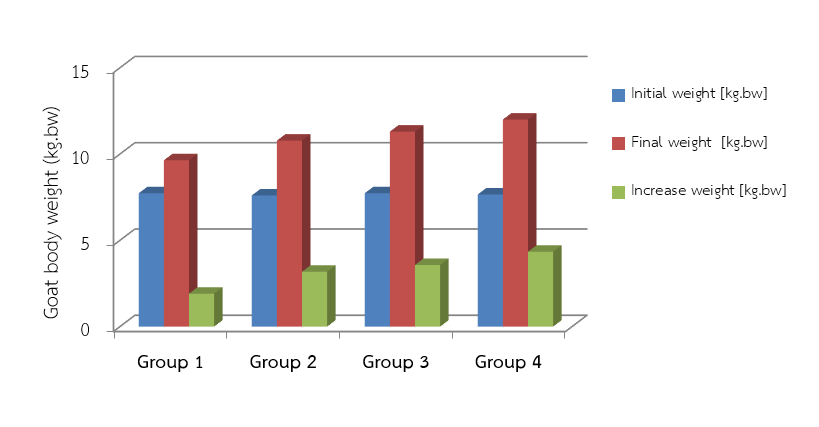
This study aimed to develop an intensive native goat farming model and to enhance rearing capabilities for vulnerable (unemployed) youth in Thailand's southern border provinces. Using a completely randomized design (CRD), twenty 6–7-month-old native goats were divided into four groups (5 goats/group): Group 1 received only Napier grass; Group 2 received Napier grass supplemented with 2% BW commercial feed; Group 3 received Napier grass plus 2% BW concentrated feed Formula A (yeast-fermented corn); Group 4 received Napier grass plus 2% BW concentrated feed Formula B (rice bran + fish meal). (After a 120-day trial (concluding at week 16), initial weights were 7.73±1.00, 7.60±1.07, 7.73±0.81, and 7.66±1.10 kg/animal for Groups 1–4, respectively, with weight gain percentages of 19.81, 29.50, 31.59, and 36.17%, respectively). Nutritional analysis revealed that Formula A contained 13.8% crude protein, 8.1% fat, 10.2% crude fiber (CF), and 40–50% moisture; whereas Formula B contained 15.20% protein, 4.5% fat, 9.4% crude fiber (CF), and 40–50% moisture. Fresh Napier grass contained 9.8% protein, 0.6% fat, 33.2% crude fiber (CF), and 9.3% moisture, while fermented Napier grass
contained 10.2% protein, 10.2% fat, 32.1% crude fiber (CF), and 9.9% moisture. Production costs averaged at 5.80 THB/kg (dry) and 3.49 THB/kg (fresh) for Formula A, and 10.54 THB/kg (dry) and 6.33 THB/kg (fresh) for Formula B, enabling farmers to reduce feed costs by over 50%.
References
Department of Livestock Development. 2023. Goat population statistics and operational plan 2023–2027. Bangkok: Ministry of Agriculture and Cooperatives. 104 p. [in Thai]
FAO. 2024. Analysing data from on-farm trials: ANOVA and factorial experiments. Retrieved from https://openknowledge.fao.org/server/api/core/bitstreams/a5abbb18-2bd2-4811-b1bef8bd1f8d4bf8/content/x5470e06.htm
Gómez-Limón, J.A. and L. Riesgo. 2012. Sustainability assessment of olive groves in Andalusia: a methodological proposal. New Medit 11(1): 39–49.
Hamid, A.M. 2024. Assistance in fattening goat farming business: Diversification strategy and productivity improvement "Gus Shor Farm" Kanugrahan Maduran Lamongan Village, Sahwahita. Community Engagement Journal 1(2): 79–95. https://doi.org/10.69965/sahwahita.v1i2.57
Khan, N. and M. Hussein. 2021. Analysis of profits and break even point of Jamnapari goat farming. Journal La Lifesci. 2(3): 8–14. https://doi.org/10.37899/journallalifesci.v2i3.377
Kongkaew, P. 2020. Community waste management and waste in goat farms. Bangkok: National Research Council of Thailand. 144 p. [in Thai]
Massachusetts Institute of Technology D-Lab, and Heifer International. 2016. Needs assessment of smallholder goat farmers in Odisha, India (D-Brief). Retrieved from https://d-lab.mit.edu/sites/default/files/inline-files/Heifer%20Goat%20Herder%20D-Brief%20v12%20(1).pdf
Mehanzel, S.H. 2012. Impact of Goat Development Project on Livelihood Assets: The Case of Northern Red Sea Region in Eritrea. Master Thesis. Wageningen University & Research Repository. 63 p.
Ministry of Agriculture and Fisheries, Livestock Research Improvement Division. (n.d.). Goat Management Systems. Jamaica: Bodles Research Station. 8 p.
Polviset, W. and N. Prakobsaeng. 2019. The Comparison of Protein Sources in Total Mixed Ration in Goats. 30 p. In Research Report. Maha Sarakham: Faculty of Agricultural Technology, Rajabhat Maha Sarakham University.
Santoso, A.B., K. Bekzhanov, S.F. Batubara, A.R. Hasyim, S. Hidayat, V. Aryati, R.A. Saptati and N.Chairuman. 2024. Feed sufficiency model on corn-goat integration in Deli Serdang Regency North Sumatra, Indonesia. International Journal of Design & Nature and Ecodynamics 19(2): 639–648. https://doi.org/10.18280/ijdne.190230
Sebsibe, A. and Z. Tadesse. 2011. Design of an Experiment to Compare Performance and Meat Quality Characteristics of Three Ethiopian Goat Genotypes under Varying Nutritional Conditions: Biometrics and Research Methods Teaching Resource Case Study 13. Nairobi, Kenya: International Livestock Research Institute (ILRI). 15 p.
Urošević, M., D. Drobnjak, N. Ersoy and P. Stoji. 2020. Osnovni principi organske proizvodnje u kozarstvu [basic principles of organic goat farming]. Veterinarska Stanica 51(1): 87–91. https://doi.org/10.46419/vs.51.1.9
Downloads
Published
How to Cite
Issue
Section
License
Copyright (c) 2026 Journal of Agricultural Research and Extension

This work is licensed under a Creative Commons Attribution-NonCommercial-NoDerivatives 4.0 International License.
This article is published under a Creative Commons Attribution-NonCommercial-NoDerivatives 4.0 International License (CC BY-NC-ND 4.0), which allows others to share the article with proper attribution to the authors and prohibits commercial use or modification. For any other reuse or republication, permission from the journal and the authors is required.


